
Get Paid Within 24 Hours on an Out of Province Car Sale in Alberta
Sell an out of province vehicle from Alberta quickly. Follow the paperwork checklist, avoid curbers, and get a binding cash offer with 24 hour pickup.
Get Paid Within 24 Hours on an Out of Province Car Sale in Alberta

The fastest lawful way to sell your 2018 or newer running vehicle is a binding cash offer from a licensed Alberta buyer like Kamocars, with pickup and payment handled within 24 hours. Standard Alberta paperwork still applies, and most personal vehicle sales owe no tax under CRA rules, details below.
TL;DR:
- Most vehicle sales in Alberta under $1,000 in proceeds and adjusted cost base do not require tax reporting; gains from appreciating vehicles are rare.
- Completion of a full Alberta bill of sale, lien search, and registration cancellation is essential to avoid delays in ownership transfer and payment.
- A licensed buyer’s quick inspection and payment within 24 hours depend on having all paperwork, including lien payout and vehicle documentation, prepared in advance.
- Selling to an out-of-province buyer shifts registration responsibilities to them, but sellers must confirm that payment has cleared before vehicle handoff.
- Beware of unlicensed sellers or curbers by verifying business registration details, matching buyer IDs, and avoiding inconsistent contact information to prevent scams.
Table of Contents
- How a licensed cash offer car buying service works
- Paperwork and steps to transfer ownership in Alberta
- Pricing and tax: when you must report a sale to CRA
- Avoid scams and curbers: red flags and verification steps
- Prepare your car to speed inspection and payout
- Timeline: realistic expectations from offer to paid pickup
- Legal requirements and title transfer when the buyer is in another province
- Inspection and emissions differences that matter for an out-of-province buyer
- Handling registration and licensing transfer for an out-of-province buyer
- Common pitfalls in out-of-province sales and how to avoid them
- Transport options and who’s responsible for getting the car there
- Is speed worth more than squeezing out the last dollar?
- How to get a cash offer from Kamocars
- FAQ
- Sources
How a licensed cash offer car buying service works
Selling to a licensed buyer follows a predictable sequence, and knowing it in advance can save time and help avoid surprises at pickup.
You start by submitting basic details online: your VIN, mileage, a few clear photos, and a short description of the vehicle’s condition. From that information, a buyer can generate an instant appraisal using current market data, similar to the process we use at Kamocars.
An offer becomes binding once a quick inspection confirms the condition matches what you reported. The main exceptions that can change a binding offer are undisclosed accident damage, a mismatched odometer reading, or a lien that was not mentioned upfront.
Once you accept, the process moves quickly:
- You sign a bill of sale and provide valid identification that matches your vehicle registration.
- The buyer confirms there are no outstanding liens or arranges payout of your remaining loan balance.
- Payment is issued securely, often by e-transfer or certified funds, and the vehicle is typically picked up promptly.
- You receive a signed copy of the paperwork for your own records.
Pro Tip: Have your lien payout balance ready before the appraisal call. It speeds up the final numbers significantly.
Paperwork and steps to transfer ownership in Alberta
Ownership transfer in Alberta is straightforward, but missing a document can delay payment by a day or more. Follow these steps in order.
- Complete a standard Alberta bill of sale, which must include both parties’ full names, the VIN, odometer reading, sale price, and signatures.
- Request a Vehicle Information Report through a registry agent to confirm the vehicle’s recorded Alberta history before the sale.
- Run a personal property lien search on the VIN so both you and the buyer know whether any financing is still attached.
- Cancel your own registration at a registry agent once the vehicle changes hands, bringing your ID and plates; you can learn the exact steps in our guide to transferring vehicle registration in Alberta.
- Keep copies of the signed bill of sale and proof of payment for at least a few years in case questions come up later.
A free, fillable template is available in our Alberta bill of sale guide if you want to prepare the document before a buyer arrives.
Pricing and tax: when you must report a sale to CRA
Most private vehicle sales do not trigger any tax reporting. The CRA treats a vehicle as personal-use property, and if both your proceeds and your adjusted cost base are $1,000 or less, you do not need to report the sale at all.
To check whether reporting applies, subtract your adjusted cost base (what you originally paid, plus certain improvements) and any reasonable selling costs from your proceeds of disposition (the sale price). For the vast majority of sellers, a depreciating daily driver, this calculation results in no gain and nothing to report. A gain becomes possible mainly with rare or collectible vehicles that appreciated in value, a scenario that does not apply to most 2018 and newer daily-use trucks and SUVs.
Capital losses on personal-use property generally are not deductible, so a car that sold for less than you paid does not create a write-off either. If you are selling to a company rather than an individual, our breakdown on avoiding CCA recapture when you sell to a business covers the edge cases that can apply.
Avoid scams and curbers: red flags and verification steps
Private sales carry a real risk that does not exist when you sell to a licensed business: curbers, unlicensed sellers who pose as private individuals to dodge consumer protection rules. AMVIC warns that curbers often list multiple vehicles using the same contact information, and the vehicle’s registration frequently is not in the seller’s own name.
Before accepting any offer from someone claiming to be a licensed buyer, confirm it for real:
- Ask for the business’s registration number and verify it is active with AMVIC.
- Match the buyer’s ID to the name on any paperwork they provide.
- Be wary if the same phone number or email shows up across several unrelated listings.
- Confirm the buyer can explain lien clearance and payment timing clearly, without pressure tactics.
One AMVIC-documented pattern involves a registration listed under a different name than the person selling the vehicle, a common tell that the seller is operating outside the rules that license dealers must follow, according to AMVIC’s guidance on curbers.
If something feels off, you can report a curber directly to AMVIC or contact local police if you suspect outright fraud.
Prepare your car to speed inspection and payout
A little preparation turns a same-day inspection into a same-day payout. Work through this checklist before your appointment.
- Gather your VIN, both sets of keys, maintenance records, and recent service receipts.
- Take two or three clear photos showing the exterior, interior, and odometer.
- Address small, obvious issues (a burned-out bulb, low washer fluid) that otherwise read as neglect during inspection.
- Disclose any known mechanical issues, accident history, or liens upfront rather than waiting for the inspector to find them.
- Have your driver’s license and current registration ready to show at pickup.
Pro Tip: Skip cosmetic detailing unless it’s quick and cheap. Our checklist of tasks Alberta sellers can skip covers what actually moves the needle on your offer.
Timeline: realistic expectations from offer to paid pickup
Working with a licensed cash offer buyer compresses a process that can take weeks privately into a matter of hours or a couple of days. A typical path looks like this: you get an online appraisal within minutes to hours, a physical inspection happens the same day or is booked for the next, and payment follows immediately after, often within 24 hours, as outlined in our how it works breakdown.
Delays usually trace back to a handful of avoidable issues: an unresolved lien that needs payout coordination, a registration that doesn’t match the seller’s ID, missing paperwork, or simply a seller who isn’t available at the agreed pickup window.
Because a licensed business operates under AMVIC’s regulatory framework, you also get a clearer path to recourse if something goes wrong after the sale, something a private buyer simply cannot offer.
Legal requirements and title transfer when the buyer is in another province
When your buyer lives outside Alberta, your legal obligation as the seller does not change: you still sign a valid Alberta bill of sale, cancel your own registration, and hand over a clean title with any lien discharged. What changes is who handles what happens next.
Title transfer itself is governed by the province where the vehicle will be newly registered, not by Alberta. Once you have completed your side (signed bill of sale, cleared lien, canceled plates), the buyer is responsible for registering the vehicle in their home province under that province’s rules. You are not required to understand or manage another province’s registry process, and you should not attempt to transfer “into” a system that isn’t yours.
What you do need to confirm before releasing the vehicle is that the buyer’s payment has actually cleared, since reversing a transaction after the vehicle has crossed a provincial border is far harder than resolving one locally. This is one of the clearest advantages of selling to a licensed buyer who completes payment and paperwork before pickup, rather than a private buyer who may ask to “sort out registration later.” Keep your signed bill of sale, VIR, and proof of payment regardless of where the buyer is headed. If a dispute ever arises, that paperwork is your evidence that the sale was completed correctly on your end, under Alberta rules, on the date you handed over the keys.

Inspection and emissions differences that matter for an out-of-province buyer
Alberta does not require a provincial emissions test for private vehicle sales, which surprises sellers who assume every province runs the same program. Some other provinces do require an emissions or safety inspection before a vehicle can be newly registered there, and that inspection is the buyer’s responsibility, not yours, once the vehicle leaves Alberta.
Your Vehicle Information Report only reflects Alberta’s recorded history, so if a buyer from another province asks about inspection standards in their home jurisdiction, direct them to that province’s registry or transportation ministry rather than guessing. Giving inaccurate information about another province’s rules can create confusion after the sale even though it isn’t your legal obligation.
What you can control is giving an honest, complete picture of the vehicle’s actual condition: any warning lights, recent repairs, or known mechanical issues. A vehicle that passes a buyer’s home-province inspection smoothly is one where the seller disclosed everything accurately at the time of sale. This is also where selling to a licensed buyer simplifies things: the standard bill of sale and VIR you provide become the documentation trail that follows the vehicle, regardless of what inspection regime applies wherever it ends up registered.
Handling registration and licensing transfer for an out-of-province buyer
Once you’ve signed the bill of sale and handed over the vehicle, registering it in a new province is entirely the buyer’s task, governed by that province’s own motor vehicle rules. Your responsibility ends at canceling your Alberta plates and confirming payment has cleared.
That said, a smooth handoff benefits everyone. Provide the buyer with the signed bill of sale, the VIR, proof that any lien was discharged, and your own canceled registration confirmation. These documents are typically what another province’s registry office will ask to see before issuing new plates and a new registration to the buyer.
If you cancel your Alberta registration before the buyer has secured temporary transit permissions in their home province, flag that clearly so there’s no confusion about who is covering the vehicle legally during transport. Our guide to transferring vehicle registration in Alberta walks through the cancellation steps on your side in detail. Selling to a licensed buyer who manages pickup logistics removes most of this coordination from your plate entirely, since the handoff happens as a single, documented transaction rather than an informal exchange you have to manage long-distance.
Common pitfalls in out-of-province sales and how to avoid them
The single biggest pitfall is releasing a vehicle before payment has fully cleared, especially with a long-distance buyer where a bounced e-transfer or stopped check is much harder to chase down after the fact. Confirm funds are in your account, not just “sent,” before handing over keys.
A second common issue is incomplete or mismatched paperwork: a bill of sale missing the VIN or odometer reading, or a buyer’s ID that doesn’t match the name on the registration they’re providing. Either gap can hold up the buyer’s registration process in their new province and sometimes leads to the seller getting contacted weeks later to resolve it. Using a standard Alberta bill of sale filled out completely at the time of sale avoids this almost entirely.
A third pitfall is underestimating lien complexity. If your vehicle is financed and the buyer is out of province, lien discharge needs to be confirmed before the vehicle leaves Alberta; trying to sort it out after the fact, across provincial lines, is far harder. Licensed buyers typically handle lien payout directly as part of the transaction, which removes this risk from the seller’s side altogether.
Finally, sellers sometimes assume a verbal agreement with an out-of-province buyer is enough. It isn’t. Every detail, price, condition disclosures, and payment terms, belongs in writing before the vehicle moves.

Transport options and who’s responsible for getting the car there
Once a sale is complete, someone has to physically move the vehicle, and that responsibility should be agreed on before you accept an offer, not after. Three common arrangements exist: the buyer drives it themselves, the buyer arranges third-party transport, or a licensed buyer’s own pickup service handles it as part of the purchase.
If the buyer or their representative drives the vehicle away, confirm they have valid insurance coverage for that drive before it leaves your driveway. An uninsured drive, even for a short distance, exposes both parties if something happens en route. If a transport company is hired, that arrangement and its cost are typically the buyer’s responsibility, since they are the one relocating the vehicle for their own purposes.
Selling to a licensed buyer like Kamocars simplifies this question entirely: pickup is arranged as part of the transaction, so you aren’t negotiating transport logistics with a stranger or waiting on a tow truck that may or may not show up. The vehicle is collected, payment is confirmed, and your responsibility ends there. Whatever path you choose, put the transport arrangement and who covers it in writing alongside your bill of sale, so there’s no ambiguity if the vehicle is damaged or delayed between your driveway and its next destination.
Is speed worth more than squeezing out the last dollar?
Selling privately can net a slightly higher price, but it also means managing strangers, verifying funds, chasing paperwork, and absorbing risk if something goes wrong after the fact. For most Alberta sellers with a 2018 or newer vehicle in running condition, speed and certainty usually outweigh the marginal upside of a private sale, especially when a lien, a tight timeline, or an out-of-province buyer adds complexity.
Honest disclosure protects both sides regardless of which route you choose. A seller who discloses an issue upfront avoids disputes later; a buyer who pays promptly and documents everything removes the seller’s biggest risk. We built our process around those two things: a registered Alberta business, more than 500 completed transactions, and pickup that happens on the same day the offer is accepted.
— Omar
How to get a cash offer from Kamocars
Getting an offer from us takes a few minutes, and there’s no haggling once the number is on the table. We review your vehicle using current Canadian wholesale data, confirm it with a quick inspection, and handle the rest from there.
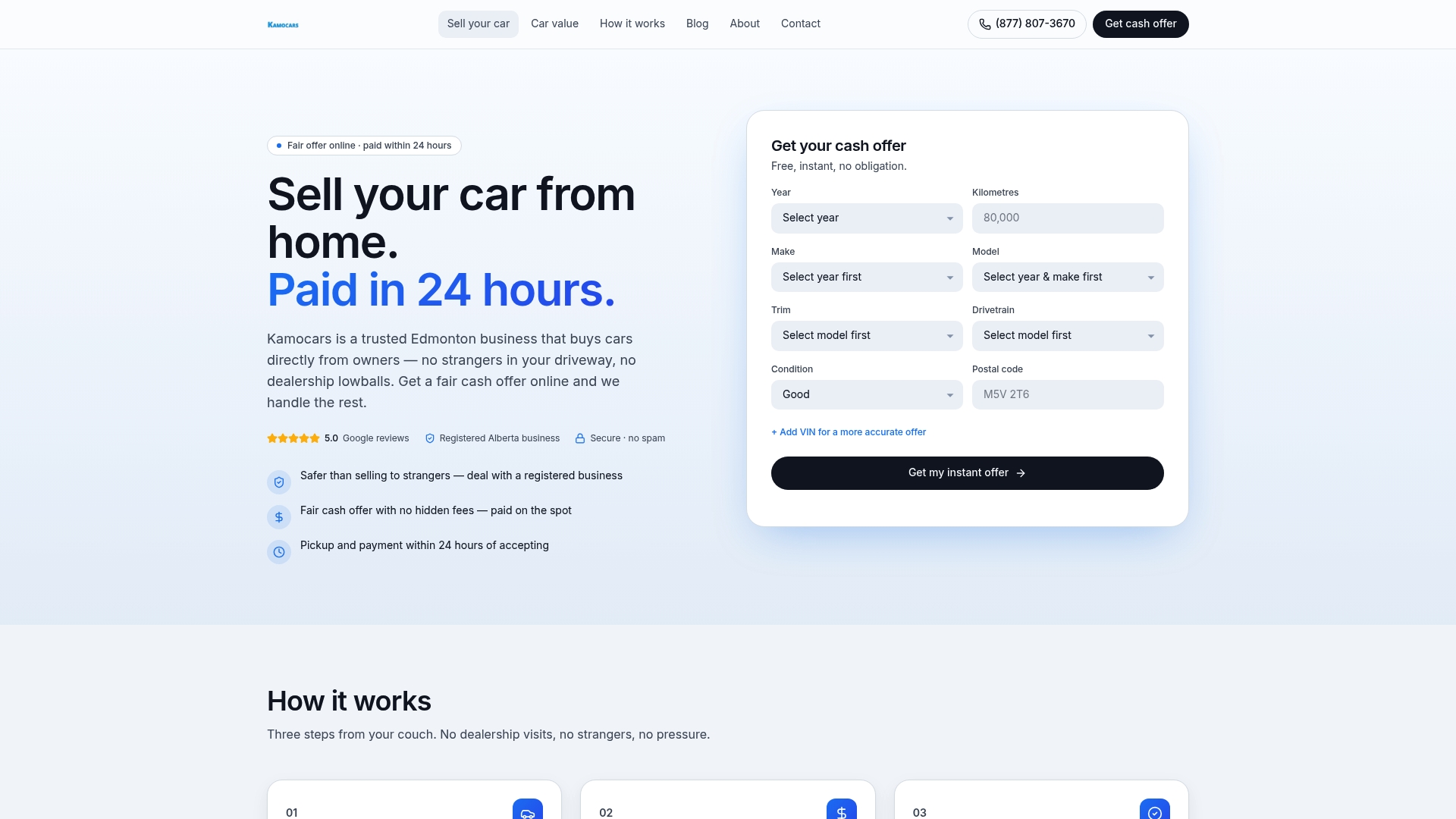
Here’s what the process looks like on our end:
- Submit your VIN, mileage, and a few photos through our Sell My Car page.
- Receive a binding cash offer with no last-minute deductions once a quick inspection confirms the details.
- Get free pickup anywhere in Alberta, with lien payout and paperwork handled as part of the sale.
- Receive secure payment within 24 hours of accepting the offer.
We’re a registered Alberta business with BBB accreditation, so the protections that come with selling to a licensed buyer apply to your sale from the start. If your 2018 or newer car, truck, or SUV is still running, get your offer from Kamocars and see the number before you commit to anything.
FAQ
Do I have to pay tax when I sell my personal car in Alberta?
Most personal vehicle sales don’t trigger any tax reporting. The CRA treats cars as personal-use property, and no reporting is required when both your proceeds and adjusted cost base are $1,000 or less, which covers the vast majority of daily-driver sales.
What paperwork do I need to sell my car in Alberta?
You need a completed standard Alberta bill of sale with both parties’ names, the VIN, odometer reading, price, and signatures. It’s also wise to pull a Vehicle Information Report beforehand to confirm the vehicle’s recorded Alberta history.
How do I know if a car buyer is actually licensed?
Ask for the buyer’s business registration number and confirm it’s active before accepting an offer. AMVIC warns that curbers often list multiple vehicles under the same contact details and may not have registration in their own name, so a mismatch there is a clear red flag.
How fast can I actually get paid for my car?
With a licensed cash offer buyer, payment typically happens within 24 hours of accepting the offer, once a quick inspection confirms the vehicle’s condition matches what you reported. Delays usually come from unresolved liens or incomplete paperwork rather than the process itself.
What happens if my buyer is in another province?
Your obligations as the seller don’t change: you still sign a valid bill of sale, clear any lien, and cancel your own registration. The buyer is responsible for registering the vehicle under their own province’s rules once it arrives there.
Sources
Recommended
Get a real cash offer in 2 minutes
Trusted business. Fair price. Paid on the spot when we pick up your car.