
Avoid CCA Recapture When You Sell Your Car to a Company in Canada
Know when a sale to a company becomes reportable, which CRA forms to file (T2125, T777), provincial tax quirks, and how to get fast, documented payment.
Avoid CCA Recapture When You Sell Your Car to a Company in Canada

Selling your personal vehicle to a company or dealer is usually not a taxable event in Canada. The exception that changes everything: if you claimed the vehicle for business use, whether through Capital Cost Allowance or motor-vehicle expenses, the sale becomes a disposition you must report to the CRA, and it can trigger recaptured CCA or a terminal loss. If that’s your situation, keep reading before you sign anything, and check whether Form T2125 or T777 applies to you.
TL;DR:
- Selling a vehicle claimed for business use may trigger taxable recapture of CCA or a terminal loss, depending on the sale proceeds relative to UCC.
- Proper documentation, including signed bills, proof of lien clearance, and clear records of business use, are crucial to avoid CRA disputes and delays.
- Provincial rules vary significantly, with some provinces like Alberta charging no sales tax, while others like Ontario and Quebec apply specific PST or QST calculations.
- CRA forms such as T2125, T777, and T1 capital gains line must be correctly filed if the vehicle was used for business purposes or claimed as employment expenses.
- A verified, promptly executed sale with a documented offer and traceable payment provides better legal and tax clarity than rushing into a transaction with unverified buyers.
Table of Contents
- How the CRA Taxes a Sale of a Business-Used Vehicle
- Step-by-Step: Selling Your Car to a Company in Canada
- What Paperwork You Need, and How Provincial Rules Differ
- Which CRA Forms Apply to Your Sale
- Trade-In to a Dealer or Sell to a Company: Which Wins?
- Common Pitfalls When Selling a Car to a Company
- Why a Fast, Documented Buyer Matters More Than People Think
- Your Quick Tax and Paperwork Checklist
- Get a Fast, Documented Offer From Sellkamocars
- Sources
How the CRA Taxes a Sale of a Business-Used Vehicle
A vehicle sold purely for personal use passes through your hands tax-free. Once you’ve claimed CCA or motor-vehicle expenses against it, the CRA treats a sale to a company as a disposition, and that word carries real tax weight.
Proceeds of disposition is simply what you got for the car, whether that’s a cash payment from a company buyer or a trade-in credit. Undepreciated Capital Cost (UCC) is what’s left of the vehicle’s tax value after you’ve deducted depreciation year after year. The gap between those two numbers decides what happens next.
- Proceeds exceed UCC: you get recaptured CCA, which is added back as business income on your return.
- Proceeds fall short of UCC, and it’s the last asset in that class: you get a terminal loss, which you can deduct against business income.
- Proceeds land close to UCC: minimal or no tax consequence.
Picture a delivery van bought for $30,000 with a UCC of $12,000 after several years of CCA claims. Sell it to a company for $18,000, and $6,000 becomes recaptured income. Sell it for $8,000 instead, and you likely claim a $4,000 terminal loss.
GST/HST rarely applies when an individual sells a personal or business vehicle privately, since you’re not a GST/HST registrant making a taxable supply in the course of commercial activity. Dealers and registered businesses buying and reselling vehicles operate under different rules.
One wrinkle worth flagging: if you sell to a corporation you control, or to a family member’s company, the Income Tax Act deems the transaction to happen at fair market value regardless of the price on paper. A Section 85 rollover can defer the tax hit in these non-arm’s-length transfers, but it demands specific forms and professional guidance. Don’t attempt one without an accountant.
Step-by-Step: Selling Your Car to a Company in Canada
A clean sale to a company follows a predictable sequence. Miss a step and you risk a payment delay, a title problem, or a tax filing headache months later.
- Get a written offer. Ask how the valuation was calculated, whether it’s based on current wholesale data, and confirm the buyer is a registered business, not an anonymous online contact.
- Clear any lien. Contact your lender for a payoff quote, and confirm whether the buyer will pay the lienholder directly or wait for a clear title.
- Handle inspection and disclosure. Some buyers require a quick inspection; disclose any accidents, mechanical issues, or outstanding recalls upfront.
- Agree on payment method and timing. Insist on traceable payment, such as e-transfer or direct deposit, with a clear date.
- Sign a bill of sale and complete the provincial transfer. Keep signed copies for your own records.
- Log the business-use percentage. If the vehicle was ever used commercially, write down that percentage now, while it’s fresh, for your business vehicle expense reporting.
Pro Tip: Photograph the odometer and the vehicle’s condition on the day of pickup. If a tax or warranty dispute ever comes up, timestamped photos settle it faster than memory does.
What Paperwork You Need, and How Provincial Rules Differ
Every province requires the same core documents, but a few details shift depending on where you live.
- Vehicle registration or title in your name
- A signed bill of sale showing price, date, and both parties’ information
- Lien release or payoff confirmation, if applicable
- Government-issued ID matching the registration
- Odometer disclosure, required in several provinces for used-vehicle sales
Provincial quirks matter more than most sellers expect. Alberta charges no provincial sales tax on vehicle sales, and transfers go through registry agents using standard bill-of-sale forms. Ontario applies retail sales tax based on the vehicle’s value, and trade-ins to a dealer typically reduce the taxable amount on the new purchase, unlike a straight private sale. British Columbia and Quebec apply their own PST or QST rules with separate calculations for trade-ins versus private sales. Before finalizing anything, check your provincial paperwork requirements and confirm current rules with your local motor-vehicle registry, since these details change more often than people assume.
Which CRA Forms Apply to Your Sale
If your vehicle was ever a business asset, three CRA touchpoints matter.
- T2125 — Statement of Business or Professional Activities: sole proprietors report the sale here, adjusting proceeds and CCA figures by the vehicle’s business-use percentage.
- T777 — Statement of Employment Expenses: employees claiming vehicle costs against employment income use this form and must reflect the sale in the following year’s expense claim.
- T1 capital gains line: recaptured CCA gets reported as business income, not a capital gain, but the CRA’s capital gains calculation guidance is still useful for understanding how proceeds and cost base interact.
Sellers who track business-use percentage year by year, rather than guessing at tax time, consistently get cleaner numbers on these forms and fewer follow-up questions from the CRA.
Trade-In to a Dealer or Sell to a Company: Which Wins?
The honest answer depends on whether you’re buying another vehicle right away.
Trade-ins carry a built-in tax advantage in provinces like Ontario, where sales tax on your new purchase applies only to the net difference between the new price and your trade-in allowance. Selling to a company skips that math entirely, and the tax result depends purely on whether the vehicle was a personal or business asset.
- Net cash: trade-in allowances often run lower than a company’s direct cash offer.
- Speed: a company sale typically closes in a day or two; dealer trade-ins are bundled into a longer purchase negotiation.
- Paperwork: direct sales usually mean simpler, standalone documentation.
- Negotiation leverage: insist on a written, itemized trade-in allowance kept separate from the new vehicle’s discount, so one number can’t be used to disguise the other.
Common Pitfalls When Selling a Car to a Company
Most problems trace back to unclear paperwork or an unverified buyer, not the sale itself.
- Non-arm’s-length pricing: selling to your own company at a below-market price invites a CRA fair-market-value adjustment, even if no cash changed hands at that price.
- Bundled dealer math: some dealers inflate a “discount” on the new vehicle while quietly shrinking your trade-in allowance, so always request the trade-in value in writing before discussing the new purchase price.
- Unverified buyers: confirm business registration before handing over keys, and never accept a payment method you can’t independently confirm has cleared.
- Missing records: hang on to the bill of sale, inspection notes, and any written offer. If the CRA asks about a disposition years later, you’ll want a paper trail, not a memory.
Pro Tip: Ask a potential company buyer for their business registration number before you agree to a price. A legitimate buyer will hand it over without hesitation.
Why a Fast, Documented Buyer Matters More Than People Think
Most guides treat “sell it fast” and “sell it correctly” as separate goals, one for convenience and one for the accountant. That split is largely artificial. A rushed private sale with no bill of sale, no verified buyer, and no record of business-use percentage creates exactly the kind of documentation gap that turns a routine disposition into a drawn-out CRA conversation months later.

Where a registered buyer earns its keep isn’t just speed. It’s the paper trail that speed produces when it’s done right: a documented offer, a traceable payment, and a clear title transfer on the same day. Kamocars, for instance, builds its process around instant appraisals from current market data, pickup and payment within 24 hours, and registered business status that gives sellers a verifiable counterparty instead of an anonymous online buyer. Sellers with more than 500 completed transactions behind that model aren’t gambling on whether the buyer is real; they know before pickup day.
None of that replaces professional advice for non-arm’s-length transfers or corporate structuring. If your vehicle sale touches either, talk to an accountant before you sign, not after.
— Omar
Your Quick Tax and Paperwork Checklist
A disposition triggers reporting only when the vehicle was claimed for business use. Personal sales stay off your tax return entirely.
- Confirm business-use percentage and gather CCA history if applicable.
- Keep the bill of sale, lien payoff confirmation, and any written offer.
- Talk to an accountant if the sale is non-arm’s-length or involves recapture.
| Situation | Action needed |
|---|---|
| Purely personal vehicle | No reporting required |
| Business-use vehicle, sole proprietor | File proceeds and CCA adjustment on T2125 |
| Employment-use vehicle | Adjust next year’s T777 claim |
| Sale to your own company | Confirm fair market value; consider Section 85 |
Get a Fast, Documented Offer From Sellkamocars
Once you’ve sorted the tax side, the actual sale should be the easy part. Sellkamocars is the faster alternative to haggling with strangers online or waiting through a dealer’s trade-in appraisal. It gives Alberta owners of more recent cars, trucks, and SUVs an instant cash offer built on current Canadian wholesale data, with pickup and payment handled within a short timeframe.
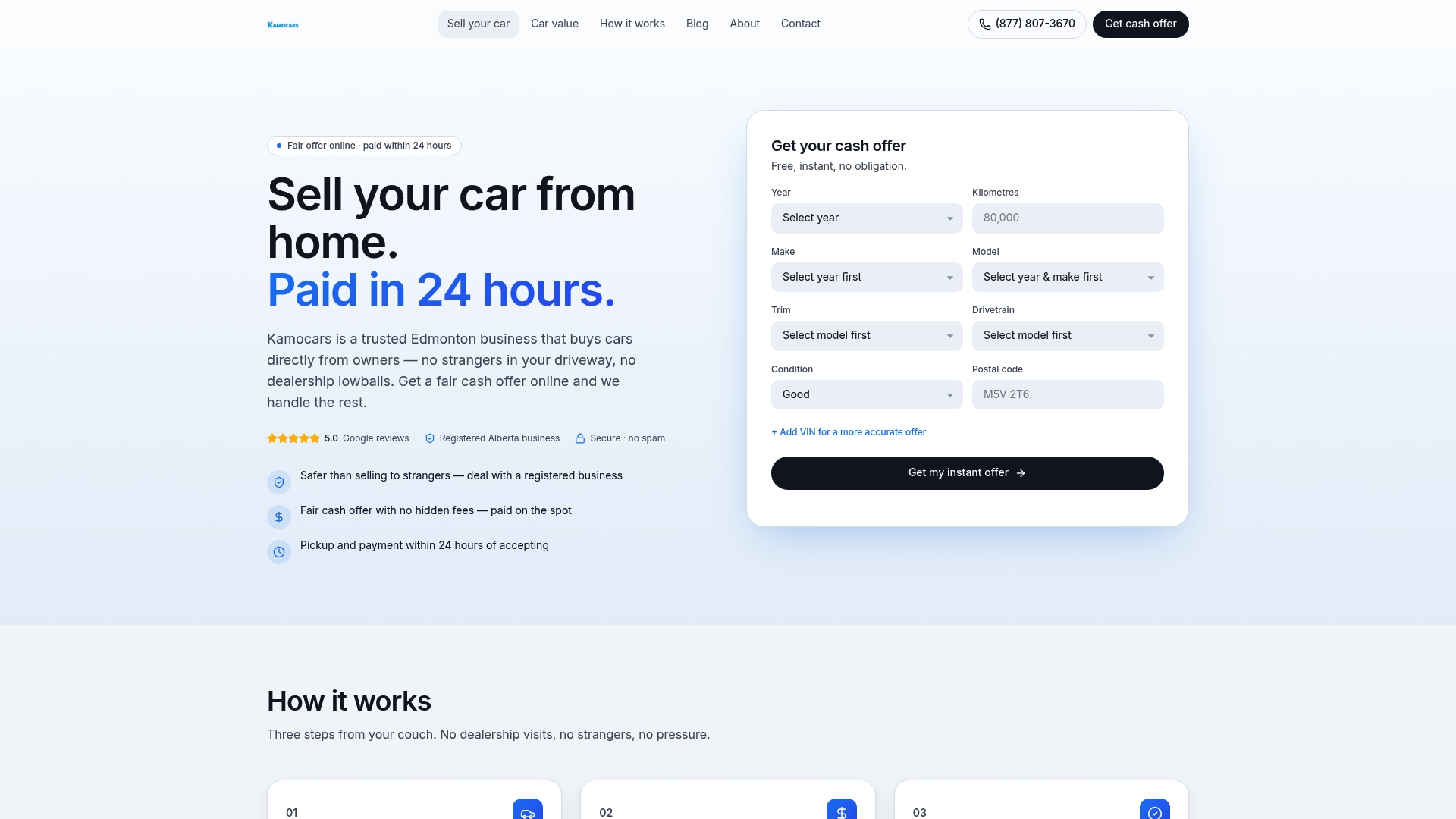
That speed doesn’t come at the cost of the paper trail this article just walked you through. Sellkamocars operates as a registered business, so you get a verifiable buyer, a documented transaction, and secure payment instead of an anonymous online exchange. If you’re financing or leasing the vehicle, that gets handled directly too.
If you’re ready to see a number, get a cash offer for your car in Edmonton and find out what your vehicle is worth before you commit to a dealer’s trade-in math or a stranger’s lowball offer.
Sources
- T2125 — Statement of Business or Professional Activities
- T777 — Statement of Employment Expenses
- When is GST/HST payable on vehicle sales? — guidance from a Canadian tax lawyer
Recommended
Get a real cash offer in 2 minutes
Trusted business. Fair price. Paid on the spot when we pick up your car.