
Alberta Used Car Prices: Check 2 Values Before You Sell
Compare Alberta values across two sources, factor in taxes and registration fees, then use local trends to price a sale or consider a cash offer.
Alberta Used Car Prices: Check 2 Values Before You Sell

Alberta used car prices have moved differently than the rest of Canada over the past couple of years, with provincial averages shifting more sharply than the national trend. If you’re buying or selling, your first move should be to triangulate value using at least two sources and run a lien and vehicle history check before you commit to a number. A fast cash offer from a trusted local buyer is worth considering if you want certainty over haggling.
TL;DR:
- Compare one retail listing median, one wholesale or trade in estimate, and three to five local listings; asking prices are not sale prices.
- Alberta’s truck and SUV mix can distort provincial averages, so match comparables by model, condition, mileage, and region, especially between cities and rural communities.
- Dealer purchases from GST/HST registered businesses incur tax, while private sales between nonregistrants generally do not; Alberta registration and inspection fees may still apply.
- A private sale may net more but demands listings, test drives, paperwork, and lien clearance; a binding service offer includes pickup and payment within 24 hours.
Table of Contents
- Alberta Average Prices and the Short Term Trend
- Where to Check Vehicle Values in Alberta
- Key Factors That Move a Vehicle’s Price in Alberta
- How GST/HST and Registration Fees Affect Your Total Cost
- Seller Checklist: Getting a Realistic Alberta Price
- How a Local Online Buyer Turns Market Value Into Cash
- City Versus Rural Pricing Differences Within Alberta
- Seasonal Patterns That Affect Used Car Prices in Alberta
- How Fuel Type and Transmission Affect Resale Value
- Private Sale, Dealer Trade-In or Car Buying Service: What Fits Your Situation
- Negotiating Your Price and Avoiding Lowball Offers
- Reading Alberta’s Price Trends Without Overreacting
- Get a Fast, Local Cash Offer for Your Vehicle
- FAQ
- Sources
Alberta Average Prices and the Short Term Trend
Recent market reporting on Canadian used car prices shows that vehicles are sitting longer on lots and that provincial averages have not moved uniformly across the country. Alberta has tracked differently than some other provinces, and that gap matters more than the national headline number if you’re pricing a specific vehicle.
One of the clearest patterns in recent data is that Alberta’s used car averages have shifted more than some other provinces, largely because the local market leans heavily toward SUVs and trucks rather than sedans. When a province sells proportionally more larger vehicles, the average price gets pulled upward even if comparable sedans are softening at the same time. That’s why a province-wide percentage change tells you about the mix of vehicles changing hands, not necessarily about what your specific make and model is doing.
If you’re pricing a vehicle, treat the provincial average as background context only. A three-year-old half-ton truck and a three-year-old compact sedan can move in opposite directions in the same month, and the blended average will hide both stories.
Where to Check Vehicle Values in Alberta
Before you settle on a price, pull numbers from more than one source. Each valuation tool measures something slightly different, and conflating them leads to unrealistic expectations on both sides of a deal.
- VMR Canada publishes wholesale and retail values drawn from Canadian transaction data, useful for a baseline range.
- AMA’s Price a Car tool gives Alberta-specific trade-in estimates for recent-model vehicles.
- Gold Book and Canadian Red Book, often accessible through public libraries, offer another reference point for older or less common models.
- Local comparable listings on marketplaces show you what similar vehicles are actually asking in your area right now.
Retail value, wholesale value, trade-in value and asking price are four different numbers, and mixing them up is the most common pricing mistake we see. Retail reflects what a dealer might sell the car for after reconditioning; wholesale or trade-in reflects what a dealer or buyer would pay to acquire it; asking price is simply what a seller has chosen to list, which may or may not be realistic.
Pro Tip: Pull one retail listing median, one wholesale or trade-in estimate, and three to five local comparable listings before you name a price.
You can also run your specifics through Kamocars’ free Alberta car value tool to get a quick reference point alongside your other research.
Key Factors That Move a Vehicle’s Price in Alberta
Two vehicles of the same year and model can sell for noticeably different amounts once you account for condition, history and how they’re presented to buyers.
- Vehicle type matters more in Alberta than in most provinces because SUVs and trucks make up a larger share of the local market and tend to hold value differently than sedans.
- Odometer reading and age remain the two biggest single factors in any valuation tool, with higher kilometers for the model year pulling the price down.
- Accident history and service records shift buyer confidence significantly. A clean vehicle history report tied to accident records tends to support a stronger asking price, while unexplained gaps in service history invite lower offers.
- Listing price versus sold price can diverge widely, and listings marked “contact for price” skew any median you calculate from a marketplace search, so exclude them from your comparables.
Local demand also plays a role that’s easy to underestimate. A model that’s common and well-supported by Alberta service shops will generally move faster and hold price better than something unusual for the region, even if the spec sheets look similar on paper.
How GST/HST and Registration Fees Affect Your Total Cost
Tax treatment depends entirely on who you’re buying from, and this trips up a lot of first-time private buyers.
- GST/HST applies when you buy from a GST/HST-registered automotive business, such as a dealership, and is charged on the sale price.
- Private sales between individuals who are not GST/HST registrants generally do not attract GST/HST, which is one reason private-party prices can look lower than dealer prices for comparable vehicles.
- Registration and inspection fees apply when you register a used or out-of-province vehicle in Alberta, and first-time registrations or salvage and commercial vehicles may require a safety inspection.
- Registry agents handle the paperwork for plate transfers and registration, so confirm what documentation they’ll need before your appointment.
If GST/HST timing or exemptions are unclear for your specific transaction, our guide to used car GST rules in Canada walks through common scenarios and a practical checklist.
Seller Checklist: Getting a Realistic Alberta Price
A well-prepared listing sells faster and closer to asking price than one where the buyer has to chase down basic facts.
- Assemble your paperwork first: registration, service records, and a personal property lien search so buyers can confirm the vehicle is free and clear.
- Use Alberta’s standard bill of sale format, which spells out what details the document needs to include.
- Order a vehicle history report and consider a pre-sale safety inspection, both of which reduce buyer hesitation and support your asking price.
- Triangulate your number using retail, wholesale and comparable listings, then build in a small negotiation margin above your true floor.
Pro Tip: A completed personal property lien search costs little compared to the time you’ll lose explaining its absence to a nervous buyer.
Once you’ve got your documentation and a defensible price range, you’re in a position to decide whether you want to negotiate privately or take a faster, fixed route instead.
How a Local Online Buyer Turns Market Value Into Cash
For sellers who’d rather skip strangers, test drives and back-and-forth negotiation, a direct cash-offer service converts your triangulated value into money without the listing process.
- A binding cash offer means the number you’re quoted is the number you get, reviewed by local staff rather than generated blind.
- Free home pickup anywhere in Alberta removes the need to meet buyers at your house or a parking lot.
- Payment and lien clearance handled within 24 hours means financed or leased vehicles can be processed without you juggling the payout yourself.
- Registered business status matters here, since it distinguishes a legitimate buyer from informal classifieds transactions where recourse is limited.
This route tends to make the most sense when you’re short on time, want to avoid haggling, or are dealing with a vehicle that still has a lien attached. Whatever offer you receive, compare it against your own triangulated market value first so you know exactly what you’re trading convenience for.
City Versus Rural Pricing Differences Within Alberta
Alberta isn’t one uniform used car market. Prices for the same model can vary between Calgary, Edmonton and smaller communities, driven by inventory levels, buyer competition and transportation costs.
Larger cities generally have more listings for any given model, which keeps prices competitive through sheer volume of comparable inventory. A popular compact SUV in Calgary might have dozens of similar listings at any given time, pushing sellers toward a market-clearing price. In smaller towns, the same model might have only one or two local listings, giving the seller more pricing power simply because a buyer has fewer nearby alternatives.
Rural buyers also tend to place a premium on trucks and four-wheel-drive SUVs suited to gravel roads, farm use or winter travel on secondary highways, which can push those vehicle categories higher in rural markets than the provincial average would suggest. Conversely, small fuel-efficient sedans sometimes sell for less in rural areas simply because local demand skews toward larger, more capable vehicles.
Shipping or towing a vehicle between a rural seller and an urban buyer adds a cost that both sides factor into negotiations, sometimes shaving a few hundred dollars off what a seller might otherwise expect. If you’re comparing listings across the province, filter for your specific region rather than relying on a single Alberta-wide number, since what sells well in Edmonton may not reflect what a similar vehicle fetches two hours outside the city.

Seasonal Patterns That Affect Used Car Prices in Alberta
Timing your purchase or sale around Alberta’s seasons can meaningfully change what you pay or receive.
Winter tends to push demand toward all-wheel-drive and four-wheel-drive vehicles, SUVs and trucks equipped with winter tires, often at a small premium over the same model listed in summer. Convertibles, older rear-wheel-drive vehicles and anything without proven cold-weather reliability tend to soften in price during the colder months simply because fewer buyers are shopping for them.
Spring and early summer typically bring a wave of new listings as people upgrade before road trip season, which increases buyer choice and can soften prices slightly on common models. Tax refund season in the spring also tends to bring more cash buyers into the market, which can offset some of that softening for well-priced, well-presented vehicles.
If you’re selling, listing in late winter or early spring, just before the seasonal inventory wave hits, often gets you in front of buyers with less competition from other sellers. If you’re buying, late fall and early winter sometimes offer better deals on vehicles that aren’t winter-ready, provided you’re comfortable with the trade-offs.
How Fuel Type and Transmission Affect Resale Value
Fuel type and transmission choice both influence how quickly a vehicle sells and what it sells for in Alberta specifically.
Gas-powered vehicles remain the default expectation for most Alberta buyers, particularly for trucks and larger SUVs used for towing, hauling or rural travel. Diesel trucks often command a premium among buyers who need towing capacity or who put on high highway kilometers, since diesel engines are associated with durability over high-mileage use. Hybrid and electric vehicles represent a smaller share of the Alberta used market than in provinces with more charging infrastructure, and resale values can be more sensitive to battery health, charging access and winter range performance than they are for comparable gas models.
Transmission type matters less than it once did, since most new vehicles now ship with automatic transmissions as standard, but a manual transmission on an otherwise desirable vehicle, like a sports car or a specific truck trim, can actually appeal to a smaller but more motivated buyer pool. For everyday commuter vehicles, a manual transmission typically narrows your buyer pool and can soften the price slightly compared to an equivalent automatic.
If you’re pricing a vehicle with an unusual fuel type or transmission for its category, widen your comparable search specifically to similar configurations rather than the broader model average, since mixing automatic and manual, or gas and diesel, comparables into one median will distort your number.
Private Sale, Dealer Trade-In or Car Buying Service: What Fits Your Situation
Alberta sellers generally choose between three routes, and each trades speed, effort and price differently.
A private sale typically nets the highest price because there’s no dealer margin built in, but it demands the most time and exposure. You’re responsible for marketing the vehicle, screening strangers, handling test drives, drafting a compliant bill of sale and clearing any lien yourself.
A dealer trade-in is the fastest conventional route if you’re also buying another vehicle, since the dealer handles paperwork and nets the transaction against your new purchase. The trade-off is that dealers typically offer below private-sale value to account for their own resale margin and reconditioning costs.
A car buying service like Kamocars sits between those two options: you get a binding cash offer without listing the vehicle publicly, without hosting strangers at your home, and without negotiating back and forth, with pickup and payment typically handled within 24 hours. It won’t always match a top private-sale outcome, but it removes the time and effort cost that private selling requires, which is exactly the trade-off that matters most if you need the sale done quickly or you’re dealing with a lien that complicates a private transaction.
The right choice depends on how much your time is worth and how comfortable you are managing the private-sale process end to end.

Negotiating Your Price and Avoiding Lowball Offers
Private buyers often open with a number well below your asking price, testing whether you’ll accept it out of impatience. Knowing your floor before you start negotiating protects you from settling too quickly.
Set your floor using your triangulated value range, not your asking price, and decide in advance how far you’re willing to move. If a buyer’s opening offer comes in significantly below your researched wholesale value, treat that as a signal they haven’t done their homework rather than a reason to panic and accept.
Having your documentation ready, including a vehicle history report and a recent safety inspection, gives you leverage because it removes the uncertainty buyers typically use to justify lowball offers. A buyer who can see clean records and a lien search has less room to argue for a steep discount.
If a private buyer’s offer consistently lands below what a registered cash-offer service would pay, that’s worth factoring into your decision. Comparing a firm written offer against an uncertain private negotiation often clarifies which route actually nets you more once your time and risk are accounted for.
Reading Alberta’s Price Trends Without Overreacting
Provincial averages make headlines, but they’re a blunt tool for an individual transaction. Alberta’s heavy mix of SUVs and trucks inflates the province-wide number in ways that don’t apply if you’re pricing a sedan or an older hatchback, so always compare against like-for-like models rather than the headline figure.
Neither buyers nor sellers need to time the market precisely. A well-documented vehicle priced against real comparables will sell fairly in most conditions, and chasing short-term swings usually costs more in delay than it saves in price.
— Omar
Get a Fast, Local Cash Offer for Your Vehicle
Once you’ve triangulated your vehicle’s value using retail listings, wholesale estimates and local comparables, requesting a cash offer takes a few minutes through our Sell My Car page or our free value tool.
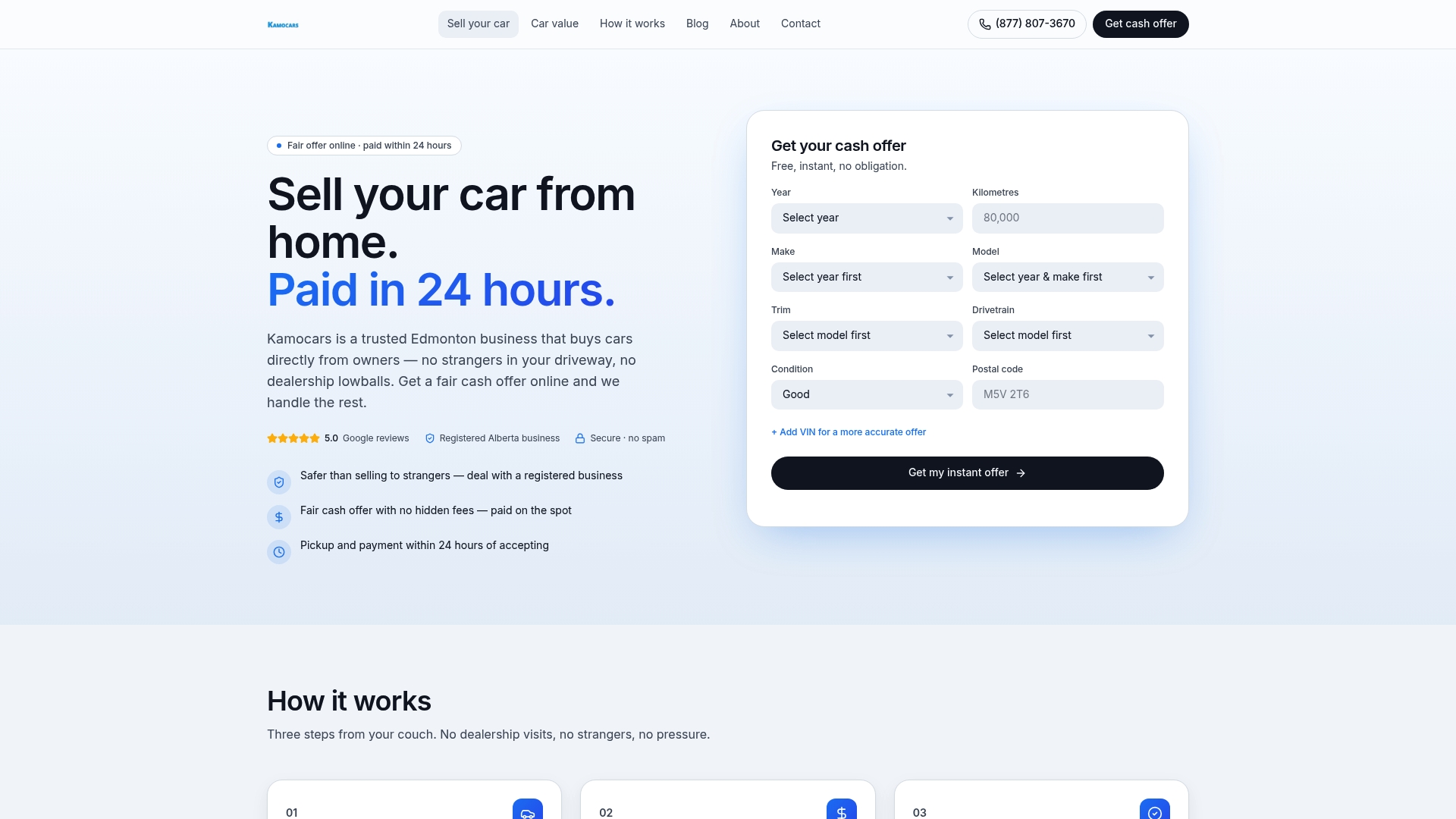
We review your details, send a binding offer, and handle pickup and payment within 24 hours, including lien clearance if your vehicle is still financed. Compare whatever we offer against your own researched range so you know exactly what you’re getting.
| Selling route | Typical speed | Effort required |
|---|---|---|
| Private sale | Days to weeks | High (listing, showings, negotiation) |
| Dealer trade-in | Same day | Low, but tied to a new purchase |
| Kamocars cash offer | Within 24 hours | Low (one appraisal, one pickup) |
FAQ
Is It Cheaper to Buy a Car in Alberta or Ontario?
Price comparisons between provinces depend heavily on which specific vehicle and trim you’re comparing, since provincial averages reflect different vehicle mixes rather than a flat cost-of-living difference. Alberta’s market leans more toward SUVs and trucks, so a direct comparison only makes sense model-for-model rather than province-to-province.
What Is the Cheapest Car to Buy in Alberta?
There’s no single fixed answer, since the cheapest option shifts with inventory, season and condition, but older compact sedans and hatchbacks with higher kilometers typically sit at the lower end of the Alberta used market. Checking current comparable listings and a valuation tool for your specific budget range gives a more accurate picture than any fixed list.
How Much Is the Tax on a Used Car in Alberta?
If you buy from a GST/HST-registered dealership, GST/HST applies to the sale price. If you buy privately from someone who isn’t a registrant, the sale generally does not attract GST/HST, though registration and inspection fees may still apply.
What Are the Best Used Cars to Buy Under $10,000 in Canada?
The best options in that budget range vary by region and depend on mileage, accident history and how well the vehicle has been maintained, rather than any fixed model list. Compact sedans and older midsize SUVs with documented service records and a clean vehicle history report tend to offer the most reliable value at that price point.
Sources
Recommended
Get a real cash offer in 2 minutes
Trusted business. Fair price. Paid on the spot when we pick up your car.