
Why Sell Your Car Before Trade-In: Cash Sellers' Guide
Discover why selling your car before trade-in can earn you $1,800–$2,700 more. Maximize your profit with our expert guide!
Why Sell Your Car Before Trade-In: Cash Sellers’ Guide
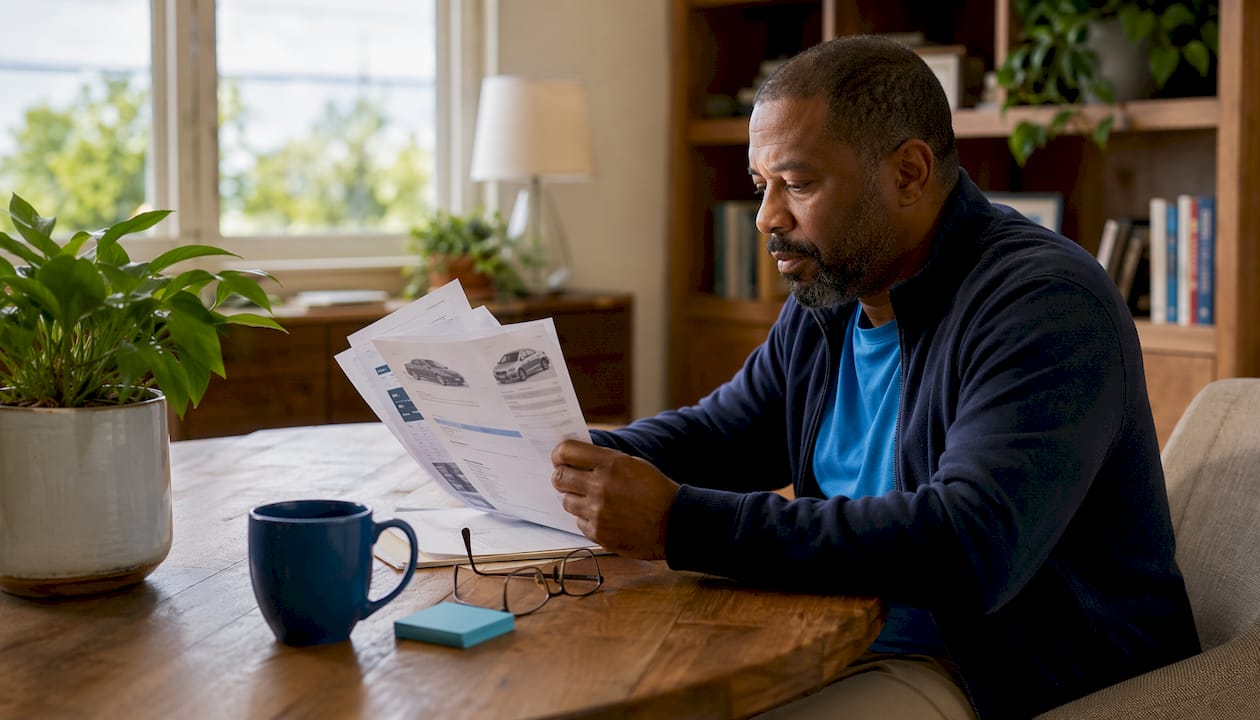
Selling your car to a private buyer before visiting a dealership typically puts more money in your pocket. Private-party values tend to be higher than dealer trade-in offers by a noticeable margin, typically 12–18% higher. On a $15,000 vehicle, this means gaining about $1,800–$2,700 more, according to recent CarSavr data. The math shifts in two situations: if your state offers a trade-in sales-tax credit that offsets most of that premium, or if you carry negative equity on your loan. Outside those two cases, selling first is almost always the stronger financial move.
Quick decision signals:
- Private-party premium: Private sales generally yield more than dealer trade-ins
- Tax credit effect: Some states offer a trade-in tax credit that reduces sales tax, which can recover a portion of the price difference
- Time cost: A private sale involves a time investment typically measured in several weeks and multiple hours
- Flip the recommendation: In high-tax states with a trade-in credit and for lower-value vehicles, trading in may be more advantageous
Table of Contents
- Who usually benefits from selling first?
- Private sale vs. dealer trade-in: the numbers that matter
- How to run the net-benefit calculation yourself
- How to sell your car privately: a practical checklist
- Quick alternatives: instant-cash buyers and dealer buybacks
- What most sellers should do right now
- Key Takeaways
- The case for keeping your negotiations separate
- Sellkamocars: a faster path to a fair cash offer
- Sourced references and further reading
Who usually benefits from selling first?
You’re a strong candidate to sell privately if most of these apply to your situation:
- Your vehicle is worth an amount generally high enough to justify the extra effort
- You own the car outright or have positive equity in your loan
- You have enough lead time before purchasing your next vehicle
- You live in a state without a trade-in tax credit
- Your car is in good condition with reasonable mileage
Pro Tip: Before you decide, pull two numbers: a private-party estimate from Kelley Blue Book and your state’s sales tax rate. Multiply the tax rate by your expected trade-in value to see the credit you’d lose by selling privately. If the private-party premium beats that number, selling first wins.
Trading in makes more sense when speed matters more than the cash difference. If your car needs significant repairs, you’re underwater on your loan, or you simply don’t want to deal with strangers, the convenience of a same-day trade-in has real value.
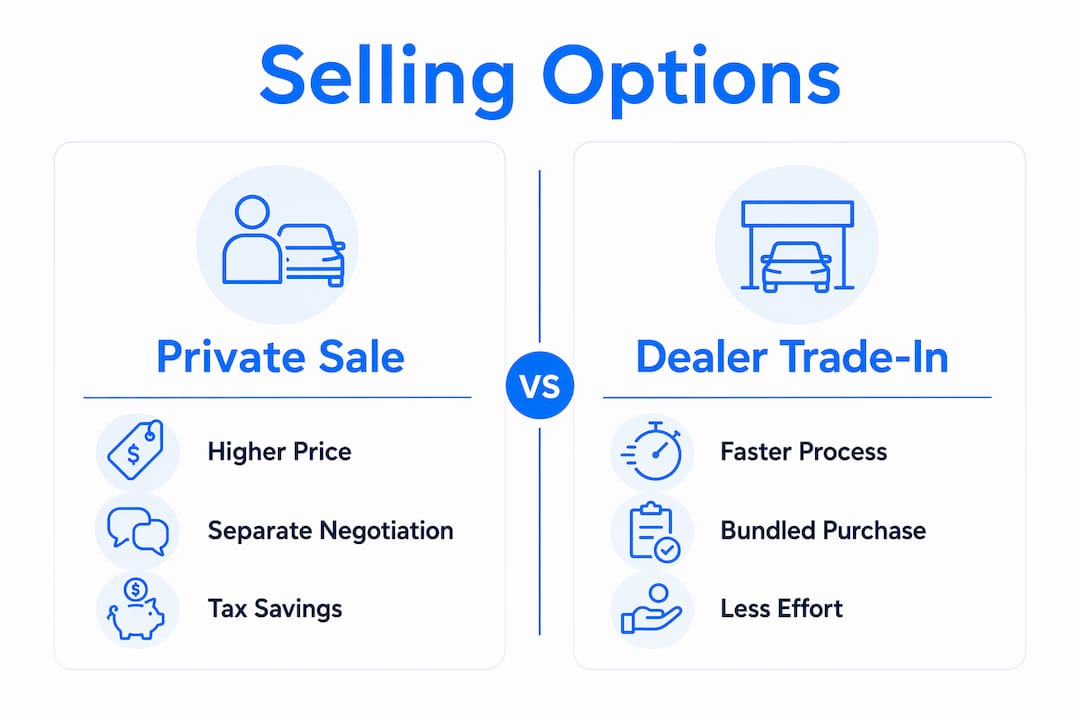
Private sale vs. dealer trade-in: the numbers that matter
Dealers price trade-ins based on wholesale auction expectations, subtracting a portion to cover reconditioning, commissions, advertising, and holding costs before making an offer. That’s not a negotiating tactic. It’s their actual cost structure. A private buyer pays retail, which is why the gap exists.

| Factor | Private Sale | Dealer Trade-In |
|---|---|---|
| Net payout | Highest (retail ceiling) | Lower (wholesale floor minus costs) |
| Sales-tax effect | No credit; you pay full tax on new car | Credit in most states; tax on net price only |
| Time required | 1–4 weeks, 6–10 hours | Same day, 1–2 hours |
| Safety/risk | Buyer screening required | None |
| Paperwork | You handle title, bill of sale, odometer | Dealer handles everything |
| Payment certainty | Negotiated; risk of scams | Guaranteed check or transfer |
| Typical fees | Listing fees, detailing | Documentation fee |
Concrete example — Texas seller with trade-in credit applies:
- Private-party sale price is higher than dealer trade-in offer by a notable sum
- The tax credit reduces the effective cost of a trade-in
- The net advantage of selling privately remains positive after considering lost tax credit
“If the private-sale premium minus your estimated time and opportunity cost still exceeds the lost sales-tax credit, selling privately is usually worth it.” — CarSavr
Selling before you go to the dealer also separates the two negotiations. When you bundle a trade-in with a new-car purchase, a dealer can offset a low trade-in offer by tightening the discount on the new vehicle. Walking in as a cash buyer removes that lever entirely.
How to run the net-benefit calculation yourself
Selling first is worth it when: (private-sale price) minus (lost tax credit) minus (time cost) > dealer trade-in offer.
Here’s the math, step by step:
| Step | What to find | Where to get it |
|---|---|---|
| 1. Private-sale estimate | KBB private-party value | kbb.com |
| 2. Dealer offer | Instant Cash Offer or appraisal | KBB, local dealers |
| 3. Raw premium | Step 1 minus Step 2 | Your math |
| 4. Lost tax credit | State tax rate × trade-in value | State revenue site |
| 5. Time cost | Hours × your hourly rate | Your estimate |
| 6. Net advantage | Step 3 minus Step 4 minus Step 5 | Your math |
Sample numbers: The raw premium minus the estimated lost tax credit and time cost results in a net benefit that favors selling privately.
If that number is positive, sell first. If it’s negative or close to zero, the trade-in is the pragmatic call.
Pro Tip: Use your offer comparison results as your negotiation floor at the dealership. Print the best private-party or instant-cash offer and show it only after the dealer makes their trade-in offer.
How to sell your car privately: a practical checklist
Selling privately can net you the most money. The process is manageable when you follow a clear sequence.
Preparation (Days 1–2):
- Pull your KBB private-party value and set your asking price 5–10% above it to leave negotiation room
- Gather your title, service records, lien release (if applicable), and a valid photo ID
- Detail the car inside and out; fix small, obvious issues like a broken switch or burned-out bulb
- Photograph the car in daylight from every angle, including the engine bay and odometer
Listing and screening (Days 2–7):
- Post on two or three platforms with a detailed description covering mileage, condition, accident history, and recent maintenance
- Screen buyers by phone before scheduling a test drive; confirm they have a valid license
- Never share your home address; use a public meeting spot for the first contact
Test drive and payment (Days 7–21):
- Meet at a bank branch during business hours — this is the single most effective safety step for private sellers
- Accept only cash or a verified wire transfer; never accept a personal check or third-party payment apps for large amounts
- If the buyer needs financing, they arrange it before meeting you
Title and paperwork:
- Complete a bill of sale, odometer disclosure statement, and title transfer at the same time as payment
- If your car has a lien, contact your lender for the exact payoff amount and arrange a simultaneous payoff at the bank; the lender releases the title directly to the buyer
“Complete the title transfer immediately at the point of sale — never hand over keys before the paperwork is signed and payment is verified.” — CarSavr
The full paperwork checklist for private sellers covers every document by state, including odometer disclosure requirements and lien release procedures.
Quick alternatives: instant-cash buyers and dealer buybacks
Not every seller has 2–4 weeks or wants to screen strangers. Three faster options exist, each with a different payout ceiling.
Online instant-cash retailers (national platforms that give you a firm offer online) typically pay more than a dealer trade-in and close the transaction in 24–48 hours. Consumer Reports recommends getting multiple instant offers because the spread between platforms can be significant. You lose some of the private-party premium but gain speed, safety, and zero buyer-screening hassle. This is the best middle-ground option for most sellers.
Dealer buybacks (selling directly to a dealership without trading in) are faster than a private sale and let you compare offers across dealers without committing to a purchase. Payout is usually close to trade-in value, but you keep the two transactions separate, which protects your negotiating position on the new car.
“Getting multiple instant offers takes just a few minutes and gives you a real bargaining chip — bring the best number to any dealer you’re shopping at.” — Cars.com
When to pick each route:
- Private sale: You have time, the car is in good condition, and the net-benefit calc shows a clear advantage
- Instant-cash offer: You want speed and safety without the private-sale effort; good for timing your sale to market demand
- Dealer buyback: You have negative equity, the car has high mileage, or you want same-day resolution
What most sellers should do right now
For most vehicle owners with positive equity and a car worth $12,000 or more, selling to a private buyer or instant-cash buyer before visiting a dealership will net more money than a trade-in. The private-party premium of 12–18% outpaces the typical trade-in tax credit in most states.
Your 24–48 hour action checklist:
- Get at least two instant-cash offers (KBB Instant Cash Offer, plus one other platform) to establish your floor
- Run the six-step net-benefit calculation above using your state’s actual sales tax rate
- If the net advantage is positive, list your car; if it’s close to zero or negative, take the best instant-cash offer or trade in
One important caveat: if you owe more on your loan than the car is worth, private buyers rarely cover a payoff above the sale price. In that case, a dealer trade-in or instant-cash buyer that handles the lien payoff is usually your only practical path.
Key Takeaways
Selling your car to a private buyer before trading in typically nets 12–18% more than a dealer trade-in offer, but the right choice depends on your state’s tax rules, your loan status, and how much your time is worth.
| Point | Details |
|---|---|
| Private-party premium | Private-party values tend to be 12–18% higher than trade-in offers, which adds roughly $1,800–$2,700 to your payout on a $15,000 vehicle. |
| Tax credit effect | States with a trade-in tax credit can recover a portion of the price difference; some states do not offer such a credit. |
| Net-benefit rule | Subtract the lost tax credit and your time cost from the raw premium; if the result is positive, sell first. |
| Loan status matters | Negative equity usually makes a trade-in or instant-cash buyer the only practical option. |
| Sellkamocars option | Sellkamocars provides a fast cash offer with 24-hour pickup and payment, no buyer screening required. |
The case for keeping your negotiations separate
The conventional advice is to “negotiate your trade-in separately from the new-car price.” That’s correct, but it misses the deeper point. When you walk into a dealership with cash in hand from a completed private sale or a firm instant-cash offer, you aren’t negotiating a trade-in at all. You’re a cash buyer. That changes the entire dynamic.
Dealers use trade-in bundling as a tool to obscure the real numbers. They can give you a generous trade-in figure while quietly tightening the new-car discount, and most buyers never notice because they’re focused on the monthly payment. Selling your car first removes that variable entirely. Your new-car negotiation becomes a single-number conversation, which is where you have the most leverage.
The one tactical tip worth keeping: even if you’ve already sold your car, get a fresh instant-cash offer the day before you visit the dealership. Bring it as a reference point. It signals to the salesperson that you know your car’s market value and that you’ve done your homework. That signal alone tends to sharpen their offers on the new vehicle.
Sellkamocars: a faster path to a fair cash offer
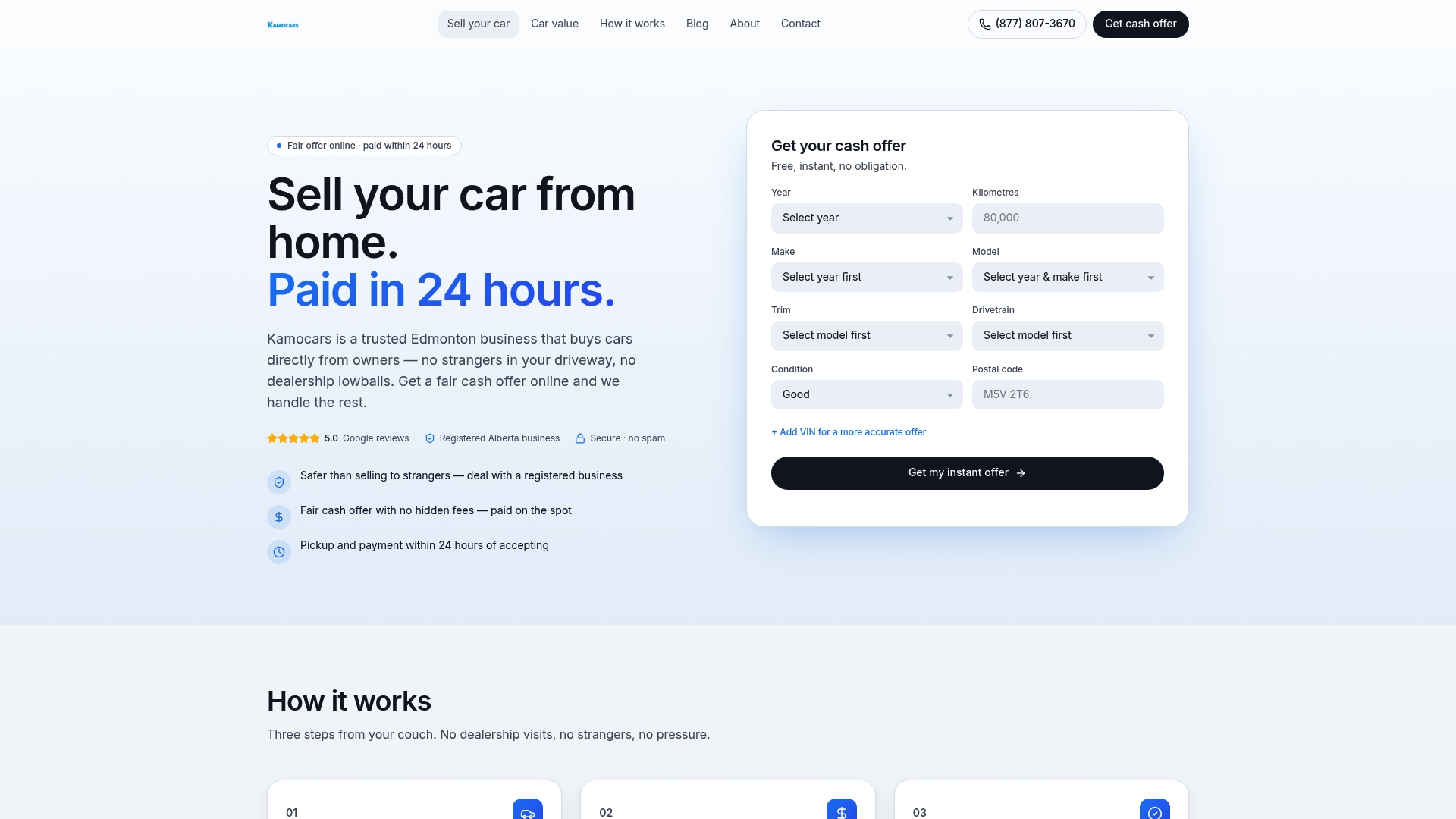
If the private-sale process sounds like more time than you want to spend, Sellkamocars offers a direct alternative. Instead of listing, screening buyers, and coordinating test drives, you get a fair cash offer based on current market data, with pickup and payment handled within 24 hours. No strangers at your door, no haggling, no paperwork headaches.
Sellkamocars is a registered business with over 500 completed transactions, which means you get the safety and certainty of a professional buyer without the low-ball offers typical of dealership trade-ins. It’s the practical middle ground between a time-consuming private sale and a dealer trade-in that leaves money on the table.
Get your cash offer today, or see how the process works from appraisal to payment.
Sourced references and further reading
The figures and guidance in this article draw from the following sources. Consult your state’s department of revenue for the exact trade-in tax credit rules in your jurisdiction, as rates and eligibility change.
| Source | Claim supported |
|---|---|
| CarSavr | Private-party premium (12–18%), states without trade-in credit, dealer margin structure, net-benefit example |
| Consumer Reports | Instant-cash offer strategy and safety |
| Chase | Trade-in convenience, same-day transaction, tax credit mechanics |
| CurbSold | Negative equity and private-sale feasibility |
| ez.car | Time estimate for private sale (1–4 weeks, 6–10 hours) |
| Kelley Blue Book | Dealer offer mechanics, paperwork checklist, valuation tools |
- State revenue sites (search “[your state] motor vehicle sales tax trade-in credit”) for exact local rules
- Best platforms to sell your car for a current overview of online selling options
This article is general information, not legal or financial advice. Confirm current tax rules and loan payoff procedures with your state’s revenue authority and your lender before making a final decision.
Recommended
Get a real cash offer in 2 minutes
Trusted business. Fair price. Paid on the spot when we pick up your car.