
No-Obligation Car Appraisal: What It Means in 2026
Discover what is a no-obligation car appraisal in 2026. Get a free vehicle estimate with no pressure to sell. Learn more today!
No-Obligation Car Appraisal: What It Means in 2026

A no-obligation car appraisal is a free, non-binding estimate of your vehicle’s market value. You get a number. You owe nothing. No pressure to sell, no commitment to the appraiser, and no fees charged to you regardless of what you decide. The process typically starts online, where you enter your vehicle details, and ends with an offer you can accept, compare, or walk away from entirely.
Here is what that looks like in practice:
- Free to start: You enter your VIN, mileage, trim, and condition online to generate a preliminary estimate at no cost.
- No commitment required: Receiving an offer does not obligate you to sell your car to anyone.
- Physical inspection follows: After the online estimate, a brief in-person inspection verifies what you reported. Physical inspections typically take about 30 minutes.
- Limited validity window: Most offers are valid for a limited time, giving you time to compare before deciding.
- Market-based pricing: The estimate reflects current demand, not a dealer’s gut feeling.
Think of a no-obligation appraisal as your opening data point. It tells you where the market sits before you commit to anything.
What types of car appraisals should you know about?
Not every appraisal serves the same purpose, and using the wrong type for your situation wastes time and money.

Informal no-obligation appraisals
These are the most common type for everyday sellers. You submit your vehicle details online or bring your car to a dealership, and you receive an estimate tied to current market data. There is no fee and no obligation to proceed. Dealers use these appraisals partly to assess inventory needs, so the offer reflects both your car’s condition and what they currently need on their lot.
Online self-assessment tools
Tools like Kelley Blue Book and Edmunds let you estimate a value range based on make, model, year, mileage, and condition. These are useful for setting expectations before you approach any buyer. They are not guaranteed purchase offers, but they give you a credible baseline for negotiation.
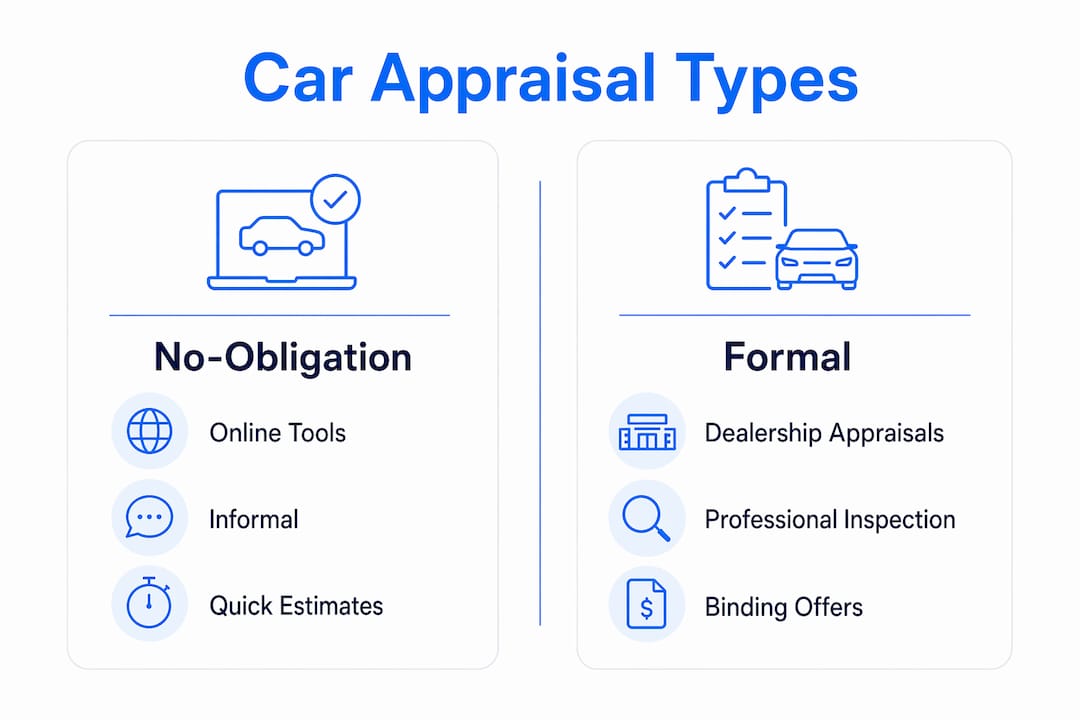
Dealership appraisals
When you bring your car to a dealership, a buyer physically inspects it and generates an offer. This is still typically free, but the offer is shaped by the dealer’s inventory goals. A dealership that already has ten similar trucks on the lot will offer less than one that needs your exact model.

Formal professional appraisals
These are paid evaluations conducted by certified appraisers, often following USPAP standards. A professional appraisal runs $100 or more and produces a legally defensible document. You need this type for insurance claims, divorce proceedings, estate settlements, or any situation where an unbiased third party must certify value.
Which type fits your situation:
- Selling your car quickly: informal no-obligation appraisal
- Comparing market value before negotiating: online self-assessment
- Legal, insurance, or estate purposes: formal professional appraisal
- Trading in at a dealership: dealership appraisal
Pro Tip: Run an online self-assessment before your dealership visit. Walking in with a Kelley Blue Book range gives you a reference point and makes it harder for a buyer to lowball you.
How does the no-obligation appraisal process work, step by step?
The process is straightforward, but knowing each stage helps you prepare and avoid surprises.
-
Enter your vehicle details online. Start with your VIN or license plate, then add mileage, trim level, condition, and any known damage. The more accurate your input, the closer the estimate will be to your final offer.
-
Receive your preliminary estimate. The platform generates an offer based on your inputs and current market data. This number is a starting point, not a guarantee.
-
Review and decide whether to proceed. You can stop here. If the estimate looks reasonable, move to the next step.
-
Schedule or attend a physical inspection. A buyer or appraiser examines the car in person to verify your reported condition. This step typically takes about 30 minutes at a dealership or can be done at home with some services.
-
Receive your final offer. If the inspection matches your description, the offer holds. Discrepancies, such as undisclosed damage or aftermarket modifications, can reduce the final payout.
-
Compare offers before the window closes. Most offers are valid for 3–7 days. Use that window to get a second or third quote from other buyers.
-
Accept, decline, or negotiate. You are never locked in. Accept the best offer, walk away, or use competing quotes as leverage.
For a full walkthrough of what to bring and what to expect, the car selling process guide at Sellkamocars covers each stage in detail.
What factors actually determine your car’s appraisal value?
Appraisers do not pull a number from thin air. Several concrete factors drive the estimate, and understanding them helps you predict where your offer will land.
Vehicle-specific factors:
- Make, model, and year: Some brands and model years hold value better than others. A well-regarded trim from a popular brand will consistently outperform a comparable vehicle from a less desirable one.
- Mileage: Lower mileage generally means higher value, though condition often matters as much as the odometer reading.
- Condition: Paint, interior wear, mechanical health, and tire condition all factor in. Buyers assess these during the physical inspection.
- Accident and repair history: A clean vehicle history report from a source like the National Motor Vehicle Title Information System strengthens your appraisal. Undisclosed accidents discovered at inspection will drop your offer.
- Title status: A clean title is worth more than a salvage or rebuilt title, sometimes by thousands of dollars.
External market factors:
- Local demand: A pickup truck commands a premium in rural markets. A fuel-efficient compact does better in urban areas with high gas prices.
- Seasonal trends: Convertibles sell for more in spring. Four-wheel-drive vehicles spike in value heading into winter.
- Economic conditions: Interest rates, fuel prices, and used-car inventory levels all shift what buyers will pay on any given day.
Honest reporting ties all of this together. Accurate self-reporting keeps your initial estimate close to your final offer and prevents the frustrating experience of watching your number drop at inspection. For a deeper look at how condition specifically affects what dealers will pay, the car condition guide at Sellkamocars breaks it down by category.
How does a no-obligation appraisal differ from a formal professional appraisal?
The gap between these two is wider than most sellers realize, and confusing them leads to real problems.
A no-obligation appraisal is a market-based purchase offer. The entity making the offer, whether a dealership or an online buying service, wants to acquire your car at a price that works for their inventory and resale margin. The estimate is free, fast, and useful for sellers who want to know what the market will pay right now. It is not a neutral, third-party assessment of value.
A formal professional appraisal is something different entirely. Certified appraisers operate under USPAP standards, which require impartiality, documented methodology, and a defensible conclusion. These appraisals cost $100 or more and carry legal weight in court, with insurance companies, and in estate proceedings. A professional appraisal is the right tool when you need an unbiased expert opinion, not a purchase offer.
A no-obligation appraisal quote is a starting benchmark, not a guaranteed sale price. Consumers should treat it as a preliminary figure subject to verification during physical inspection. The final offer depends on whether the car’s actual condition matches what was reported online.
The most common misconception sellers carry into the process is that the online estimate is the number they will receive at closing. It rarely is, unless the car’s condition matches the description exactly. Treat the initial figure as a range, not a contract.
What are the advantages and limitations of no-obligation car appraisals?
No-obligation appraisals are genuinely useful tools, but they have real limits worth knowing before you rely on one.
Advantages:
- Zero cost. You pay nothing to find out what your car is worth in the current market.
- No pressure. The non-binding nature means you can gather multiple offers without committing to any of them.
- Speed. Online estimates take minutes. Even the full process, including inspection, can wrap up in a single day.
- Market accuracy. Offers from reputable buying services reflect real-time demand, not stale book values.
- Comparison power. Getting two or three no-obligation quotes gives you negotiating leverage and a clearer picture of true market value. Sellers who evaluate multiple cash offers consistently land better outcomes than those who accept the first number they see.
Limitations:
- Not legally binding. A no-obligation appraisal cannot be used in court, for insurance claims, or in estate disputes.
- Offer adjustments are common. If your car has undisclosed damage or modifications, the final offer will drop after inspection.
- Dealer interest shapes the number. The appraising party has a financial stake in the transaction. Their offer reflects what they need, not just what your car is worth.
- Limited validity. Most offers expire within 3–7 days, so you need to move quickly if you plan to act on one.
- Online estimates vary. Different platforms use different data sources, so two online estimates for the same car can differ by hundreds of dollars.
For sellers exploring cash sale options in other markets, a cash-for-car guide covering the Calgary area walks through a similar appraisal and pickup process worth reviewing for comparison.
How do you evaluate whether an appraisal source is credible?
Not every platform offering a free car appraisal deserves your trust. Here is how to separate reliable sources from ones that will waste your time.
Check for registered business status. A credible appraisal source operates as a registered business with a verifiable address and contact information. Anonymous online forms with no business identity behind them offer no accountability if something goes wrong.
Look at the valuation methodology. Reputable services use independent or third-party valuation data. Some platforms partner with independent valuation services specifically to remove dealer bias from the equation, which means the offer reflects fair market value rather than inventory pressure.
Read the terms around offer validity and inspection. A trustworthy source clearly states how long the offer is valid, what triggers an adjustment, and what happens if the inspection reveals discrepancies. Vague terms around these points are a warning sign.
Verify transaction history and reviews. Volume matters. A service with hundreds of completed transactions and documented customer ratings has a track record you can assess. A new or unverified platform has none.
Understand who is making the offer. Some online platforms connect you with a network of dealers, while others buy directly. Knowing which model you are dealing with tells you whose interests the appraisal serves. Direct buyers tend to offer more consistent pricing because there is no middleman adjusting the number.
Sellkamocars operates as a registered business with over 500 completed transactions, offers based on current market data, and handles payment within 24 hours. That combination of accountability, speed, and transparency is the standard worth measuring any appraisal source against.
Key Takeaways
A no-obligation car appraisal gives you a free, non-binding market value estimate with no requirement to sell, making it the most practical first step for any car owner considering a sale.
| Point | Details |
|---|---|
| Free and non-binding | No-obligation appraisals cost nothing and carry no requirement to sell or buy. |
| Inspection verifies the estimate | Physical inspections, typically about 30 minutes, confirm condition and finalize the offer. |
| Offers expire within a limited time window, usually a few days. | Use the validity window to compare multiple quotes before committing. |
| Honest reporting protects your offer | Undisclosed damage found at inspection will reduce the final payout from the initial estimate. |
| Formal appraisals serve different needs | USPAP-compliant professional appraisals typically cost $100 or more and are required for legal or insurance purposes. |
Recommended
Get a real cash offer in 2 minutes
Trusted business. Fair price. Paid on the spot when we pick up your car.