
What Does Dealer Wholesale Value Mean for Sellers?
Discover what dealer wholesale value means for sellers. Learn how it impacts trade-ins, offers, and your vehicle's true worth today!
What Does Dealer Wholesale Value Mean for Sellers?
Dealer wholesale value is the price a licensed dealer would pay to acquire a vehicle — typically at auction or through a manufacturer invoice — and it sets the industry’s floor for trade-ins, insurance totals, and every offer you’ll receive. When a dealer hands you a trade-in number that feels insultingly low, wholesale value is usually the reason. It’s not a negotiating trick; it’s the dealer’s actual cost anchor.
Three sources you’ll encounter most often when this number comes up:
- Manheim Market Report (MMR): The dominant dealer-only auction data feed, updated in near real time based on actual transactions.
- Kelley Blue Book (KBB): Publishes both trade-in and wholesale indicators that consumers can access.
- Carfax: Provides vehicle history and wholesale value context, particularly useful when evaluating condition-adjusted pricing.
Table of Contents
- What does dealer wholesale value mean and how does it work?
- What factors push your vehicle’s wholesale value up or down?
- How does wholesale value compare to trade-in, private-party, and retail?
- Where can you find wholesale value data in the U.S.?
- How you can use wholesale value when selling or buying
- What’s the typical gap between wholesale and retail?
- Is buying at wholesale actually a good idea?
- Next steps to put this knowledge to work
- Key Takeaways
- Wholesale value is a tool, not a verdict
- Useful sources
What does dealer wholesale value mean and how does it work?
Wholesale value is the amount a dealer paid — or would pay — to buy a vehicle at a used-car auction, and it functions as the baseline for every pricing decision that follows. Carfax describes it as the acquisition cost dealers use when deciding what to offer on a trade-in or what to bid at auction. Edmunds frames it as the dealer’s rock-bottom figure — the price below which selling the car makes no financial sense.
Here’s how the math works in practice. Before bidding at auction, a disciplined dealer calculates a “buy-bid” limit: projected retail price minus reconditioning costs, transport fees, lot overhead, and a target profit margin. That ceiling is the wholesale number. Dealers rarely exceed it, even under auction pressure, because doing so compresses or eliminates margin.
Wholesale price is not a consumer metric. It’s an internal cost anchor that dealers use to decide whether a vehicle is worth acquiring at all — and at what price they can afford to buy it.
For new vehicles, the equivalent concept is the manufacturer’s invoice price, which represents what the dealer paid the factory. Wholesale and invoice serve the same function: they define the floor below which the dealer loses money on the transaction.
What factors push your vehicle’s wholesale value up or down?
Condition and mileage are the two biggest levers, but several other variables move the number significantly. Understanding them helps you focus on what you can actually control before selling.
Vehicle-specific factors:
- Title status: A salvage or rebuilt title can cut wholesale value by a third or more compared to a clean-title equivalent. How car condition affects dealer offers explains the specific deductions dealers apply.
Market and timing factors:
- Seasonal demand: Trucks and SUVs spike in late fall and winter; convertibles peak in spring. Timing your sale around these cycles can meaningfully improve the number you receive.
Pro Tip: Before you get a trade-in quote, pull a free KBB trade-in estimate and note the condition range. That spread between “fair” and “good” condition is roughly what dealers are calculating when they set their buy-bid.
How does wholesale value compare to trade-in, private-party, and retail?
These four values are often confused, but they represent distinct points on the same pricing ladder. Wholesale sits at the bottom; retail sits at the top.
| Value type | Who sets it | Typical position | What it includes |
|---|---|---|---|
| Wholesale | Auction market / dealer buy-bid | Lowest tier | Raw acquisition cost, no reconditioning |
| Trade-in | Dealer offer to consumer | Between wholesale and private-party | Slight premium over wholesale for convenience |
| Private-party | Negotiated between individuals | Below retail | No dealer overhead, but seller absorbs time and risk |
| Retail | Dealer asking price | Highest tier | Reconditioning, warranty, overhead, profit margin |
A concrete example makes the spread clear. A vehicle that sells at auction for $15,000 might appear on a retail lot priced at $19,000–$20,000 after the dealer adds reconditioning, transport, advertising, and margin. The trade-in offer for that same car from a dealer would typically land somewhere between the $15,000 wholesale floor and the private-party value. Wholesale value helps explain why trade-in offers consistently look lower than what you’d get selling privately.
Understanding these value tiers in detail is the single most useful thing you can do before walking into any negotiation.
Where can you find wholesale value data in the U.S.?
No single source owns the definitive wholesale number, but several tools give you a reliable range.
Dealer-facing (closest to true wholesale):
- ACV Auctions: A digital dealer-to-dealer auction platform that publishes a public glossary and provides real-time wholesale transaction data to participating dealers.
Consumer-accessible (translated wholesale indicators):
- Kelley Blue Book: KBB’s trade-in tool gives consumers a range that approximates dealer wholesale, though it’s calibrated for consumer use rather than auction floors.
- Carfax: Useful for condition-adjusted wholesale context and vehicle history, which directly affects what any auction buyer would bid.
Auction-focused platforms and dealer-facing tools like Manheim/MMR and Black Book are where wholesale moves in near real time. Consumer-facing sites like KBB and Carfax translate that data into accessible trade-in and private-party estimates — useful anchors, but not the raw auction floor.
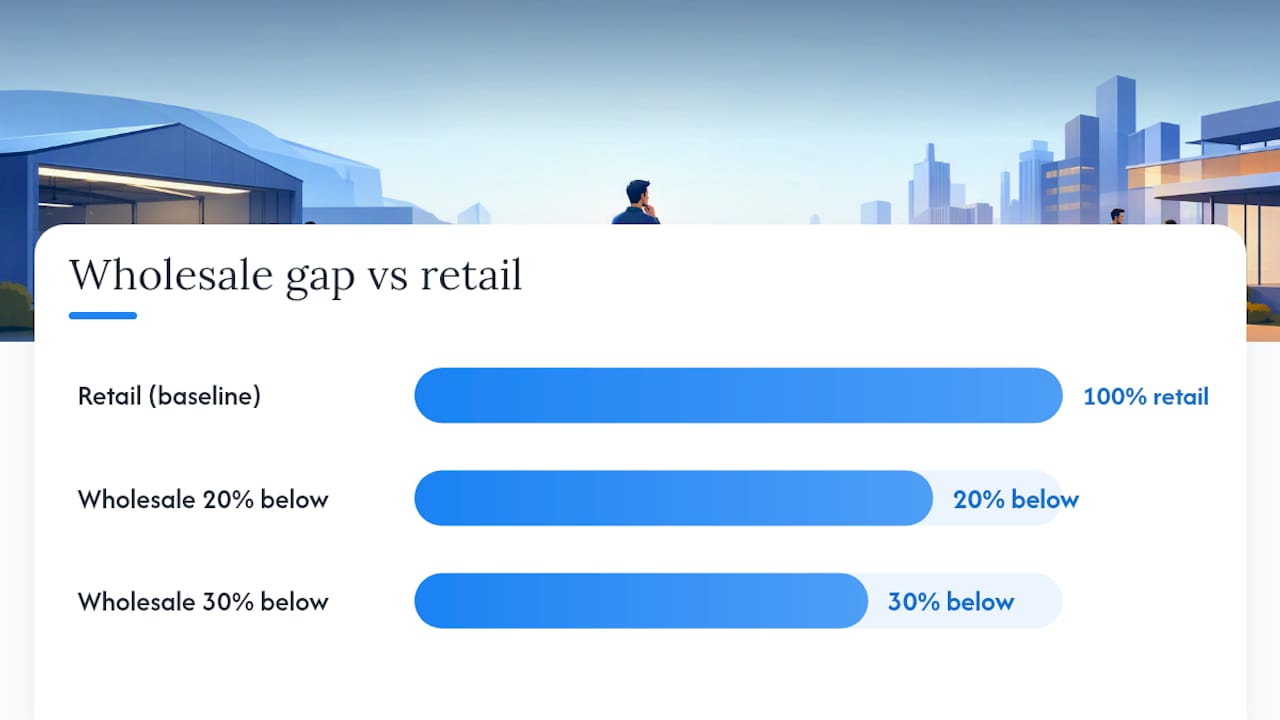
The practical takeaway: LegalClarity notes that wholesale typically sits 20%–30% below retail, reflecting auction-level pricing without reconditioning or dealer overhead. Use that range as a sanity check when comparing sources.
How you can use wholesale value when selling or buying
Knowing the number is only useful if you act on it. Here’s how to put it to work on both sides of a transaction.
If you’re selling:
- Pull KBB’s trade-in estimate and NADA’s clean trade value to establish your wholesale floor before any dealer conversation.
- Gather service records and recent maintenance receipts. Documented history reduces a dealer’s perceived reconditioning risk and can lift their buy-bid.
- Get at least three offers: a dealer trade-in, a private-party listing estimate, and an instant online buyer quote. Comparing multiple offers against your wholesale anchor shows you exactly how much each channel is paying above the floor.
- Time your sale to seasonal demand peaks where possible — trucks in fall, convertibles in spring.
If you’re buying:
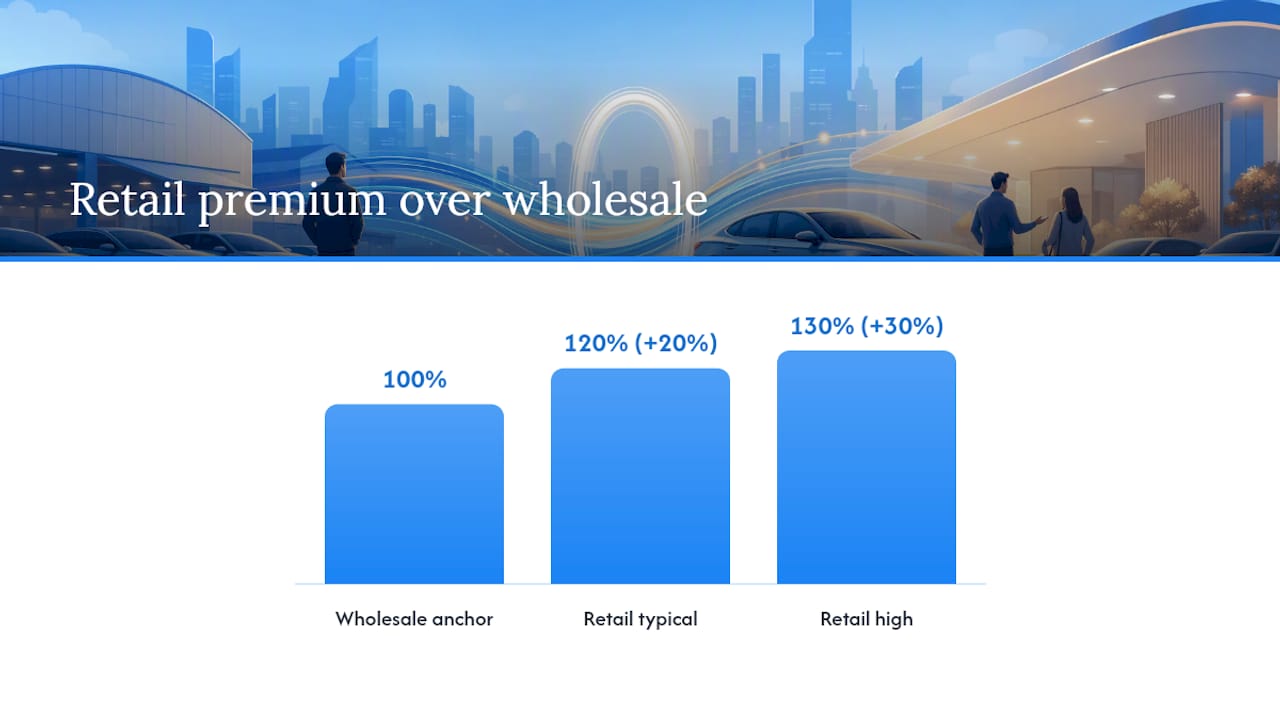
- Use the wholesale anchor to evaluate whether a dealer’s asking price is reasonable. A retail price 20%–30% above a known wholesale comparable is normal; significantly higher gaps may signal a high-demand model or an overpriced unit.
- Request a vehicle history report through Carfax or a similar provider. Auction history, prior damage, and title status all affect what the vehicle was worth at wholesale and what it should cost you at retail.
- Print comparable auction sales or MMR data if you can access it. Walking in with documented wholesale comparables shifts the negotiation dynamic.
Pro Tip: Private sellers often misread consumer-facing retail guides when setting their asking price. If you’re buying from a private seller, referencing KBB’s trade-in range (not the private-party range) gives you a more realistic wholesale-anchored starting point for negotiation.
What’s the typical gap between wholesale and retail?
The spread between what a dealer pays and what you pay at retail covers several real costs, not just profit.
| Cost component | Typical range | Notes |
|---|---|---|
| Reconditioning | — | Varies widely by vehicle age and condition |
| Transportation / auction fees | — | Depends on distance and auction platform |
| Lot time and carrying costs | — | Longer inventory time increases cost |
| Advertising and sales overhead | — | Varies by dealership size and market |
| Dealer profit margin | Variable | Compressed on high-demand units, wider on slow movers |
Industry references, including LegalClarity’s wholesale explainer, consistently cite a 20%–30% retail markup above wholesale as the typical range. That spread narrows on high-demand models and widens on slow-moving units, salvage-title vehicles, or models with high reconditioning needs.
Edmunds explains that retail is primarily an asking price, while wholesale is the dealer’s cost floor. The gap between them is not negotiable in the sense that dealers genuinely need it to cover overhead. What is negotiable is how much of that spread you absorb as the buyer.
Understanding why dealers lowball trade-in valuations gives you a clearer picture of the specific math behind low offers.
Is buying at wholesale actually a good idea?
Access to wholesale pricing sounds like a win, but it comes with real trade-offs.
Potential advantages:
- Lower acquisition price, sometimes significantly below retail.
- Opportunity to buy, recondition, and resell at a profit if you have the skills and budget.
- Occasional access to rare trims or low-production models that don’t reach retail lots.
Real risks:
- Most wholesale channels (dealer auctions, salvage auctions) are not open to the general public. Dealer licenses are required.
- Vehicles sold at wholesale typically carry no warranty and limited consumer protections.
- Unknown repair costs can eliminate the price advantage quickly. A $14,000 wholesale unit with $3,500 in deferred maintenance is not a deal.
- Title issues (salvage, rebuilt, flood) are common in wholesale inventory and can affect insurability and resale value.
Practical cautions if you do pursue wholesale-adjacent channels:
- Always get an independent pre-purchase inspection from a mechanic you trust.
- Pull a Carfax or AutoCheck report before committing.
- Budget a realistic reconditioning reserve — not a best-case estimate.
- Understand that wholesaler and retail dealer business models differ in ways that affect buyer protections and pricing transparency.
Next steps to put this knowledge to work
You now have the framework. Here’s how to act on it quickly:
- Get a wholesale anchor estimate — Pull KBB’s trade-in range and NADA’s clean trade value for your specific year, make, model, trim, and mileage. These are your floor references.
- Check the vehicle history — Whether buying or selling, a Carfax report surfaces title issues, accident history, and prior auction activity that directly affect wholesale value.
For sellers ready to skip the dealership entirely, Sellkamocars provides instant cash offers based on current market data, with free pickup and payment within 24 hours.
Key Takeaways
Dealer wholesale value is the industry’s cost floor — knowing it lets you evaluate every offer, trade-in, and insurance total with clear eyes.
| Point | Details |
|---|---|
| Wholesale is the dealer’s cost floor | It’s what dealers pay at auction or invoice, not a consumer-facing price. |
| Typical retail markup is 20%–30% | That spread covers reconditioning, overhead, and profit. |
| Use multiple sources as anchors | Manheim/MMR, Black Book, KBB, NADA, and Carfax each reflect wholesale differently; cross-reference them. |
| Condition and title status move the number most | A salvage title or deferred maintenance can cut wholesale value sharply relative to a clean comparable. |
| Get multiple offers before deciding | Comparing dealer trade-in, private-party, and instant buyer quotes against your wholesale floor shows you the true spread. |
Wholesale value is a tool, not a verdict
Most people treat wholesale value as the number they’re stuck with. That’s the wrong frame. Wholesale is a starting point — the dealer’s cost anchor — and understanding it shifts you from a passive recipient of offers to an informed negotiator.
What often gets missed: the gap between wholesale and retail isn’t arbitrary. It reflects real costs that dealers incur. Attacking that spread aggressively in a negotiation rarely works. What does work is using wholesale data to identify when a dealer’s offer is genuinely below market versus when it’s a fair reflection of your vehicle’s condition and demand. Those are two very different situations, and conflating them is where most sellers lose leverage.
The smarter move is to combine a wholesale anchor with condition-based evidence: service records, clean title, low mileage, and comparable auction sales. That combination gives you a defensible position, not just a number to argue about.
Useful sources
The following tools and guides were referenced throughout this article. Each serves a distinct role depending on whether you need dealer-facing auction data or consumer-accessible estimates.
- Asking, Trade-In, Wholesale: Pricing Basics for Used-Car Buying
- Wholesale Car Value: What It Is and How It Works - LegalClarity
- What Is Wholesale Value?
- What Is Wholesale Value? — Kelley Blue Book
- What Is Wholesale Value? | ACV Auctions glossary
- Wholesale Car Price: Trade-In & Wholesale Value Tips
- Auto Wholesaler vs Auto Dealers - AFC
Recommended
Get a real cash offer in 2 minutes
Trusted business. Fair price. Paid on the spot when we pick up your car.