
Types of Fair Car Valuations: A Seller's Guide
Discover the types of fair car valuations to maximize your sale. This guide helps sellers understand valuation methods and get the best price.
Types of Fair Car Valuations: A Seller’s Guide

Fair Market Value (FMV) is defined as the price an informed, unpressured buyer pays an informed, unpressured seller in an open market, and it serves as the core benchmark for all types of fair car valuations. Sellers who understand the full range of car valuation methods, from trade-in value to private party value to dealer retail, consistently make better decisions and walk away with more money. The difference between these values can run into thousands of dollars on the same vehicle. This guide breaks down each valuation type, explains when to use it, and shows you how to get fair car value online before you accept any offer.
1. What is Fair Market Value, and why does it matter?
Fair Market Value is the foundation of every car pricing conversation. FMV represents the price between two informed, unpressured parties in an open market, making it the most neutral and widely accepted standard for private sales and insurance settlements.
The market hierarchy for vehicle values ranks as follows:
- Retail Value (highest): what a dealer charges buyers on the lot
- Private Party Value: what sellers earn in a direct sale to another individual
- Trade-In Value: what a dealer offers when you trade toward another vehicle
- Wholesale/Auction Value: what dealers pay at auction
- Salvage Value (lowest): what a totaled or heavily damaged vehicle fetches
FMV typically sits between private party value and trade-in value. Insurance companies use FMV when settling total-loss claims, so knowing it protects you in both selling and insurance contexts.
The sales comparison approach is the most common method for calculating FMV. It compares your vehicle to similar recently sold vehicles and adjusts for mileage, condition, and factory options. This approach forms the basis of most online valuation tools.
Pro Tip: When researching FMV, always filter results by your local market. A vehicle priced at $18,000 in one city may be worth $19,500 in another due to regional demand.
2. Trade-in value: how dealers price your vehicle
Trade-in value is the amount a dealer offers you toward the purchase of another vehicle. It is consistently the lowest among common value types because dealers must account for reconditioning, overhead, and profit margin before reselling your car.
Factors that reduce trade-in value include:
- Reconditioning costs: dealers budget for detailing, mechanical repairs, and safety inspections
- Overhead: lot fees, staff, and financing costs all come out of their margin
- Profit target: dealers need room to make money when they resell your vehicle
- Market risk: they carry the vehicle on their lot until it sells
The convenience of a trade-in is real. You avoid listing your car, managing buyer inquiries, and handling paperwork. But that convenience has a price, and it usually comes directly out of your pocket.
Most consumers confuse trade-in value with private party value and feel shortchanged when a dealer’s offer comes in low. The offer is not arbitrary. It reflects the dealer’s cost structure, not a judgment of your car’s worth.
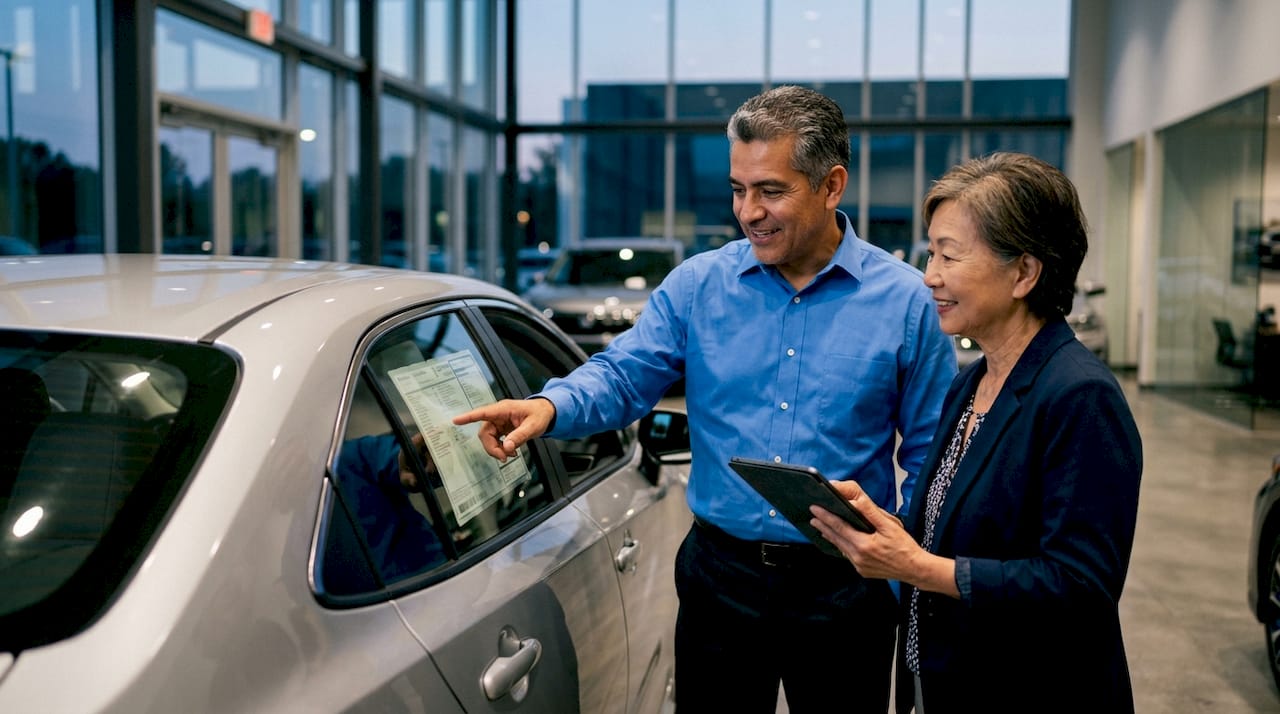
Pro Tip: Get an instant cash offer from a registered car-buying service before you walk into any dealership. Instant cash offers are typically valid for about 7 days and give you a guaranteed floor price to use as leverage in trade-in negotiations.
3. Private party sale value: maximizing what you get
Private party sale value is the price you negotiate directly with another individual buyer, with no dealer in the middle. Private sales typically net 10–20% more than a dealer trade-in, making this the highest realistic value most sellers can achieve for a standard used vehicle.
The tradeoff is effort. Private sales require you to:
- Set a competitive asking price using current market data
- Write and post a detailed listing with quality photos
- Screen buyer inquiries and schedule test drives
- Handle title transfer, bill of sale, and any lien releases
- Manage the risk of no-shows, lowball offers, and payment disputes
Pricing correctly is the most critical step. Set your price too high and the listing goes stale. Set it too low and you leave money on the table. Use a free car value tool to anchor your asking price to real market data before you list.
Condition, mileage, and unique features all move your private party price up or down. A one-owner vehicle with full service records and low mileage commands a premium. Highlight these details in your listing. Buyers pay more when they feel confident about what they are buying.
4. Dealer retail value and other valuation methods
Dealer retail value is the asking price a dealership puts on a used vehicle sitting on its lot. It includes overhead and profit margin and sits above FMV. This is the number you see on window stickers, not a number you should expect to receive when selling.
Understanding dealer retail value matters because it sets the ceiling for what buyers in your market are willing to pay. If a dealer is asking $22,000 for a comparable vehicle, your private party price of $19,500 looks attractive to buyers who want to skip the dealership.
Beyond the four common value types, two specialized methods apply to specific vehicle categories:
- Cost approach: calculates replacement cost new minus depreciation. Used primarily for custom or antique vehicles where comparable sales data is limited.
- Income approach: values a vehicle based on its earning potential. Applied mainly to commercial vehicles and fleet units where revenue generation is the primary use case.
Auction value is a fourth category worth knowing. It is the wholesale price dealers pay when buying vehicles at auction. Auction value sits below trade-in value and is rarely relevant to private sellers, but it explains why dealer offers feel so low. Dealers often buy at auction for less than they would offer you in a trade-in.
5. How to get fair car value online: tools and tips
Getting an accurate online valuation starts with your VIN. VIN-based valuations are more accurate than Year/Make/Model lookups because they capture your vehicle’s specific trim level, factory-installed options, and packages. The price difference between a base trim and a fully loaded version of the same model can reach several thousand dollars.
Common mistakes sellers make when using online tools:
- Confusing value types: a tool showing “trade-in value” is not showing what you can earn in a private sale
- Ignoring condition adjustments: selecting “good” when your vehicle is “excellent” understates your car’s value
- Using national averages: regional demand matters more than national data for your actual sale
Regional factors like seasonality and local inventory can cause the same vehicle’s valuation to vary by $500 to $1,500 across different markets. A truck sells for more in a rural market than in a dense urban center. A convertible peaks in value in spring, not october.
Pro Tip: Run valuations on at least two independent tools and compare the results. If the numbers diverge significantly, dig into the condition inputs and regional settings. Discrepancies usually trace back to trim level or condition mismatches.
Use the Sellkamocars free Alberta car value tool to get a market-based estimate before you commit to any selling channel. Knowing your number before you enter any negotiation is the single most effective way to avoid leaving money on the table.
Key takeaways
The most effective approach to fair car valuations is to identify which value type matches your selling channel, then use VIN-based tools and regional market data to set a price that reflects your vehicle’s actual condition and local demand.
| Point | Details |
|---|---|
| FMV is the core benchmark | Fair Market Value represents the neutral, informed price between unpressured buyers and sellers. |
| Trade-in value is the lowest | Dealer overhead and profit margin reduce trade-in offers below private party and FMV levels. |
| Private sales return the most | Selling directly to a buyer typically nets 10–20% more than a dealer trade-in offer. |
| VIN beats Year/Make/Model | VIN-based lookups capture trim and options, delivering far more accurate valuations. |
| Regional data changes everything | The same vehicle can vary by $500 to $1,500 in value depending on local market conditions. |
What I’ve learned about valuation types after hundreds of car sales
Most sellers walk into the process thinking there is one number: what their car is worth. The reality is that your car has at least four different values simultaneously, and each one is correct in its own context. The trade-in offer is not wrong. It is just the wrong number for the wrong channel.
The sellers who get the best outcomes are the ones who treat valuation as a negotiation tool, not a fixed answer. They get an instant cash offer first. That number becomes their floor. Then they decide whether the extra effort of a private sale is worth the potential upside. For a $10,000 vehicle, a 15% premium means $1,500 more in your pocket. That math is worth knowing before you decide.
The biggest mistake I see is sellers accepting the first offer without knowing what type of value it represents. A dealer quoting trade-in value is not quoting FMV. Those are different numbers, and confusing them costs sellers real money. Check out how private vs. dealer sales compare to see the full breakdown of what each channel actually returns.
My honest advice: spend 20 minutes on valuation research before you talk to anyone. Run a VIN lookup, check regional pricing, and get at least one instant cash offer. You will walk into every conversation knowing exactly where you stand.
— Omar
Sellkamocars makes fair car pricing straightforward
Knowing your car’s value is the first step. Acting on it quickly is the second. Sellkamocars provides instant cash offers based on current market data, so you get a fair price without the back-and-forth of traditional dealership negotiations.
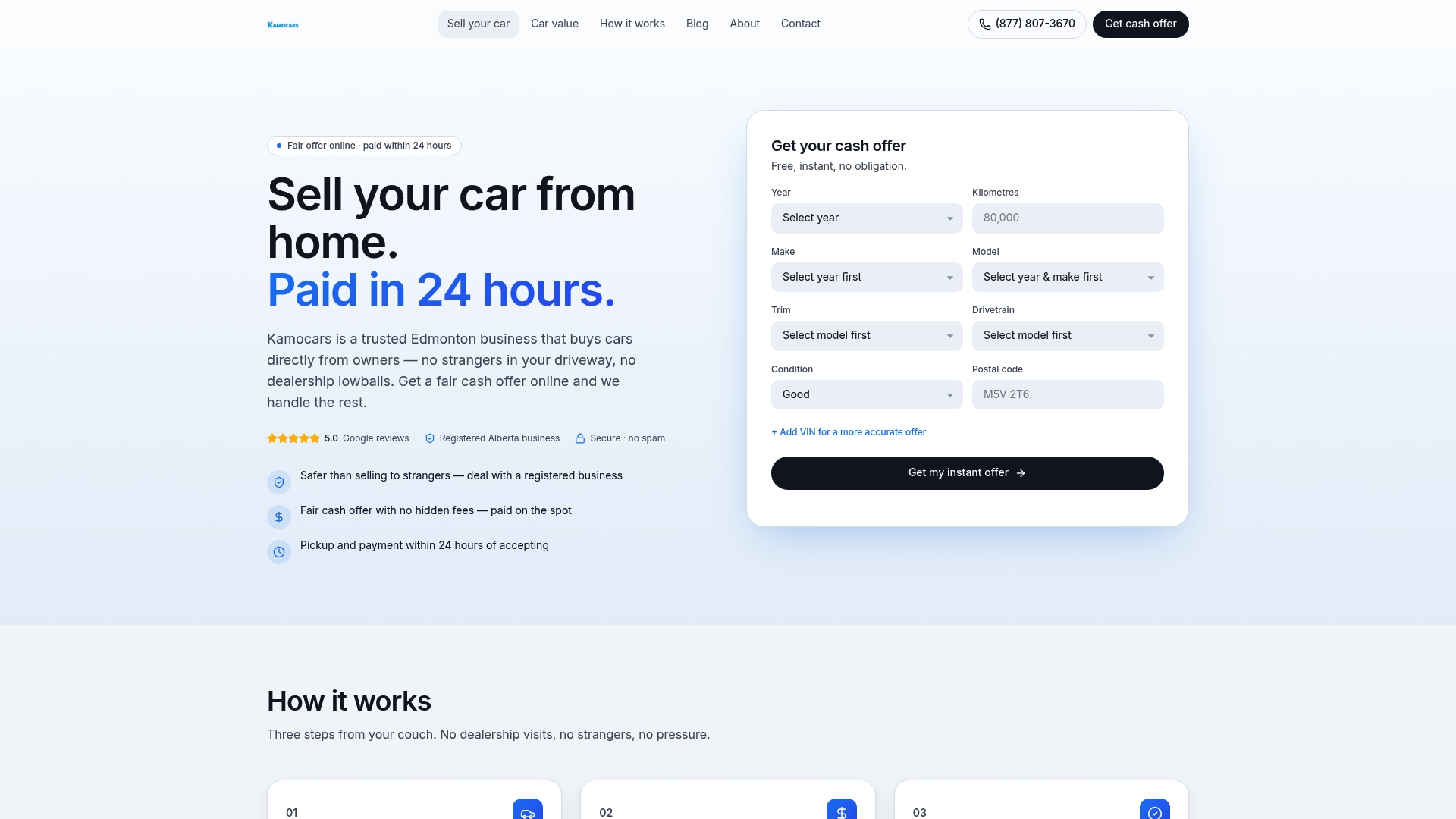
The process is built for sellers who want speed and transparency. Submit your vehicle details, receive a fair cash offer, and get paid within 24 hours with free pickup included. Sellkamocars has completed over 500 transactions as a registered business in Edmonton, giving sellers the security that informal platforms cannot match. Sell your car online and see how straightforward a fair sale can be. You can also review the full how it works process before you commit to anything.
FAQ
What is the difference between FMV and trade-in value?
Fair Market Value is the neutral price between informed, unpressured buyers and sellers in an open market. Trade-in value is lower because it reflects dealer overhead, reconditioning costs, and profit margin.
How much more can I get from a private sale vs. a dealer trade-in?
Private party sales typically return 10–20% more than a dealer trade-in offer. The exact difference depends on your vehicle’s condition, mileage, and local market demand.
Why does my car’s value vary between online tools?
Different tools use different value types, condition inputs, and regional data sets. Always confirm whether a tool is showing trade-in, private party, or retail value, and use your VIN for the most accurate result.
How do regional factors affect my car’s value?
Seasonality and local inventory can shift the same vehicle’s value by $500 to $1,500 between markets. Trucks command higher prices in rural areas, and convertibles peak in spring.
What is the fastest way to establish a fair selling price?
Get a VIN-based online valuation, then request an instant cash offer from a registered car-buying service. The cash offer sets your floor price and gives you a concrete benchmark for any negotiation.
Recommended
Get a real cash offer in 2 minutes
Trusted business. Fair price. Paid on the spot when we pick up your car.