
Sell Smarter: Tesla Resale in Canada 2026, Battery Health & FSD
2026 snapshot of Tesla resale in Canada: which models hold value, why battery health and FSD change offers, and how Alberta sellers get fast cash.
Sell Smarter: Tesla Resale in Canada 2026, Battery Health & FSD
Short answer: used Tesla prices in Canada have largely stabilized in 2026 after two rough years of price cuts, and the Model 3 and Model Y remain the strongest resale performers on the road. If you need cash now and your battery health and FSD status check out, listing today makes sense. If you’re not in a rush and your warranty still has runway, holding through the year is the smarter play.
TL;DR:
- The resale value of used Tesla Model 3 and Model Y remains strong in Canada 2026, supported by their efficiency, lower repair costs, and demand.
- Documented battery health above 90%, FSD and hardware status, and winter-ready features significantly boost the vehicle’s valuation.
- Market demand has stabilized with prices rising month-over-month in early 2026, especially in provinces like Quebec and British Columbia with strong EV incentives.
- Selling early in 2026 is advised if your warranty is expiring soon, as prices tend to be firmer and buyer confidence higher at this time.
- Using a professional battery report and FSD documentation before listing can maximize offers, with private sales yielding the highest net proceeds.
Table of Contents
- Best Used Tesla Models In Canada 2026: A Practical Ranking
- What Actually Moves Tesla Resale Value In Canada
- How To Check And Document Your Tesla Before Listing
- Private Sale, Trade-In, Or Direct-Buy: Choosing Your Selling Route
- Tesla Resale In Canada: 2026 Market Snapshot
- Typical Price Ranges For 2021 To 2024 Tesla Models
- How Tesla Resale Value Varies Across Canadian Provinces
- Costs And Fees When Selling A Tesla In Canada
- How Incentives And Policy Changes Affect Used Tesla Pricing
- Preparing Your Tesla For Sale: What Actually Moves The Needle
- Best Time To Sell Your Tesla In 2026
- What We’re Seeing On The Ground In Alberta
- Sell Your Tesla Fast With Kamocars
- Sources
Best Used Tesla Models In Canada 2026: A Practical Ranking
Not every Tesla holds its ground the same way once it leaves the factory. If you’re deciding what to buy or gauging what your own car might fetch, the pecking order in 2026 looks fairly consistent across the used market.
Model 3 sits at the top for a reason. It’s the cheapest to insure, the cheapest to repair thanks to parts commonality across trims, and the most efficient in cold Canadian winters, especially versions with the heat pump introduced in the 2021 refresh. Buyers shopping used EVs gravitate toward it first, which keeps demand steady.
Model Y runs a close second and, in some Canadian cities, actually edges ahead because it’s a crossover in a market that overwhelmingly prefers crossovers. Cargo space, all-wheel drive as standard on most trims, and the same efficient drivetrain as the Model 3 make it the practical family choice.
Model S and Model X depreciate faster in relative terms. They cost more new, which means a bigger dollar drop even if the percentage decline is similar, and parts/service costs run higher outside major metro service centers.
For model years, here’s what tends to move fastest:
- 2021 to 2023 Model 3 and Model Y hit the sweet spot: heat pump included, updated hardware, and enough age that pricing has come down from new without excessive mileage.
- Long Range trims consistently outsell Standard Range on the used market because Canadian winters cut real-world range noticeably.
- FSD attached to the VIN (not just purchased separately) adds real resale premium, since transferable FSD licenses have become a scarce asset in 2026 after Tesla tightened transfer rules.
- Hardware version (HW3 vs HW4) matters more now than it did two years ago, since buyers researching resale value ask about it directly.
What Actually Moves Tesla Resale Value In Canada
Battery health is the single biggest lever on your final offer, full stop. Buyers, and especially specialist EV buyers, now ask for a battery report before making an offer.
Here’s what tends to carry the most weight during a valuation:
- Battery state-of-health, verified through a third-party report rather than the dashboard’s rough estimate.
- Software and FSD status, tied permanently to the VIN and visible in the Tesla account.
- Mileage and how it was accumulated (highway commuting ages a battery differently than short city hops).
- Winter-ready extras, like an included heat pump, winter tire package, or all-weather floor mats already installed.
- Provincial rebate context, since a market like Quebec, where Roulez vert has driven strong EV adoption, tends to have deeper used-EV demand than provinces with less rebate history.
The battery warranty (generally 8 years) transfers with the car in Canada, and that transferability is a meaningful trust signal buyers factor into their offer. A Tesla still inside its battery and drive unit warranty period gives a buyer real protection, and it should show up in your asking price.
By the numbers: Used EV listing prices showed month-over-month gains in early 2026 as demand firmed up following shifts in government credit eligibility, a clear signal the market has stopped its multi-year slide.
How To Check And Document Your Tesla Before Listing
A little prep work before you list changes the offers you get. Here’s the order that works:
- Pull a battery state-of-health report. Request one through a diagnostic tool or an EV-specialist inspection service; anything above roughly 90% health at typical mileage strengthens your negotiating position considerably.
- Document FSD and hardware status. Log into your Tesla account, confirm whether FSD is active and VIN-locked, and note whether you’re running HW3 or HW4.
- Gather service records and charging history. Consistent Supercharger use versus predominantly Level 2 home charging is worth mentioning, since slower charging patterns are generally easier on long-term battery health.
- Handle small fixes first. Fresh tires, chip-free glass, a full interior detail, and a working winter tire set often return more in offer price than they cost to fix.
- Set your number using real comparables. Check VMR Canada’s model-specific values as an institutional baseline, then adjust up or down for your actual battery health and software status before picking a sale channel.
Pro Tip: Screenshot your Tesla app’s battery degradation history and FSD status before you list. Buyers trust a documented screenshot far more than a verbal claim, and it saves you from re-explaining the same details to every inquiry.
Private Sale, Trade-In, Or Direct-Buy: Choosing Your Selling Route
Each route trades off net proceeds against speed and hassle, and the right one depends on how much time and effort you actually want to spend.
- Private sale usually nets the highest sale price, but it demands the most work: photos, listings, test drives with strangers, and buyers who will push hard on price unless you can prove battery health up front.
- Dealer trade-in is the path of least resistance if you’re buying another vehicle at the same time, and in some provinces you only pay sales tax on the price difference, which is worth reading up on before you decide. Offers tend to run conservative, though, since dealers price in their own resale risk.
- Direct-buy services, including Kamocars, sit in between: you get a firm cash number fast, often within 24 hours, and a company that actually understands VIN-tied software and battery health tends to value your Tesla more accurately than a generalist used-car buyer would.
If speed and certainty matter more to you than squeezing out the last dollar, present your battery report and FSD documentation up front. It’s the fastest way to push a direct-buy offer closer to what a private sale might net you, without the weeks of back and forth.
Tesla Resale In Canada: 2026 Market Snapshot
The used Tesla market in Canada has been on a wild ride since 2024, but 2026 is finally settling into something more predictable. Recurrent’s Q3 2026 market data shows month-over-month price gains across several used-EV segments as demand recovered following changes to federal credit eligibility. That’s a meaningful shift from the steep depreciation curves Tesla owners were dealing with through 2024 and into 2025.
New-car pricing context still matters here. CarCostCanada’s 2026 Model Y trim pricing shows where new units land, which sets the ceiling that used pricing works down from. If you’re selling, early 2026 conditions favor you more than late 2025 did. If you’re buying, expect less room to negotiate deep discounts than a year ago.
Typical Price Ranges For 2021 To 2024 Tesla Models
Exact pricing depends heavily on mileage, trim, and battery condition, but here’s a realistic frame for what’s moving in the Canadian market right now.
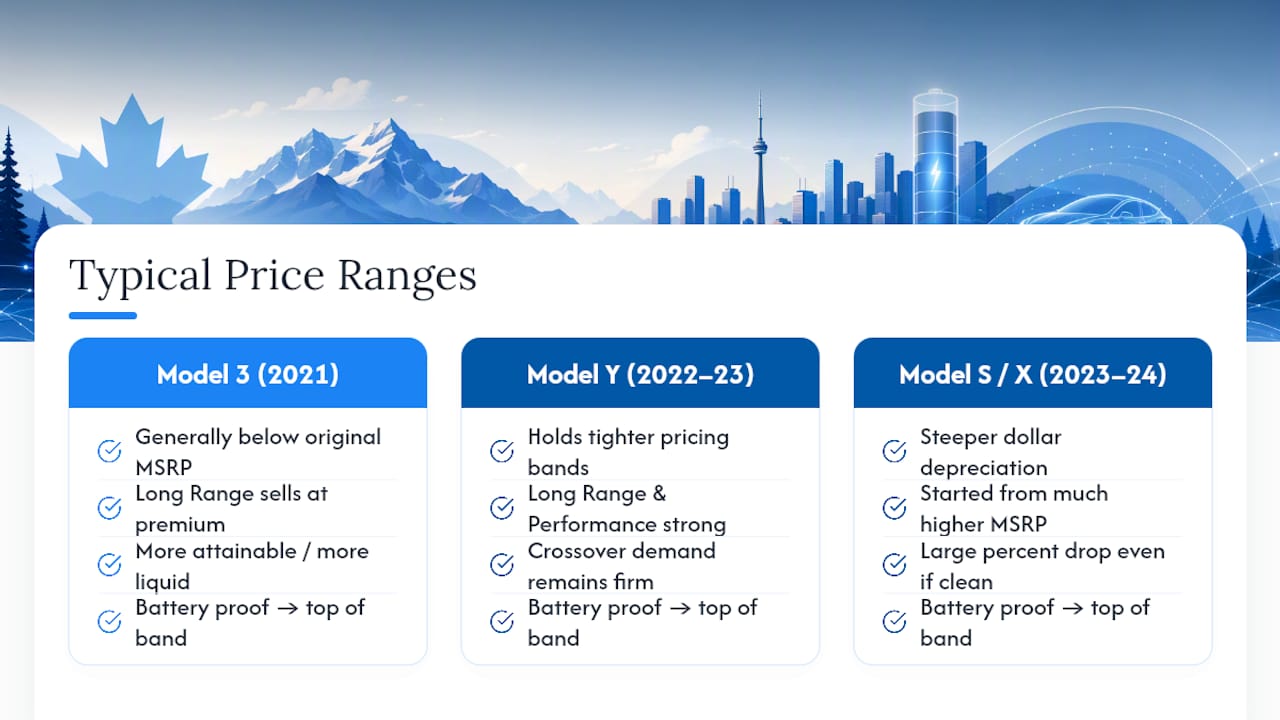
A 2021 Model 3 Standard Range with moderate mileage and a clean battery report is generally trading well below its original MSRP, while a comparable Long Range trim commands a real premium over the Standard Range version, largely because of the range advantage in winter.
2022 and 2023 Model Y units, especially Long Range and Performance trims, tend to hold the tightest pricing bands because demand for the crossover body style hasn’t softened the way sedan demand has in some markets. Driving reinforces that the Model 3 and Model Y consistently rank as the more attainable and more liquid used-EV choices in Canada right now.
2023 to 2024 Model S and Model X units depreciate on a steeper dollar curve simply because they started at a higher price point. A three-year-old Model X can represent a large percentage drop from new, even though the car itself may have low mileage and excellent battery health.
The single biggest swing factor across every model year isn’t the year itself. It’s whether the seller can prove battery health and clean software status, which routinely moves a car from the bottom of its price band to the top.
How Tesla Resale Value Varies Across Canadian Provinces
Where you sell matters almost as much as what you’re selling. Quebec has the deepest used-EV market in the country, driven by years of strong incentive support through Roulez vert, which means Tesla listings there tend to move faster and at firmer prices than in provinces with thinner EV adoption.
British Columbia runs a similar pattern, especially in Vancouver and Victoria, where EV infrastructure is mature and buyers are comfortable with used electric vehicles as a category, not just Teslas specifically.
Alberta tells a different story. EV adoption has grown steadily, but the market is smaller and more price-sensitive, and cold-weather performance questions come up more often in buyer conversations here than in milder provinces. That actually works in favor of well-documented, winter-package-equipped Teslas, since sellers who can prove strong cold-weather range and battery health stand out more clearly in a market where fewer buyers already assume EVs perform well in winter.
Ontario sits in the middle: strong overall demand concentrated in the Greater Toronto Area, with softer pricing the further you get from major population centers. If you’re selling in a smaller city or town anywhere in the country, expect a narrower buyer pool and slightly longer time to sell privately, which is exactly where a direct-buy option starts to look more attractive.
Costs And Fees When Selling A Tesla In Canada
Selling privately isn’t free, even before you account for your time. If you’re registered for GST/HST as a business or sell frequently enough to look like one, tax obligations can apply, but most private individuals selling their own personal vehicle don’t collect sales tax on that transaction. Trading in at a dealership works differently: many provinces let you pay tax only on the price difference between your trade and your new purchase, which can offset a lower trade-in offer.
Beyond tax, budget for a pre-sale inspection if you want to reassure buyers (expect a modest fee at most independent shops), plus the cost of a battery health report if your service center or a third-party diagnostic provider charges for one. Documentation costs are minor: a lien payout letter if you’re still financing, and in most provinces a bill of sale you can draft yourself.
The hidden cost most sellers miss is time. Weeks spent fielding low-ball offers, no-show test drives, and repeated questions about battery health add up, and that time has real value even if it doesn’t show up on a receipt. A direct-buy service eliminates most of that, trading a small amount of top-line price for a fast, fixed number with no back-and-forth.
How Incentives And Policy Changes Affect Used Tesla Pricing
Government incentive programs shape used Tesla demand more than most sellers realize. When a province offers a strong point-of-sale rebate on new EVs, it doesn’t just boost new-car sales. It also increases the pool of drivers already comfortable with EV ownership, which feeds directly into used-market demand a few years later as those early buyers trade up.
Changes to federal credit eligibility rules in Canada have had a visible ripple effect on the used-EV market through 2025 and into 2026, and that shift is part of what’s driving the stabilization Recurrent’s data captures in early 2026. When new-EV incentives tighten, more buyers shift toward used inventory instead, which supports used pricing rather than dragging it down.
The reverse also holds. Provinces that scaled back or paused their EV rebate programs saw softer new-EV demand, and that softness eventually shows up in used pricing too, since fewer new EVs on the road today means a smaller supply of trade-ins feeding the used market five years from now. If you’re timing a sale, pay attention to whether your province’s incentive program is expanding or winding down. It’s a leading indicator for where used demand is heading next.
Preparing Your Tesla For Sale: What Actually Moves The Needle
Detailing your Tesla properly before photos go up isn’t optional if you want top dollar. A clean interior, streak-free glass, and tires with visible tread all signal a well-maintained car before a buyer even asks a question. Buyers assume a dirty car has a neglected battery too, fairly or not, so presentation does real work here.
Small mechanical items matter more than most sellers expect. A cracked windshield, worn wiper blades, or a warning light on the dash, even a minor one, gives a buyer an opening to negotiate down harder than the actual repair cost would justify. Fixing these before listing typically costs far less than the discount a buyer will demand if you leave them for negotiation.
Winter equipment is worth calling out specifically in your listing. A Tesla sold with a proper winter tire set already mounted, or evidence of a working heat pump, removes a question mark that otherwise costs you leverage in Canadian markets. EV battery health checks are increasingly treated as standard pre-sale documentation in used-EV markets broadly, and Canadian buyers are catching up to that expectation fast. Many sellers underprice this step entirely: a battery report plus modest cosmetic prep often returns far more than either costs.
Best Time To Sell Your Tesla In 2026
Timing your sale within 2026 comes down to two things: your own warranty clock and where the broader market sits. Early 2026 data shows prices firming up after a rough stretch, which means waiting for a dramatic price spike later in the year is a gamble, not a strategy grounded in current signals.
If your Tesla’s battery and drive unit warranty is getting close to its 8-year mark, selling before that coverage lapses gives buyers real reassurance and keeps your offer stronger. Once the warranty expires, buyers price in more risk, and that shows up directly in lower offers regardless of how well the car has actually held up.
Spring tends to be a naturally stronger selling window across Canada generally, as buyer activity picks up ahead of summer driving season. Combine that seasonal lift with the market stabilization already underway in 2026, and the case for selling sooner rather than later, particularly if your battery health and FSD documentation are already in good shape, is fairly strong right now.
What We’re Seeing On The Ground In Alberta
Kamocars has completed over 500 transactions, and the pattern we see repeatedly is simple: sellers who show up with a battery report and clear FSD documentation get better offers, full stop, regardless of which channel they choose. If you’re sitting on a Tesla in Alberta right now, the practical next step is straightforward. Get a battery health report, request a direct-buy quote to see where you stand, then decide whether private sale, trade-in, or a fast cash offer fits your timeline.
— Omar
Sell Your Tesla Fast With Kamocars
If you’ve read this far, you already know the routine: list privately and spend weeks fielding lowball offers and no-show buyers, or trade in and accept a conservative number from a dealership pricing in its own risk. Kamocars is the faster alternative for Alberta Tesla owners who want a fair number without either of those trade-offs. We build offers using current Canadian wholesale data and VIN-level details, including battery health and FSD status, so your Tesla’s actual condition shows up in the number, not just its year and mileage.
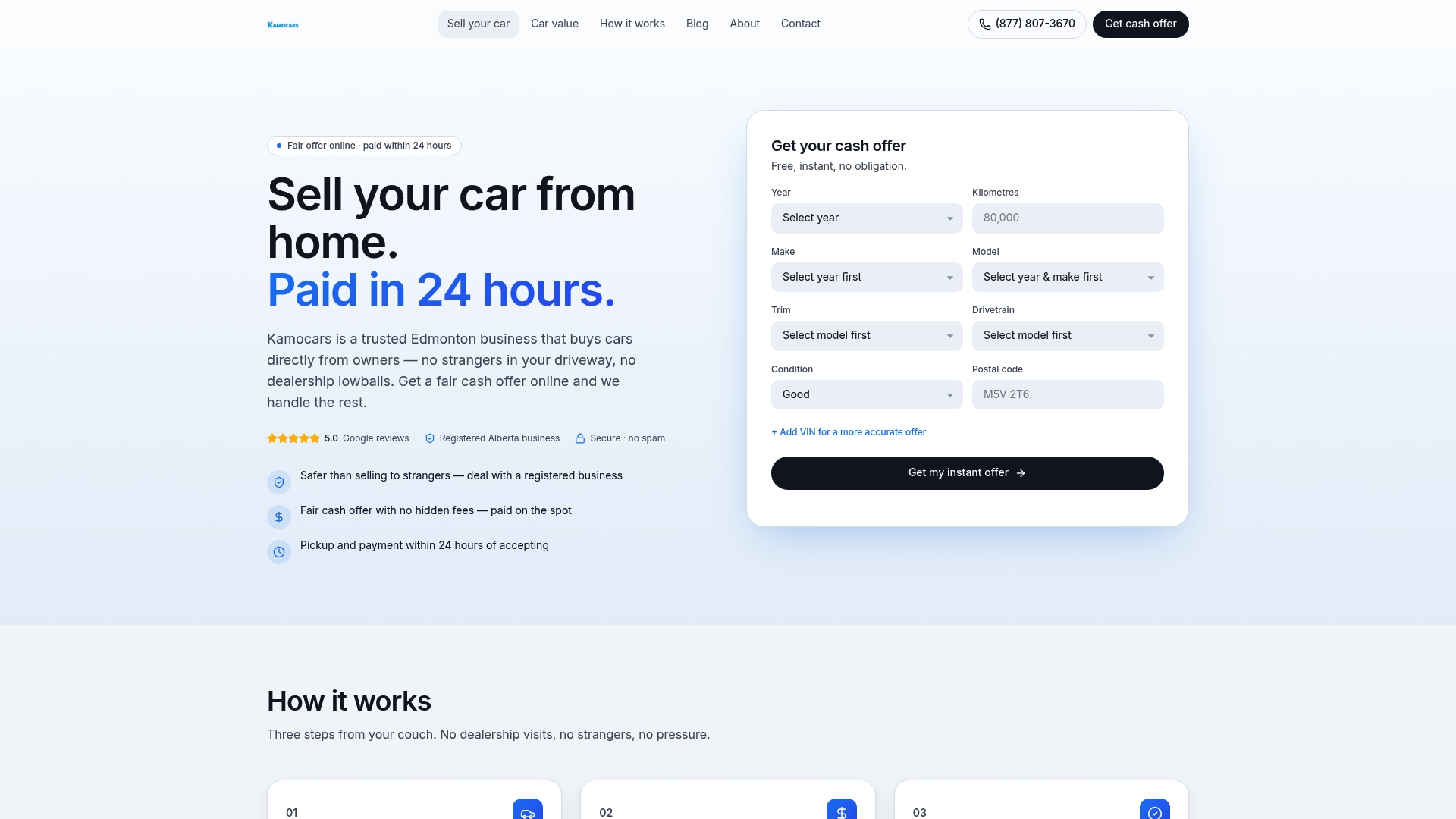
Once you accept, we handle pickup and pay you within 24 hours, whether your Tesla is financed, leased, or owned outright. As a registered business, Kamocars is built for sellers who want speed and certainty without haggling with strangers online. If you’re in Grande Prairie, get a free cash offer for your Tesla today, or check out our Leduc offer page if you’re closer to Edmonton.
Sources
- Used Electric Car Prices & Market Report — Q3 2026
- Canadian Used Car Prices - 2023 Tesla Model S (VMR Canada)
- Unlock 2026 Tesla Model Y invoice price in Canada
- Cheapest Tesla Cars in Canada for 2026 - Explore now!
Recommended
Get a real cash offer in 2 minutes
Trusted business. Fair price. Paid on the spot when we pick up your car.