
Sell Your Car Sight Unseen in Canada: Get Paid Within 24 Hours
Sell your car sight unseen in Canada safely and fast. Use instant offers, verify buyers, secure payment, and lock a 24 hour payout.
Sell Your Car Sight Unseen in Canada: Get Paid Within 24 Hours
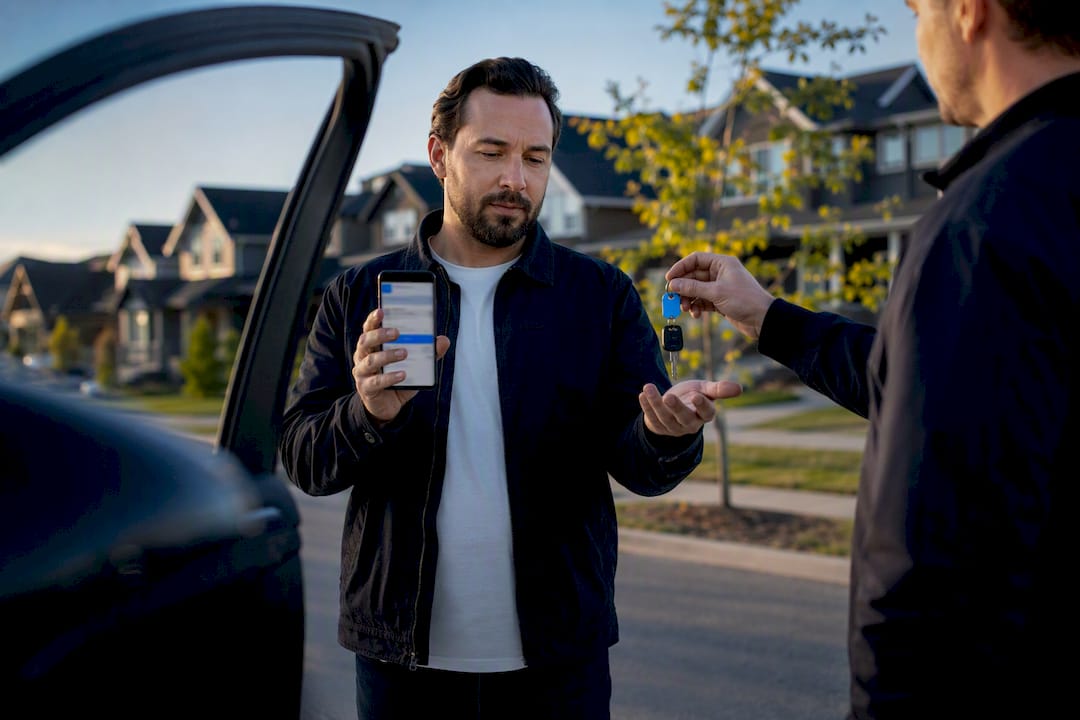
Yes, you can sell your car sight unseen to an online cash buyer. Instant offers from buying businesses skip the buyer meetups entirely, but the offer usually stays conditional until an in-person verification at pickup, which acts as the safety checkpoint. A reputable buying service typically completes pickup and payment within a few days after you accept.
TL;DR:
- Buyers usually reserve the final sale price until in-person verification at pickup, which confirms VIN, mileage, and undetected damage.
- Pay attention to the 10-25 percent discount expected when accepting an instant offer, reflecting resale risks and transport costs.
- Verify the buyer’s registration, contact details, written policy, and reviews to prevent scams involving overpayment or counterfeit checks.
- Prepare essential paperwork ahead of time, including the vehicle title, bill of sale, registration, and proof of ownership, to avoid delays.
- Conduct honest, detailed descriptions and photos of the vehicle’s condition to minimize discrepancies and protect your payout.
Table of Contents
- Fast Sell Options: Instant Cash Offer vs. Trade-In vs. Private Sale
- How Do You Complete a Sight-Unseen Sale Step by Step?
- What Documents and Prep Do You Need Before Accepting an Offer?
- How Fast Is the Process, and What Price Gap Should You Expect?
- How Do You Verify a Buyer and Spot a Scam?
- How Do You Accurately Describe Your Car’s Condition Remotely?
- What’s the Best Way to Handle a Remote Inspection?
- How Do You Handle Payment Safely in a Sight-Unseen Sale?
- What Legal Considerations Apply to a Sight-Unseen Car Sale?
- How Do You Communicate and Negotiate Without Meeting the Buyer?
- What Sellers Get Wrong About the Speed-Versus-Price Trade-Off
- Ready to Sell? Here’s How Kamocars Gets You Paid Fast
- Sources
Fast Sell Options: Instant Cash Offer vs. Trade-In vs. Private Sale
Speed, safety, and payout size rarely line up in your favor at the same time. Picking the right method starts with knowing which one you’re willing to sacrifice.
An instant cash offer is the fastest way to sell a car without meeting a buyer. You submit your vehicle’s details online, get a price backed by market data, and skip the back-and-forth entirely. Trade-ins sit in the middle: the dealer handles paperwork and rolls your equity into a new purchase, but you’re tied to buying something from them. Private-party sales net the most money, according to Kelley Blue Book’s selling guide, but they cost you time, strangers in your driveway, and the occasional no-show buyer.
Instant offers make the most sense when:
- You’re relocating and need the vehicle gone before a moving date
- You’re settling an estate and want a clean, fast transaction
- You’ve already bought your next vehicle and don’t want two payments overlapping
- You’d rather take a slightly lower number than spend weeks fielding lowball texts
If your priority is certainty over maximum dollars, the instant-offer route is built for exactly that trade-off. For a side-by-side breakdown of how each option stacks up on risk and convenience, Kamocars’ comparison of private buyer, dealer, and instant-offer routes is worth a look before you commit.
How Do You Complete a Sight-Unseen Sale Step by Step?
Selling a car through photos and a VIN lookup feels strange the first time. It’s a straightforward process once you know the order of operations.
- Submit your VIN, mileage, and photos. Accurate details produce an accurate number. Blurry photos or a guessed odometer reading almost always lead to a lower final offer at inspection.
- Compare the offer against private-party value. Use a private-value benchmark, like the ones KBB publishes, so you know exactly how much of a discount you’re accepting for speed.
- Review what acceptance actually confirms. Accepting an offer locks in a price pending verification. Before scheduling pickup, confirm the payment method, the pickup window, and who exactly is showing up to inspect the car.
- Meet the inspector at pickup. They’ll check the VIN against your title, confirm mileage, look for undisclosed damage, and verify the car starts and drives as described.
- Sign the transfer only after payment clears. Never hand over keys or a signed title before funds are confirmed in your account or you’re holding certified payment.
- Close out the paperwork trail. Keep copies of the bill of sale and signed title transfer, cancel your insurance, and notify your provincial registration authority if required.
Online valuations, including ones built on data sources like Canadian Black Book, are estimates. Planet Motors notes that final numbers are still subject to in-person verification, which is exactly why step four matters as much as step one.
Pro Tip: Photograph your odometer, all four tires, and any existing dents or windshield chips before you submit your listing. It matches what the inspector will see and removes the easiest excuse for a last-minute price cut.
For a deeper walkthrough of what the final handoff involves, Kamocars’ guide to remote car sales covers the identity and title checks buyers run before releasing funds.
What Documents and Prep Do You Need Before Accepting an Offer?
Delays at pickup almost always trace back to missing paperwork, not a haggling buyer. Get these ready before you accept anything.
Required documents:
- Vehicle title or your province’s equivalent ownership document
- A signed bill of sale
- Current registration
- Government-issued photo ID matching the name on the title
If applicable, add these to the pile:
- Lien release or payoff letter, if the vehicle is financed
- Power of attorney paperwork, if someone else is signing on your behalf
- Lease payoff contact information, if the vehicle is leased rather than owned
Helpful extras that speed up inspection:
- Recent service records
- A VIN-based vehicle history report
- Spare keys and remotes
- Close-up photos of any damage or wear
Before pickup day, clear out personal items, give the car a basic wash, disable any toll transponders, and note the current odometer reading. Kamocars’ document checklist and legal paperwork guide both walk through provincial variations in more detail.
How Fast Is the Process, and What Price Gap Should You Expect?
Instant offers trade money for speed, and the trade-off is quantifiable. Sellers who go the instant-offer route commonly receive 10 to 25 percent below private-party value in exchange for completing the sale in one to three days instead of weeks.
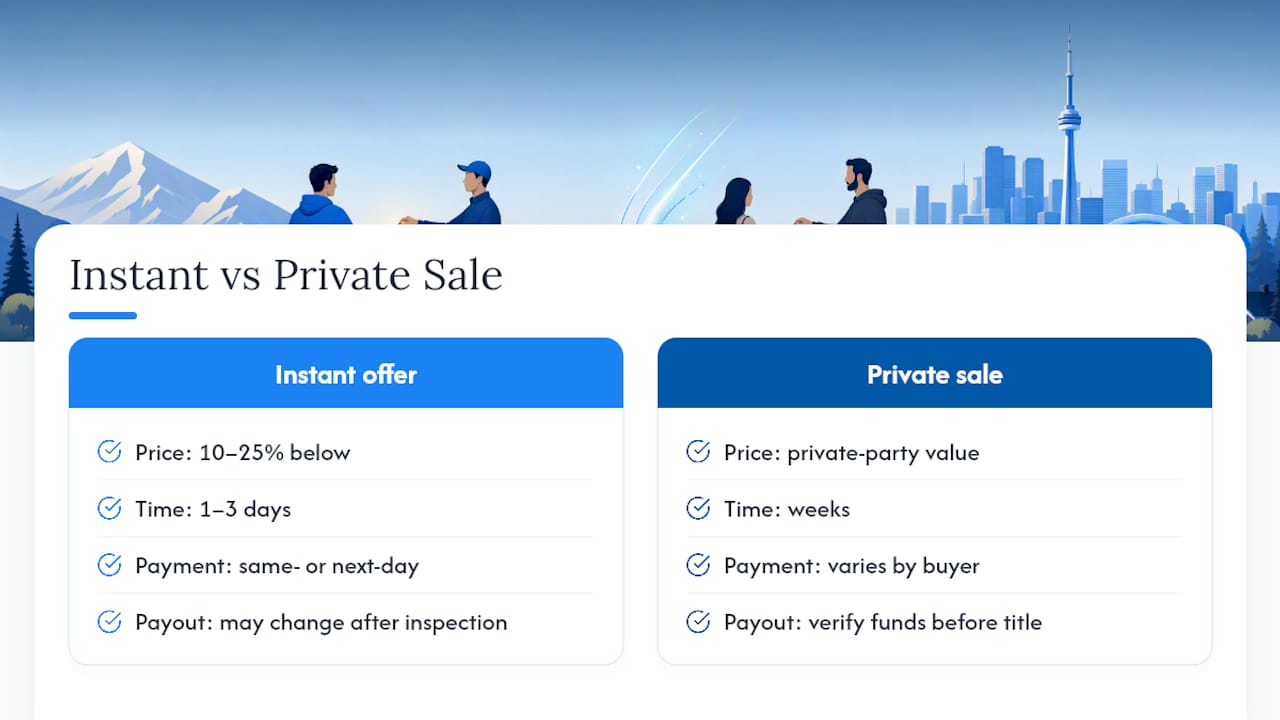
That gap covers the buying business’s resale risk, transport costs, and the certainty they’re offering you. Reputable services advertise same-day or next-day direct deposit once the in-person inspection confirms the car matches its listing, according to Planet Motors. Watch for two payment formats: direct bank deposit, which you can verify by checking your account before releasing the title, and certified funds, which you should confirm with the issuing bank rather than trusting the paper alone.
The in-person verification step exists for a reason beyond ceremony. If the inspector finds undisclosed damage, a rebuilt title, or a mileage discrepancy, the final payout can shift from the online estimate. Growth in remote vehicle transactions since the pandemic has pushed more services toward written delivery and pickup windows, so ask for that window in writing before you commit to a date.
How Do You Verify a Buyer and Spot a Scam?
Selling without meeting the buyer in person removes a layer of gut-check instinct you’d normally rely on — see these tips for preventing auto theft that also highlight safe practices relevant to vehicle handoffs. Replace it with a short verification routine.
Check before you agree to anything:
- Business registration and a real, local physical address
- A published phone number and email tied to the company, not a personal cell number
- A clear, written pickup and payment policy
- Reviews or a transaction history you can independently confirm
OMVIC’s guidance on remote transactions specifically recommends verifying dealer registration and getting contract terms in writing, a step that applies just as well to instant-offer buyers as it does to traditional dealers.
Common red flags include overpayment schemes where a buyer sends more than the agreed amount and asks for a refund, counterfeit cashier’s checks that clear temporarily before bouncing, and pressure to release the vehicle before funds are confirmed. If anything feels rushed or off, delay the handover, request an alternate verified payment method, or contact local authorities. Kamocars’ buyer verification guide and fraud-type breakdown both cover specific scam patterns worth knowing before you accept an offer.
Pro Tip: Never sign the title over until the funds are visible and cleared in your account. A pending deposit is not the same thing as confirmed money.
How Do You Accurately Describe Your Car’s Condition Remotely?
An honest, detailed description protects your final payout more than an optimistic one. Buying businesses build their offer around what you tell them, and any gap between your description and reality gets corrected at inspection, usually in their favor, not yours.
Start with the basics: exact trim level, mileage, transmission type, and drivetrain. Then move to condition specifics that photos alone can miss. Note any warning lights currently on the dash, unusual noises when braking or accelerating, tire tread depth, and whether the air conditioning and heat both work. Mention accident history even if it was minor and repaired, since a vehicle history report will surface it anyway.
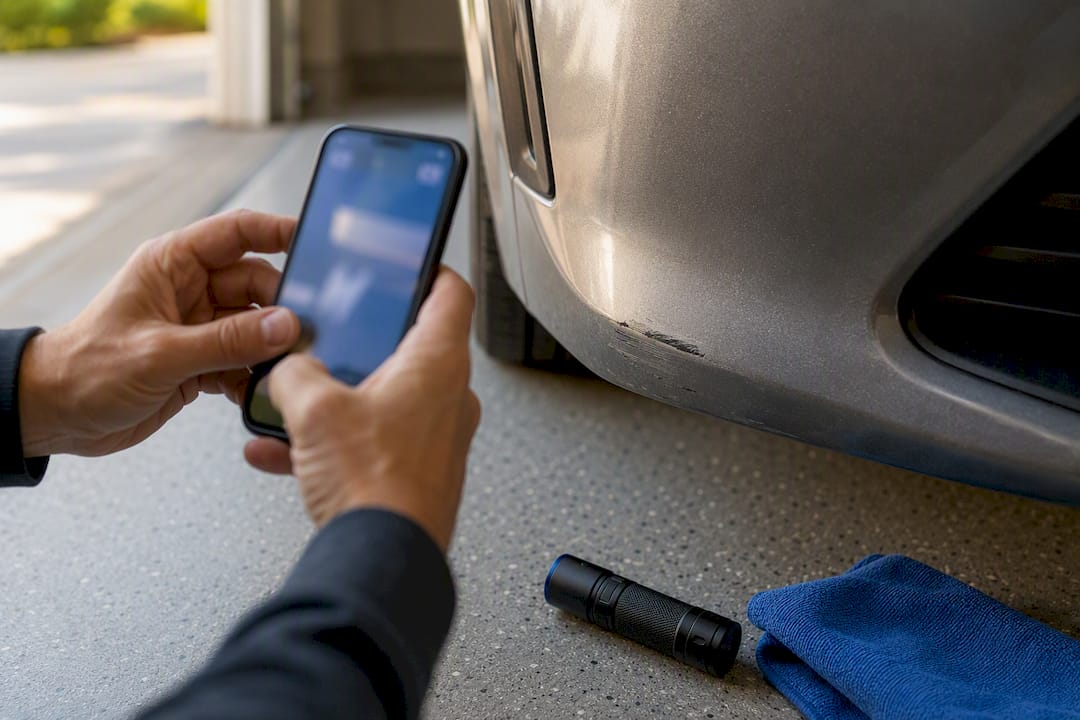
Photograph the car in daylight, from all four corners, with close-ups of the wheels, interior seats, dashboard, and odometer. Include shots of any existing damage rather than cropping it out. A windshield chip or a scuffed bumper disclosed upfront rarely moves the offer much. The same damage discovered at pickup often does, because it reads as something you tried to hide.
Be specific about maintenance history too. “Regularly serviced” means little. “Oil changed every 8,000 kilometers, new brake pads installed six months ago” gives the appraiser something concrete to price against. The more precisely you describe the car, the closer your final payout will land to your initial online offer.
What’s the Best Way to Handle a Remote Inspection?
Video calls have become the standard middle ground between static photos and an in-person walkaround, and for good reason. A live video call lets the buyer’s representative ask you to start the engine, rev it, turn the wheel lock to lock, and pan across the interior in real time. It catches things photos miss, like an inconsistent idle or a suspicious rattle.
Third-party inspection services offer another layer of verification, particularly useful for higher-value vehicles or out-of-province sales. An independent inspector visits the car’s location, runs a mechanical check, and produces a report both sides can trust. This costs money and adds a day or two, so it’s more common in private-party transactions than in instant-offer sales, where the buying business typically handles inspection themselves at pickup.
For most instant-offer transactions, the process is simpler: the online appraisal gets you a conditional number, and the buying business’s own representative performs the physical inspection at pickup rather than beforehand. That’s the moment your description gets tested against reality. If you’ve been thorough and honest in your listing, this step should confirm the number you already accepted rather than change it.
Whichever method you use, document the call or inspection. Screenshots of a video call timestamp, or a copy of a third-party inspection report, give you a record if a dispute comes up later.
How Do You Handle Payment Safely in a Sight-Unseen Sale?
Two payment methods dominate instant-offer transactions: direct bank deposit and certified funds delivered at pickup. Each has its own verification step, and skipping it is where most remote-sale problems start.
Direct deposit is the cleanest option. The buying business transfers funds to your account, and you confirm the deposit has actually landed and cleared before you sign the title over or hand off keys. A pending transfer showing in your banking app is not the same as cleared money. Wait for confirmation, even if it means the inspector stands in your driveway for an extra ten minutes.
Certified funds, like a bank draft or cashier’s check, need a different kind of verification. Call the issuing bank directly using a number you look up yourself, not one printed on the check, and confirm the check is real and the funds are available. This single step blocks the most common instant-offer scam: a counterfeit certified check that looks legitimate until it bounces days later.
Never accept a personal check, a wire request that asks you to send money back as a “refund” for an overpayment, or a promise that “payment is coming” after you’ve already released the vehicle. Legitimate buying businesses complete payment and pickup as a single, verified transaction, not two separate steps separated by trust.
What Legal Considerations Apply to a Sight-Unseen Car Sale?
Regulations governing vehicle sales are set at the provincial level in Canada, which means the exact paperwork and disclosure rules shift depending on where you live. What stays consistent everywhere is the core requirement: a valid title transfer, a bill of sale, and disclosure of known mechanical or accident history.
OMVIC’s guidance on remote transactions specifically flags dealer registration and written contract terms as the two things buyers and sellers should confirm before completing a deal outside the traditional in-person format. That guidance applies whether you’re the one buying or selling, since a legitimate buying business should be registered and willing to put pickup, payment, and inspection terms in writing without you having to ask twice.
Lien status matters legally, not just practically. If you still owe money on the vehicle, you cannot legally transfer clear title until the lien is released or paid off as part of the sale. Reputable buying businesses handle this directly with your lender as part of the transaction, but you need to disclose the lien upfront rather than let it surface as a surprise at pickup.
If your vehicle is leased rather than owned, selling it sight unseen requires contacting the leasing company first, since the vehicle technically belongs to them until the lease is bought out. Skipping this step can void the sale entirely, regardless of how smoothly the pickup itself goes.
How Do You Communicate and Negotiate Without Meeting the Buyer?
Written communication becomes your entire negotiating record when you’re not meeting face-to-face, so treat every email and text as something you might need to reference later. Ask for the offer breakdown in writing: base price, any inspection contingencies, and the exact pickup window being proposed.
If the offer comes in lower than you expected, ask specifically what drove the number. A good buying business will point to comparable market data or a specific detail in your description rather than giving you a vague “market conditions” answer. That specificity is a decent proxy for legitimacy. Vague answers are a mild red flag worth pressing on.
Negotiating remotely works best when you’ve already benchmarked the offer against a private-party value estimate. If you know your car is realistically worth a certain range privately, you can ask the buyer to explain the gap rather than accepting or rejecting blind. Most instant-offer businesses have some room to move, particularly if you can point to a clean service history or recent maintenance they may not have weighted heavily.
Keep the tone practical rather than adversarial. You’re not haggling across a hood in a driveway. You’re confirming details over email with a company that does this dozens of times a week, and a clear, specific message gets a faster, more useful response than a frustrated one.
What Sellers Get Wrong About the Speed-Versus-Price Trade-Off
Most sellers treat the discount on an instant offer as a cost they’re paying. It’s more accurate to think of it as a fee for outsourcing risk. You’re paying to skip the no-show buyers, the lowball negotiators, and the weeks of your evenings spent answering messages from people who never intended to buy.
What actually matters is whether the paperwork and payment verification steps get followed, not whether you shaved every possible dollar off the deal. I’ve seen sellers focus entirely on maximizing the number and skip the basics, like confirming a certified check with the issuing bank, and that’s backwards. Get the safety steps right first. The dollar figure is negotiable. A cleared payment is not.
Sellers who value speed and certainty tend to do better working with a registered buying service rather than an unverified private buyer offering cash. Registration means there’s a real business, a real address, and real accountability if something goes wrong. Run through the documents checklist before you accept anything, and keep every record after the sale closes. That paper trail is the only thing standing between you and a headache six months from now.
— Omar
Ready to Sell? Here’s How Kamocars Gets You Paid Fast
This service is built for exactly the sale this article just walked through: a fast, verified, no-meetup transaction that gets cash in your account instead of strangers in your driveway. Where private sales cost you weeks of showings and trade-ins tie you to buying something new, this service gives you an instant appraisal based on current market data, free pickup, and payment within 24 hours, with the paperwork handled as part of the process rather than left for you to chase down afterward.
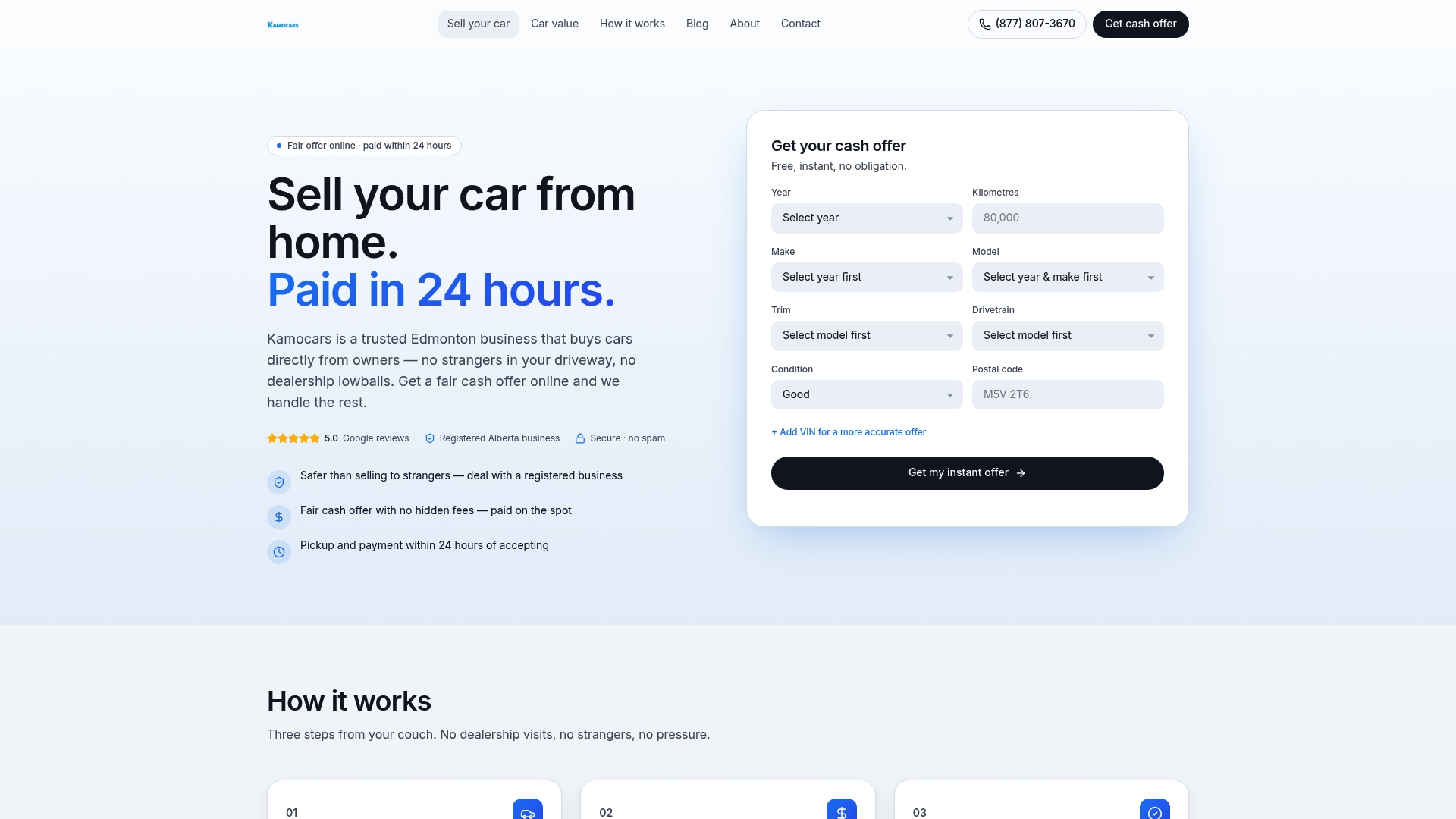
It’s suited for owners of newer cars, trucks, and SUVs that are still running and ready to hand off without the back-and-forth of private buyers. Getting started only takes a VIN, your current odometer reading, and a few clear photos. Head to the car value tool to see what your vehicle is worth right now, or jump straight into the Sell My Car flow to get a firm offer and lock in a pickup window before the day is out.
Sources
- How to Sell a Car: 10 Steps for Success - Kelley Blue Book
- Shopping options - OMVIC
- Sell My Car — Sell Your Car Online Canada | Planet Motors
- From dealership to driveway: how Canadian car delivery works and what to watch for - Optiom
Recommended
Get a real cash offer in 2 minutes
Trusted business. Fair price. Paid on the spot when we pick up your car.