
Legal Car Purchase Agreements: What U.S. Buyers Must Know
Discover the role of legal car purchase agreements. Protect your rights and money. Learn key steps before signing your car deal today!
Legal Car Purchase Agreements: What U.S. Buyers Must Know

A car purchase agreement is the definitive legal record of your transaction — the document courts, lenders, and DMVs rely on when something goes wrong. Understanding the role of legal car purchase agreements before you sign is the single most effective way to protect your money and your rights.
The short version:
- The agreement locks in price, VIN, financing terms, fees, and warranty language — all of which become legally binding once you sign.
- Written contingencies (financing approval, inspection, clear title) are your primary exit ramps. Without them in writing, you likely have no legal way out.
- Federal law requires accurate odometer disclosure, standardized financing disclosures, and clear warranty statements — but only if those items are in the contract.
- Electronic agreements carry the same legal weight as paper under the E-SIGN Act when both parties consent.
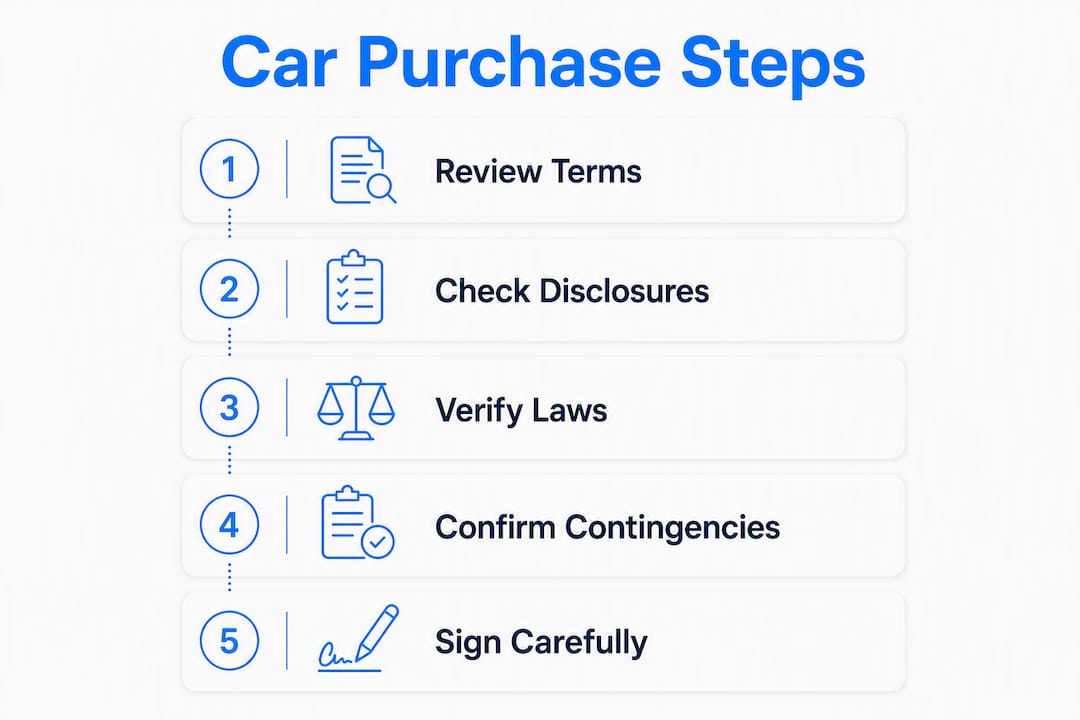
Three things to do before you sign:
- Verify the VIN on the contract matches the VIN on the vehicle and the title.
- Confirm every contingency you negotiated (inspection, financing, clear title) is written into the agreement, not just promised verbally.
- Never sign a contract with blank spaces — cross them out or refuse to proceed.
Table of Contents
- What does a car purchase agreement actually do?
- What should every U.S. car purchase agreement include?
- Which federal and state laws affect your purchase contract?
- Do contingency clauses let you cancel a signed deal?
- How to review and negotiate your contract before signing
- What to do immediately after signing
- When should you consult an attorney or file a complaint?
- Key Takeaways
- The part of the contract most buyers skip
- Sellkamocars: a transaction built around clear documentation
- Authoritative resources for U.S. car buyers
What does a car purchase agreement actually do?
The purchase agreement is the binding blueprint for the entire transaction. It identifies the buyer and seller, describes the vehicle, states the agreed price, and sets the conditions under which ownership transfers. A bill of sale, by contrast, functions more like a receipt — it confirms the exchange happened but typically contains less detail. The loan or retail installment contract is a separate document between you and the lender, governing repayment terms.
The purchase agreement is the foundation. Errors or omissions in it carry forward into the bill of sale, the loan contract, and the title paperwork. Confusing these three documents is one of the most common causes of registration and title problems after a sale.
Dealers typically use a buyer’s order (also called a purchase order), which can be binding once signed and usually includes contingencies for financing or inspection. Private-party sales use simpler written agreements, though the same legal principles apply. One specific risk to know: spot delivery, where a dealer lets you drive the car home before the lender has formally approved financing. If the lender later declines, the dealer may attempt to renegotiate the deal on less favorable terms.
What should every U.S. car purchase agreement include?
Every contract should contain these core elements. Missing any one of them creates a gap the other party can exploit.
- VIN, make, model, year, and color — the vehicle description must be exact and match the physical car.
- Buyer and seller identification — full legal names and addresses for both parties.
- Agreed purchase price — the total, not a monthly payment figure.
- Itemized fees and taxes — documentation fees, sales tax, registration fees, and any dealer add-ons listed separately.
- Trade-in credit and down payment — stated as distinct line items.
- Odometer reading — required under the Federal Odometer Act, which mandates accurate disclosure and makes tampering a federal crime.
- Delivery or possession date — when you actually take ownership.
- Signatures of all parties — unsigned contracts are unenforceable.
When financing is involved, the Truth in Lending Act (TILA) requires the contract to disclose APR, total finance charge, amount financed, total of payments, and total sale price. Verify every one of these figures matches what you were quoted verbally.
Warranty language deserves particular attention. The FTC Used Car Rule requires dealers to provide a Buyers Guide disclosing whether the vehicle comes with a warranty or is sold “as-is.” Under Magnuson-Moss, any written warranty must clearly state what it covers and for how long.

| Clause type | Standard / acceptable language | Risky / non-standard language |
|---|---|---|
| Warranty | “Vehicle covered by 90-day/3,000-mile powertrain warranty” | “Dealer may provide warranty at its discretion” |
| Condition | “Vehicle sold as-is; buyer acknowledges inspection opportunity” | “Seller makes no representations of any kind” (with no inspection right offered) |
| Financing | “Sale contingent on buyer securing financing at X APR or better” | “Sale final regardless of financing outcome” |
| Add-ons | All optional products listed with individual prices | Bundled “protection package” with no itemized cost |
| Blank spaces | All fields completed or crossed out | Any blank line left open at signing |
Pro Tip: If a dealer refuses to put an agreed repair or add-on in writing before you sign, treat that refusal as a signal the promise will not be honored. Walk away or get it written in.
Which federal and state laws affect your purchase contract?
Several federal statutes set minimum requirements for what must appear in a car purchase agreement. State laws layer additional protections on top.

| Statute | What it requires in the contract | What to verify |
|---|---|---|
| Federal Odometer Act | Accurate odometer disclosure, signed by seller | Odometer reading matches dashboard; no rollback indicators |
| Truth in Lending Act (TILA) | APR, finance charge, amount financed, total payments | All five TILA fields present and match verbal quotes |
| FTC Used Car Rule | Buyers Guide with warranty or as-is disclosure | Buyers Guide attached to or referenced in the agreement |
| Magnuson-Moss Warranty Act | Written warranties must state coverage clearly | Warranty terms are specific, not vague or conditional |
| UCC Statute of Frauds | Sales of $500+ must be in writing and signed | Agreement is signed by both parties before any money changes hands |
The UCC Statute of Frauds is the foundational rule: for any vehicle sale, a verbal agreement is essentially unenforceable. That is why written, signed contracts are the legal default for every car transaction in the U.S.
State laws vary significantly. Some states have short statutory rescission windows for specific sale types, and a handful require dealers to offer optional return programs. Your state Attorney General’s consumer division or DMV website is the most reliable place to check what applies in your state. Never assume a right exists just because you heard it does.
A note on electronic agreements: Under the federal E-SIGN Act and the Uniform Electronic Transactions Act (UETA), electronic purchase agreements are generally enforceable when both parties consent to electronic records. Confirm the agreement states that consent and provides a downloadable or printable copy before you close the browser.
Do contingency clauses let you cancel a signed deal?
Contingency clauses are the primary legal mechanism for voiding a car sale after signing. There is no universal federal three-day cooling-off period for dealership purchases — that rule applies to certain off-premises sales, not to cars bought at a dealership. Most dealership sales are final the moment you sign, unless a written contingency gives you an exit.
Standard contingencies to request in writing:
- Financing contingency — voids the deal if your lender declines or approves at a materially worse rate than stated.
- Pre-purchase inspection contingency — allows you to cancel if an independent mechanic finds defects above a specified threshold.
- Clear title contingency — voids the deal if the seller cannot deliver a title free of liens or encumbrances.
- Parts or disclosure contingency — used when a dealer has promised a specific repair or document before delivery.
For a contingency to be effective, it must state the specific condition, the deadline for satisfying it, and the consequence if it is not met. “Subject to financing” alone is often not enough — specify the rate and term.
A small number of states do provide limited cancellation windows, but these are exceptions. If you need to cancel and no written contingency applies, your options narrow quickly. Document the trigger event in writing, notify the seller or dealer in writing immediately, and preserve all receipts and communications. If the seller refuses to honor a valid contingency, contact your state’s consumer protection agency or Attorney General.
Pro Tip: Spot delivery is the highest-risk scenario for cancellation. If you drive the car home before the lender confirms financing in writing, you may face a dealer demanding a higher rate or a larger down payment days later. Get written lender confirmation — not just dealer “approval pending” — before you surrender a trade-in or make any irreversible modifications to the vehicle.
How to review and negotiate your contract before signing
Follow this sequence every time, whether you are at a dealership or completing a private-party sale.
- Run a VIN check using the National Motor Vehicle Title Information System (NMVTIS) or a service like Carfax before you ever sit down to sign.
- Pull a lien search through your state DMV to confirm no outstanding loans are attached to the title.
- Read every page, including the fine print on the back of the buyer’s order. Dealers sometimes bury arbitration clauses and add-on charges there.
- Compare the purchase order to the retail installment contract if you are financing. Errors on the purchase order carry directly into the loan documents — a mismatched number can create lender problems after the fact.
- Cross out every blank space and initial each one. A blank line is an open invitation to add charges after you leave.
- Verify all five TILA disclosures on the financing contract: APR, finance charge, amount financed, total of payments, and total sale price.
- Confirm add-ons are itemized — extended warranties, paint protection, gap insurance, and similar products must each show a separate price. Refuse any bundled “package” with no line-item breakdown.
- Get verbal promises in writing before signing. Industry guidance is consistent on this point: if the dealer promised to fix the brakes or include floor mats, it must appear in the contract.
Red flags that should make you pause or walk away:
- Contradictory numbers between the purchase order and the retail installment contract.
- Conditional delivery language that lets the dealer reclaim the vehicle at its discretion.
- Any pressure to sign before the financing is confirmed in writing.
- Verbal assurances that “we’ll fix that later” for any defect or missing document.
- An arbitration clause that waives your right to sue in court — you can often negotiate its removal.
Questions to ask before signing:
- “Can you show me the Buyers Guide for this vehicle?”
- “What is the exact APR the lender has approved, not estimated?”
- “Is this vehicle sold as-is, or does it carry a warranty? What does the warranty cover?”
- “Can you itemize every fee on this contract?”
- “What happens to this deal if my lender declines financing?”
- “Is there a lien on this title? Can I see a lien release?”
- “Will you put the promised [repair/accessory] in writing before I sign?”
- “Can I have 24 hours to have an attorney review this contract?”
For a complete breakdown of the documents you need for a legal car sale, the Sellkamocars resource covers both buyer and seller obligations in detail.
What to do immediately after signing
Signing is not the finish line. Several tasks must happen within days to complete the ownership transfer legally.
- Obtain your signed copy of the purchase agreement and bill of sale before you leave the lot or the seller’s location. Never accept a promise to mail it later.
- Confirm title transfer — a dealer typically handles this and issues a temporary tag; in a private sale, you and the seller complete the title assignment together at the DMV or by mail, depending on your state.
- File for registration with your state DMV within the window your state requires (commonly 30 days, but this varies).
- Notify your insurer before driving the vehicle. Coverage on a newly purchased car is not automatic in every policy.
- Pay outstanding taxes or fees — some states require sales tax at the DMV, separate from what the dealer collected.
For the full post-signing workflow, the Sellkamocars guide on what car sale completion involves walks through each step in sequence.
Records to keep and for how long:
- Signed purchase agreement and bill of sale: keep permanently.
- Retail installment contract and all lender statements: keep for the life of the loan plus three years.
- Buyers Guide and any warranty documents: keep for the duration of the warranty period.
- Pre-purchase inspection report: keep for at least three years or until you sell the vehicle.
- All correspondence with the dealer or seller: keep for at least three years.
When should you consult an attorney or file a complaint?
Most contract discrepancies are resolved through direct negotiation with the dealer. Some are not. Call an attorney when you encounter:
- Fraud or misrepresentation — the dealer or seller concealed a known defect, rolled back the odometer, or misrepresented the title status.
- Forged or altered documents — any signature or figure that was changed after you signed.
- Bad-faith financing — the dealer submitted your application to a lender at a rate higher than agreed, or changed loan terms after spot delivery.
- Major undisclosed damage — flood, salvage, or frame damage not disclosed before sale.
- Title defects — a lien that was not cleared, or a title that cannot be transferred cleanly.
Agencies to contact, by issue:
- State Attorney General consumer division — dealer fraud, deceptive practices, warranty violations. File online through your state AG’s website.
- State DMV — title and registration disputes, odometer fraud.
- Federal Trade Commission (FTC) — violations of the Used Car Rule (missing or falsified Buyers Guide). File at ftc.gov/complaint.
- Consumer Financial Protection Bureau (CFPB) — financing disclosure violations, predatory loan terms.
- Local consumer protection office — general disputes, small claims guidance.
Before contacting any agency or attorney, gather: copies of every signed document, the Buyers Guide, your inspection report, a timeline of events, and all written communications with the dealer or seller.
Key Takeaways
A car purchase agreement is the legally binding record of your deal — and the document that determines whether you can enforce your rights or exit the transaction if something goes wrong.
| Point | Details |
|---|---|
| Agreement is the legal record | Courts, lenders, and DMVs treat the signed purchase agreement as the primary evidence of what both parties agreed. |
| Written contingencies are your exit | Financing, inspection, and clear-title contingencies must be in writing to be enforceable; verbal promises carry no legal weight. |
| Federal law sets minimum requirements | The Federal Odometer Act, TILA, FTC Used Car Rule, and Magnuson-Moss each require specific disclosures in the contract. |
| No universal cooling-off period | There is no federal three-day cancellation right for dealership purchases; assume the sale is final once you sign. |
| Sellkamocars removes the paperwork risk | Selling to Sellkamocars means a structured, documented transaction with secure payment and no blank-space surprises. |
The part of the contract most buyers skip
Most buyers focus on the purchase price and the monthly payment. The clauses that actually determine your legal position — warranty language, arbitration waivers, contingency conditions, and add-on itemization — sit in the fine print that gets skimmed at the end of a long afternoon at the dealership.
The “as-is” clause is the clearest example. Buyers often treat it as boilerplate. Legally, it shifts nearly all risk to you: if a major defect surfaces after you drive off the lot, your remedies are limited unless you can prove fraud or an express warranty was given. An inspection contingency written into the contract before signing is the practical counter to that risk. Without it, you are relying on goodwill, not law.
The same logic applies to spot delivery. Dealers present it as a convenience. It is, until the lender declines and the dealer calls to renegotiate. The fix is simple and takes two minutes: ask for written lender confirmation before you hand over your trade-in or sign anything irreversible. Most buyers do not ask because they do not know the risk exists.
Contract language and legal jargon are designed to be intimidating. Any dealer or seller who refuses to explain a clause in plain language, or who resists putting a verbal promise in writing, is telling you something important about how they intend to honor the deal.
Sellkamocars: a transaction built around clear documentation
If you are on the selling side and want a transaction where the paperwork is handled correctly from the start, Sellkamocars offers a faster, cleaner alternative to private-party sales and dealer trade-ins. You get a cash offer based on current market data, a structured purchase process with no blank-space contracts, and payment within 24 hours of pickup.
No haggling over terms, no waiting for a buyer to secure financing, and no risk of a deal falling apart because a contingency was never written down. Sellkamocars has completed over 500 vehicle transactions with a documented process that protects both sides of the deal. If you own a 2018 or newer car, truck, or SUV in running condition, find out what your vehicle is worth and see how the process works before your next transaction.
Authoritative resources for U.S. car buyers
Use these sources to verify rules, download templates, or file complaints.
| Resource | What it covers |
|---|---|
| American Bar Association — Buying, Selling, or Leasing a Vehicle | Plain-language overview of contract law, UCC requirements, and state variations |
| Progressive — What Is a Car Purchase Agreement? | Consumer explainer covering required contract elements and federal disclosures |
| LegalClarity — Vehicle Purchase Agreement Guide | Detailed breakdown of contingencies, e-signatures, and cancellation rights |
| Iowa Legal Aid — Financing a Used Car | TILA disclosure requirements and financing contract verification steps |
| FTC — Used Car Rule and Buyers Guide | File complaints about Buyers Guide violations; access Used Car Rule guidance |
| Capital One Auto — Car Sale Contract Guide | Practical advice on red flags, add-ons, and blank-space risks |
| State Attorney General websites | State-specific consumer protection statutes, rescission windows, and complaint portals |
| State DMV websites | Title transfer procedures, registration deadlines, and odometer disclosure forms |
For state-specific rules, search “[your state] Attorney General consumer protection auto” or “[your state] DMV vehicle purchase.” Requirements for rescission windows, documentation fees, and Buyers Guide variations differ by state, and the AG and DMV sites are the authoritative sources for your jurisdiction.
This article provides general legal information for U.S. consumers, not legal advice. Confirm current rules with your state’s DMV, Attorney General’s office, or a licensed attorney before making decisions based on your specific situation.
Recommended
Get a real cash offer in 2 minutes
Trusted business. Fair price. Paid on the spot when we pick up your car.