
Sell a Financed Car in Canada: Get a Payoff Letter in 7–10 Days
Canada sellers: request a car loan payoff letter, check per diem interest, and clear the lien before sale. With template and timing.
Sell a Financed Car in Canada: Get a Payoff Letter in 7–10 Days

Contact your lender today and request a formal payoff statement dated to your planned closing date, including per-diem interest and payment instructions. Most Canadian lenders issue this within 7 to 10 business days. That letter confirms your balance, but it doesn’t clear the lien. Discharging the registration with your provincial registry is a separate step, and it’s the one sellers forget to plan for.
TL;DR:
- Request your payoff statement at least two weeks before your closing date to account for potential delays in lien discharge processing.
- Always ask for the specific per-diem interest rate to accurately recalculate costs if your payment timing shifts.
- Expect the payoff figure within 7 to 10 business days, but provincial lien discharge can take an additional 10 to 30 days after payment clears.
- If the lien release is delayed, request a written estimated date and escalate if that date is missed to avoid last-minute surprises.
- Coordinating directly with your buyer or using Kamocars can streamline lien discharge and payment, reducing the risk of delays during private sales.
Table of Contents
- Requesting Your Car Loan Payoff Request: Steps and a Copy-Ready Template
- What Your Payoff Amount Includes (and Why It’s Not Your Statement Balance)
- How Long It Takes to Get Paid Off and Clear the Lien
- Fixing Payoff Disputes and Delayed Lien Releases
- Selling to a Cash Buyer When You Still Owe on the Loan
- What Sellers Get Wrong About Payoff Timing
- Selling a Financed Car? Kamocars Handles the Payoff for You
- Where to Verify Payoff and Lien Rules
- Sources
Requesting Your Car Loan Payoff Request: Steps and a Copy-Ready Template
You have four realistic channels for getting this document, and some lenders are faster through one than another. Online banking secure messaging works well for major banks because it creates a timestamped paper trail automatically. Calling the lender’s payoff department directly is often the quickest route if you need a same-day estimate. Walking into a branch still works for credit unions and smaller lenders that don’t have a dedicated payoff line. Certified mail is the slowest option, but it’s the one to use if you need proof of delivery for a dispute later.
Whichever channel you pick, Canadian lenders typically require the same basic details to process your car loan payoff request:
- Your loan or account number, exactly as it appears on your statement.
- The vehicle’s VIN, so the payoff matches the correct lien registration.
- Your planned payoff date. Not today’s date. The date you expect funds to actually transfer.
- A request for the per-diem interest rate, so you can recalculate if closing slips by a few days.
- Payment instructions for wire transfer or certified cheque, whichever your lender accepts.
- Your preferred response method, whether that’s email, secure message, or a callback.
Here’s wording you can copy and adjust:
“I am requesting a payoff statement for account [number], VIN [number], with a payoff date of [date]. Please include the per-diem interest rate, total amount due as of that date, and instructions for wire or certified cheque payment. Please respond within 7 business days.”
If you’re selling privately or refinancing, send this request at least two weeks before your target closing date. That buffer gives you room to catch discrepancies and still hit your deadline.
What Your Payoff Amount Includes (and Why It’s Not Your Statement Balance)
Your last monthly statement is not your payoff amount for car loan purposes. A payoff letter accounts for principal, daily accrued interest, and any outstanding fees or penalties as of a specific date, not the balance from your last billing cycle.
Three things typically separate a payoff figure from your statement balance, including awareness of prepayment penalties:
- Per-diem interest: interest that accrues daily between your last statement and your actual payoff date.
- Prepayment penalties: some fixed-rate contracts charge a fee for settling early, so ask directly whether yours applies.
- Administrative or discharge fees: smaller amounts some lenders tack on to process the final closeout.
Pro Tip: Always ask your lender for the specific per-diem rate, not just the total figure. If your closing shifts by three days, you can recalculate yourself instead of waiting on a new document.
A payoff statement, a monthly statement, and a lien discharge are three different documents. Only the discharge actually removes the lender’s registered interest from your vehicle.
How Long It Takes to Get Paid Off and Clear the Lien
Two clocks are running here, and they don’t move at the same speed. Getting the payoff figure is fast. Clearing the registration is slower.
- Lenders generally issue payoff statements within about 7 to 10 business days of your request.
- After payment clears, provincial registry updates for lien discharge can take roughly 10 to 30 days, depending on your province’s system.
- Wire transfers post faster than cheques, which matters if your per-diem interest is accumulating daily until funds arrive.
- If your closing date is tight, ask your lender or a solicitor about expedited handling, since some lenders can flag urgent files for faster registry filing.
If you’re closing in under two weeks, build the registry timeline into your plan now rather than assuming the payoff letter alone finishes the job.
Fixing Payoff Disputes and Delayed Lien Releases
Most payoff problems come down to bad timing or a stale figure, and both are fixable if you catch them early.
- If the amount looks wrong, request an itemized breakdown showing principal, per-diem interest, and any fees separately, and keep every email or letter in one folder.
- If the lien release is taking longer than promised, ask your lender in writing for a specific expected release date, then escalate to their complaints department if that date passes.
- If a provincial regulator needs to get involved, your solicitor can advise on the right escalation path for your province’s registry system.
- If your buyer needs clear title immediately and the discharge is still pending, a solicitor can hold funds in trust or arrange a holdback so the sale closes on schedule while the paperwork catches up.
Pro Tip: Never rely solely on a verbal confirmation that your lien is released. Get it in writing, and confirm the registry has actually been updated before you hand over keys.
Selling to a Cash Buyer When You Still Owe on the Loan
Handing your payoff details to a buyer service doesn’t mean losing control of the process. It usually means someone else handles the parts that trip up private sellers.
You’ll still need to provide the basics: your loan account number, VIN, lender contact information, your preferred payoff date, and ID for the payout transaction. A buyer that regularly handles financed vehicles can pay your lender directly and coordinate the lien discharge on your behalf, which removes a lot of the back-and-forth private sellers get stuck managing themselves.
Before you commit to any sale, run through this quick checklist:
- Confirm your exact payoff figure and per-diem rate with your lender.
- Have your VIN and account number ready to share with the buyer.
- Ask how the buyer plans to pay your lender directly.
- Confirm who’s responsible for tracking the lien discharge afterward.
What Sellers Get Wrong About Payoff Timing
The most common mistake is waiting until a buyer is already lined up to request the payoff figure. By then, you’re negotiating a closing date around a document you don’t have yet, which puts pressure on everyone involved.
The second mistake is relying on the last monthly statement instead of a date-specific payoff. That gap, even a few dollars of per-diem interest, is enough to delay a lien discharge. Clear, early communication with your lender and your buyer’s solicitor solves both problems before they cost you a closing date. Reviewing real transactions involving financed vehicles makes one pattern obvious: sellers who request their payoff early close faster and with fewer surprises.
— Omar
Selling a Financed Car? Kamocars Handles the Payoff for You
If chasing down payoff letters, per-diem interest, and lien discharge timelines sounds like more work than you want to take on, Kamocars offers a more direct path. Instead of you juggling lender paperwork and registry timing on your own, a cash buyer may pay your lender directly and coordinate the payoff and pickup within 24 hours of accepting your offer.
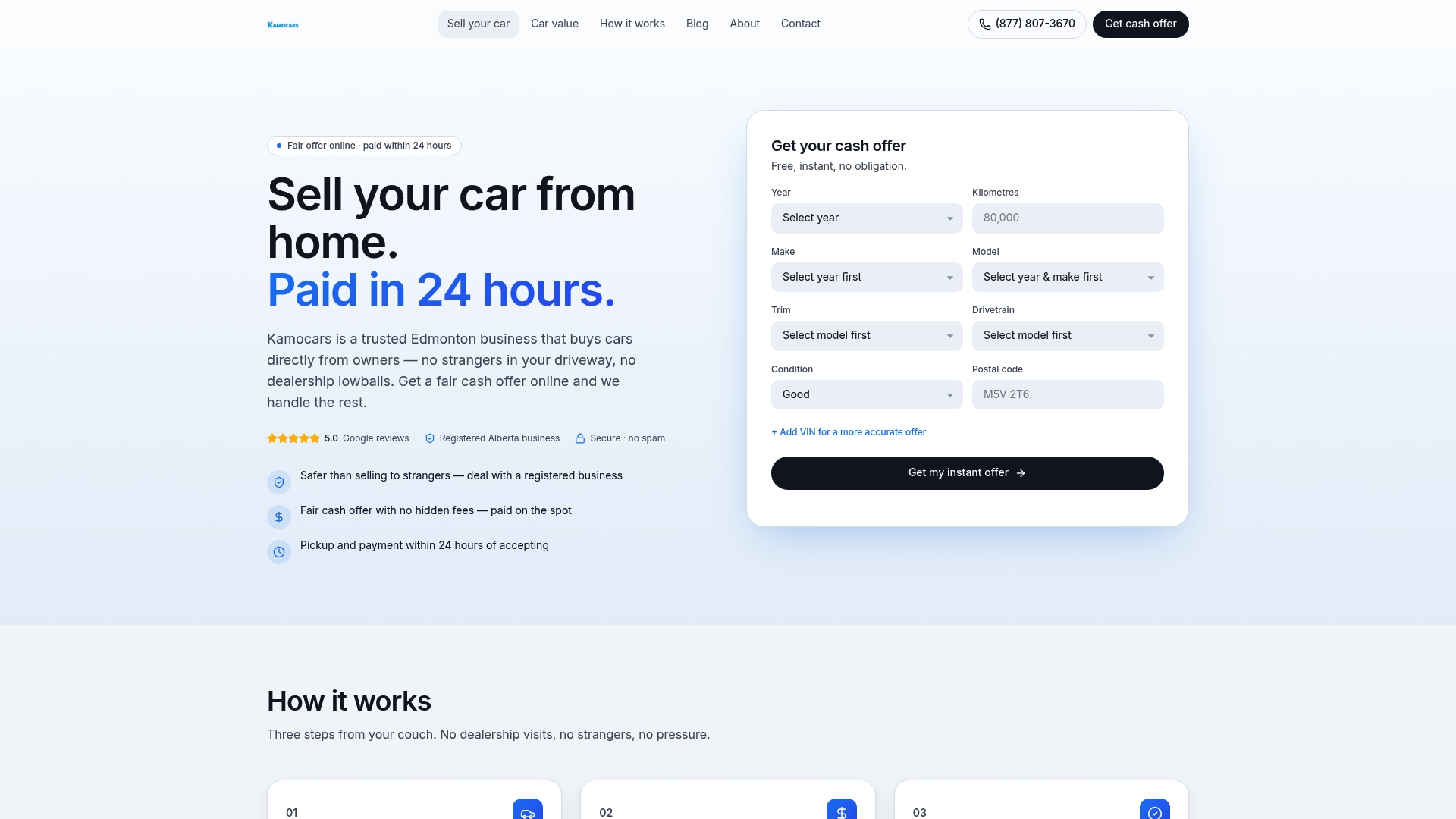
You still handle the basics: your account number, VIN, and lender contact. Kamocars takes it from there, working with lenders on financed and leased vehicles so you’re not stuck waiting on registry updates before you get paid. If your car has a lien and you’re not sure where to start, read through selling a car with a lien in Canada for the full breakdown, then get your cash offer to see what your vehicle is worth today.
Where to Verify Payoff and Lien Rules
- FCA Canada’s guidance on car loan liens for registry and discharge rules.
- Galbraith Law on payout timing for Alberta closings.
- A lien release letter template to bring to your lender or solicitor.
Sources
- Financial Consumer Agency of Canada — Risks with car liens
- Galbraith Law — Payouts: Mortgages, homeowner association and commissions
- Title lien release letter template (GenieAI)
Recommended
Get a real cash offer in 2 minutes
Trusted business. Fair price. Paid on the spot when we pick up your car.