
Online Car Valuation Process: Step-by-Step Seller's Guide
Unlock your car's value with this guide to the online car valuation process. Get ready to sell today with accurate pricing tools and tips!
Online Car Valuation Process: Step-by-Step Seller’s Guide

You can produce a seller-ready valuation right now by running a VIN-based lookup, reporting precise condition and mileage, and reconciling two or three tool outputs into a working asking price. Here’s the short version before the full walkthrough:
What you need to start:
- Your 17-digit VIN (from the dashboard or driver’s door jamb)
- Current odometer reading with a date stamp
- Your ZIP code and exact trim/package details
- 6–8 clear photos of the exterior, interior, and any damage
What to expect from the results:
- Online self-assessments typically vary from a certified on-site appraisal within a moderate range
- Use a conservative midpoint from your results as your selling baseline
- For high-stakes situations (insurance disputes, classic cars, estate valuations), a USPAP-compliant professional appraisal is worth the cost
- Sellkamocars offers a verified cash offer as a fast, no-haggle alternative once you have your baseline
Table of Contents
- What does the online car valuation process actually require?
- Which tools should you run a VIN-based lookup on first?
- How should you report condition and mileage to get accurate results?
- How do you turn three different estimates into one working price?
- How accurate are online valuations, and what pitfalls should you watch for?
- When does a professional on-site appraisal make more sense?
- How do you turn your valuation into an actual sale or trade?
- Key Takeaways
- The habit most sellers skip (and why it costs them)
- Get a fast cash offer from Sellkamocars
- Sources and further reading
What does the online car valuation process actually require?
Before you open a single tool, gather everything in one place. Running a lookup with incomplete inputs is the fastest way to get a number that doesn’t match reality.
Documents and identifiers:
- VIN or license plate. The VIN is more precise. A license plate lookup can pull the wrong trim if the DMV record is outdated. Find your VIN on the lower-left corner of the windshield, the driver’s door jamb sticker, or your registration.
- Current odometer reading. Take a photo of the cluster today. Tools weight mileage heavily, and a number from three months ago can shift the estimate by hundreds of dollars.
- Title status. Clean, salvage, rebuilt, or lien? Each affects value differently. Know which applies before you start.
Trim and options:
- Pull the original window sticker or build sheet if you have it. Factory packages (sunroof, tow package, premium audio) add real value that a base-trim lookup will miss.
- Check the door jamb sticker for RPO codes if you’re unsure what came from the factory versus what a previous owner added.
Photos (take these before you run any tool):
- All four exterior corners
- Driver’s seat and dashboard
- Odometer reading
- Any scratches, dents, or rust, close up
- Under-hood shot if the car is older or high-mileage
- Most recent service sticker on the windshield
Pro Tip: Capture condition photos before washing the car. A clean car looks better, but the pre-wash shots document actual wear and protect you if a buyer or insurer disputes the condition later.
Service records and receipts:
- Gather maintenance records, recent repair invoices, and receipts for any aftermarket work. Aftermarket modifications and maintenance history are details automated tools often miss entirely, but a human buyer or appraiser will ask about them.
Which tools should you run a VIN-based lookup on first?
Three tools dominate the online valuation space, and each returns something different. Run all three with identical inputs so the outputs are actually comparable.
Kelley Blue Book (KBB)
- Requires: VIN or license plate, ZIP code, mileage, condition rating, and selected options
- Returns: Trade-in value, private-party value, and suggested retail price as separate ranges
- Best for: Setting a private-sale asking price and understanding the gap between what a dealer will offer versus what a private buyer might pay
- KBB draws on actual sales transaction data and adjusts for regional market conditions using your ZIP code
CARFAX
- Requires: VIN
- Returns: A vehicle history report (accidents, ownership count, service records, title events) plus a history-adjusted market value
- Best for: Understanding how your car’s past affects its price. A single reported accident can reduce value noticeably; two or more owners in three years signals higher depreciation risk to buyers. Car history’s role in valuation is often the factor sellers underestimate most.
- History-based value differs from book value because it prices in real risk, not just age and mileage
Edmunds
- Requires: VIN or year/make/model, ZIP, mileage, condition, and options
- Returns: True Market Value (TMV), a retail estimate built from actual listing and transaction data in your area
- Best for: Pricing a car you plan to list privately or understanding what dealers in your region are actually selling comparable vehicles for
- Edmunds blends live listing data into its estimate, so it tends to reflect current market conditions faster than static book values
Instant cash-offer tools
- These combine market data, vehicle history, and a business margin into a single take-it-or-leave-it number
- Expect the figure to land below private-party estimates. That gap is the buyer’s reconditioning and resale margin, not a mistake.
- Best for: Sellers who prioritize speed and certainty over squeezing out the last dollar
Practical workflow: Run the VIN lookup first on each tool. Then re-enter the same mileage, ZIP, and condition grade across all three so you’re comparing apples to apples. Mixing a “good” condition entry on one tool with “excellent” on another produces a spread that tells you nothing useful.
How should you report condition and mileage to get accurate results?
The condition grade you select is the single input that moves the needle most. Most tools use four categories: Excellent, Good, Fair, and Poor. Here’s how to place your car honestly.
Condition categories in plain terms:
- Excellent: No mechanical issues, paint is flawless or near-flawless, interior has no tears or stains, tires have 50%+ tread remaining. Fewer than 5% of used cars genuinely qualify.
- Good: Minor cosmetic wear (small door dings, light interior scuffs), all systems working, tires acceptable. This is where most well-maintained cars land.
- Fair: Visible paint chips or scratches, worn interior, one or more mechanical issues that need attention, tires at or near replacement threshold.
- Poor: Significant body damage, major mechanical problems, or a salvage/rebuilt title.
Mileage tiers to know: Most tools apply a discount once a vehicle crosses 100,000 miles, with steeper adjustments around 150,000 and 200,000. If your car is at 98,500 miles, report the actual number. Rounding down to “under 100k” in conversation but entering 98,500 in the tool gives you the most accurate output.
Photo guidance that reduces valuation surprises:
- Frame damage shots straight-on with good lighting so the size is clear
- Include a ruler or coin next to a scratch if it’s borderline between categories
- Capturing vehicle condition early reduces surprises during negotiation and builds buyer trust
Pro Tip: Document aftermarket upgrades with professional receipts. A dealer-installed remote start or a certified lift kit with paperwork can add real value, but only if you can prove it was done correctly.

How do you turn three different estimates into one working price?
Line up your outputs by value type before you do any math. Mixing a trade-in number with a private-party number and averaging them produces a figure that represents neither.
- Sort by type. List your trade-in estimates in one column, private-party estimates in another, and any instant cash offers in a third.
- Average within each type. If KBB shows a private-party range of $14,500–$16,200 and Edmunds shows $15,100, your private-party midpoint is roughly $15,267. Round to $15,300 for simplicity.
- Set your asking price above the midpoint. Add 8–12% to your private-party midpoint to leave room for negotiation. At $15,300, that puts your list price around $16,500–$17,100.
- Set your walk-away floor. Use your trade-in midpoint as the absolute minimum you’ll accept. Anything above it is a win over the dealer route.
- Check regional listings. Search your ZIP code on a classifieds site for the same year, make, model, and trim. If local listings cluster $1,500 below your midpoint, adjust down. If they’re higher, hold your number.
When to trust the spread and when to investigate:
Estimates within ±5% of each other signal a stable, well-documented market for your car. A spread wider than 15% usually means one tool has the wrong trim, a different mileage tier, or stale regional comps. Fix the inputs before you set a price.
Seasonal shifts matter too. Trucks and SUVs tend to command stronger prices in fall and winter in most U.S. markets; convertibles peak in spring. If you’re within 60 days of a seasonal high, it’s worth waiting rather than pricing at a summer low.
How accurate are online valuations, and what pitfalls should you watch for?
Online tools are built for ballpark research. A formal appraisal targets ±5% accuracy with an on-site inspection, while online self-assessments commonly vary ±10–20% from that benchmark. That range is workable for pricing a private sale but too wide for legal or insurance disputes.
Common pitfalls:
- Wrong VIN or trim entry. A base-trim lookup on a fully loaded vehicle can undervalue it by thousands. Always confirm the VIN pulls the correct trim before accepting the output.
- Unreported damage. Selecting “Good” when the car has a repaired frame rail will produce an inflated estimate that collapses the moment a buyer or dealer inspects it.
- Mismatched mileage. Even a 5,000-mile difference can shift value by $300–$800 on a mid-range vehicle.
- Regionally stale comps. Tools that don’t update frequently can lag the market by 30–60 days, which matters in a fast-moving segment.
- Insurer ACV versus retail value. Insurers often rely on wholesale auction data when calculating Actual Cash Value, which can produce offers 10–20% below retail replacement value. If an insurer’s offer looks low, request the comparable sales they used and counter with retail-market comps.
How to verify a tool’s comps: Click through to the sample listings the tool shows. Check that the comparable vehicles match your trim, mileage band, and options. If the comps are base-trim or significantly higher mileage, the estimate is pulling from the wrong pool.

When does a professional on-site appraisal make more sense?
Four situations call for a certified appraisal rather than an online estimate:
- Insurance disputes and total-loss claims. If an insurer’s ACV offer is significantly below what you know the car is worth, an independent appraisal report is often the most effective leverage before formal arbitration. Many policies include an appraisal clause that triggers this process.
- Collectible, classic, or heavily modified vehicles. Online instant valuations under-value unique factors like rare trims, high-quality restorations, and documented aftermarket builds. A professional who specializes in the vehicle type will produce a defensible number.
- Estate, tax, or donation valuations. The IRS requires a qualified appraisal for non-cash charitable contributions above certain thresholds. A USPAP-compliant report is the standard that satisfies both the IRS and estate attorneys.
- Wide online estimate divergence. When your three tool outputs span more than 20% and you need a certified number to negotiate, a professional appraisal removes the ambiguity.
What a formal appraisal delivers: A thorough appraisal process includes scheduling, a 60–90 minute physical inspection, market research using comparable sales, adjustment calculations, and delivery of a USPAP-style report with photos and a signed appraiser certification. Expect the research and report phase to take 1–3 additional days after the inspection.
Cost and timeline: Certified appraisals typically run $150–$500 depending on vehicle type and report complexity. Online tools are free. The cost is justified when the dispute or transaction value is large enough that a $300 report can recover thousands.
How do you turn your valuation into an actual sale or trade?
Once you have a reconciled price, the path forward depends on what you’re optimizing for.
Decision checklist:
- Private sale gives you the highest net return but requires time, advertising, and dealing with buyers directly. Use your private-party midpoint as the asking price.
- Dealer trade-in is faster and simpler but expect an offer closer to your trade-in midpoint. Knowing common dealership appraisal tactics before you walk in prevents leaving money on the table.
- Instant online buyer (including Sellkamocars) prioritizes speed and certainty. The offer will be below private-party value but above a typical dealer trade-in lowball, and the process takes hours rather than weeks.
Step-by-step action plan:
- Print or save your reconciled price range and the tool outputs that support it.
- Prepare your ad: use your best exterior photos, list the VIN, exact mileage, trim, and all options, and state the title status upfront.
- Gather service records, both keys, and the owner’s manual. Buyers pay more for complete packages.
- Set a negotiation floor at your trade-in midpoint. Don’t go below it without a clear reason.
- Schedule any pre-sale inspection at an independent shop if you’re selling privately. A clean inspection report removes buyer hesitation.
- For a fast cash offer with free pickup and payment within 24 hours, request a no-obligation appraisal from Sellkamocars. You’ll need the same inputs you gathered in Step 1.
Timeline by path:
- Private sale: 2–6 weeks on average
- Dealer trade-in: same day to 48 hours
- Instant online buyer: 24–48 hours from quote to payment
For vehicles that may be at end-of-life or salvage candidates, a scrap value guide can help you understand whether a different valuation path applies before you run standard market tools.
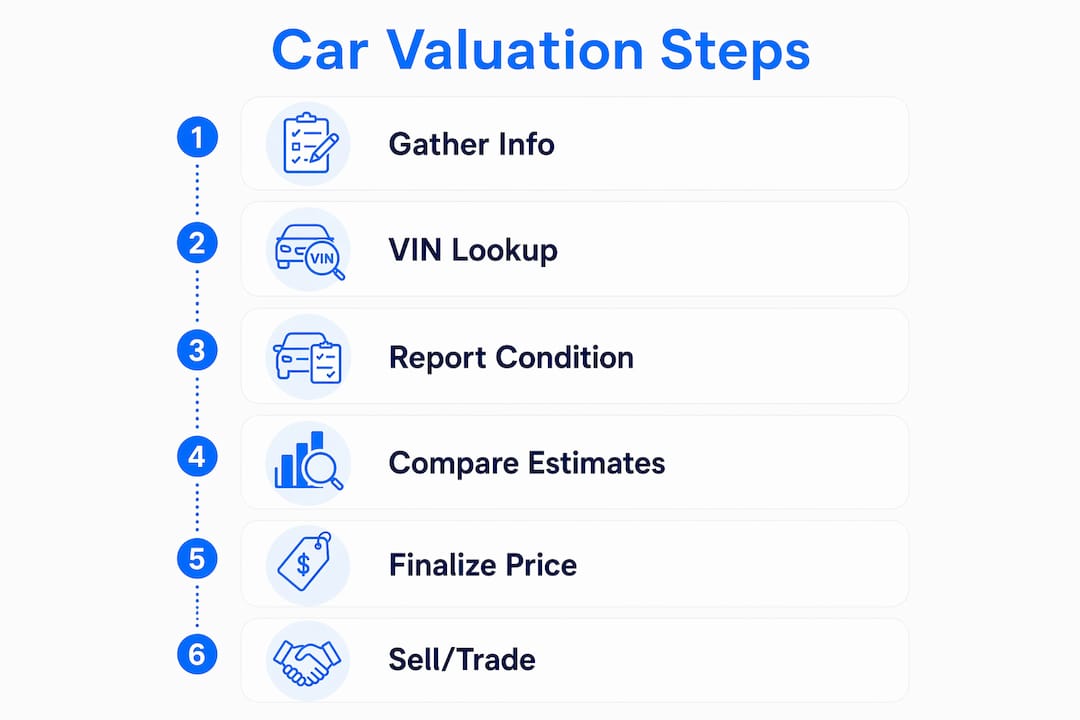
Key Takeaways
A complete online car valuation requires VIN-based lookups, honest condition reporting, and reconciling multiple tool outputs into a single working price before you approach any buyer or dealer.
| Point | Details |
|---|---|
| Gather inputs first | Collect your VIN, odometer photo, 6–8 vehicle photos, and service records before running any tool. |
| Run multiple tools | Use KBB, CARFAX, and Edmunds with identical inputs, then reconcile outputs by value type. |
| Expect some variance | Online self-assessments commonly vary ±10–20% from certified appraisal benchmarks; use a conservative midpoint. |
| Escalate for unique cars | If estimates diverge more than 15%, or the vehicle is modified or collectible, get a professional appraisal. |
| Sellkamocars as a fast exit | Sellkamocars provides a no-haggle cash offer with free pickup and payment within 24 hours for sellers prioritizing speed. |
The habit most sellers skip (and why it costs them)
The most common mistake sellers make is running an online valuation without documenting condition first. They select “Good” because it sounds right, get a number, and then watch it collapse when a buyer or dealer points out the cracked bumper cover they mentally edited out.
The fix is simple: photograph the car before you look up a single value. Those photos lock in an honest condition grade, protect you during negotiation, and give you something concrete to show a buyer who tries to talk the price down based on cosmetic issues you’ve already priced in. VIN-based lookups matter for the same reason. A license plate search can pull the wrong trim and produce a number that’s off by $2,000 before you’ve even started. Get the VIN right, get the condition documented, and the rest of the process is just math.
Get a fast cash offer from Sellkamocars
If you’ve done the valuation work and speed matters more than squeezing out the last dollar, Sellkamocars is built for exactly that situation. You get a no-haggle online quote based on current market data, a free vehicle inspection, and pickup plus payment completed within 24 hours. No strangers, no negotiation theater, no waiting weeks for a private buyer to show up.
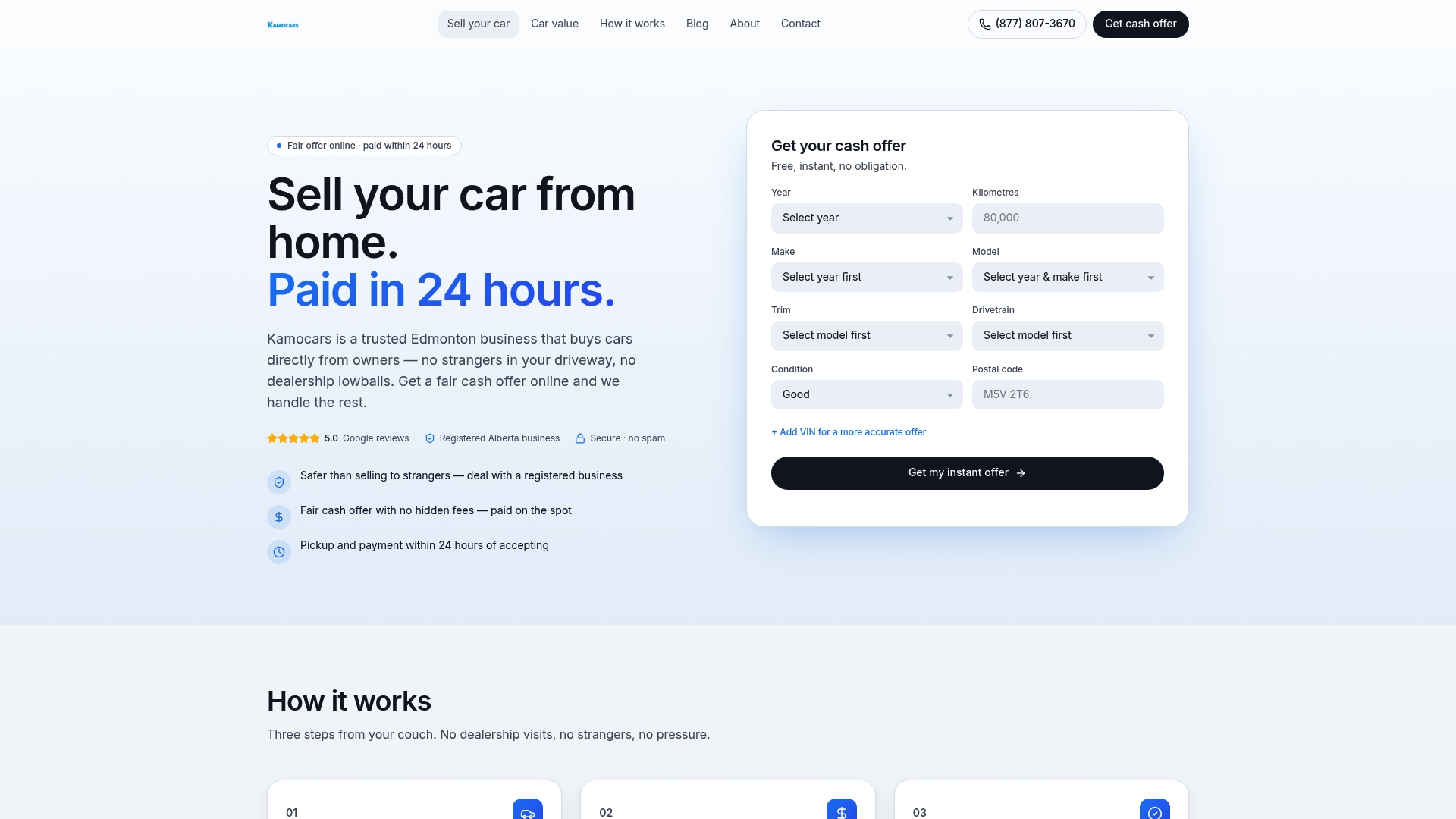
The process is straightforward: submit your vehicle details at Sell My Car, receive a documented cash offer, and schedule pickup at your convenience. Sellkamocars has completed over 500 transactions with a strong customer rating, and its registered business status means you’re dealing with a verified buyer, not an anonymous listing. To see exactly how it works from quote to payment, visit the process page and request your offer today.
Sources and further reading
- National Motor Vehicle Title Information System (NMVTIS) — official federal resource for understanding vehicle history reports and title data
- BLS Used Cars and Trucks CPI — Bureau of Labor Statistics data on used vehicle price trends
- Consumer Reports Car Value Estimator — independent tool for trade-in and market value estimates
- What Is Vehicle Appraisal? | Certified AutoBrokers Inc. — overview of appraisal types and accuracy benchmarks
- Car Appraisal Process | Auto Appraisal Group, Inc. — step-by-step breakdown of a certified professional appraisal
- What Is My Car’s ACV? | SnapClaim — explains how insurers calculate ACV and how to challenge low offers
- Types of Fair Car Valuations | Kamocars — seller-focused guide to trade-in, private-party, and retail value differences
- How Kamocars Prices Your Car — explains the data sources and methodology behind Sellkamocars’ offers
- Car Selling Options Compared | Kamocars — side-by-side comparison of private sale, dealer trade-in, and instant online buyers
Recommended
Get a real cash offer in 2 minutes
Trusted business. Fair price. Paid on the spot when we pick up your car.