
Prove "One Owner" and Add Real Value in Canada’s 2026 Market
Turn a one-owner claim into higher offers. Use VIN appraisals, complete service records, and the Alberta paperwork checklist to prove value and get better...
Prove “One Owner” and Add Real Value in Canada’s 2026 Market

A documented one owner car can help you get a better price, but it is not an automatic premium. Mileage, condition, accident history, and the VIN level data that Canadian Black Book and vehicle history reports provide still determine the real value. Your next move: run an online appraisal and have your VIN and service records ready before you negotiate.
TL;DR:
- Vehicle condition, accident history, and detailed service records influence the actual resale value more than ownership count.
- Online appraisals vary depending on regional data, dataset timing, and reconditioning assumptions, so comparing multiple tools provides better accuracy.
- Crossing common mileage thresholds like 100,000 or 160,000 kilometers causes larger value drops, regardless of overall wear.
- A complete paper trail, including lien searches and verified maintenance history, significantly strengthens your private sale or trade-in offer.
- Selling through services like Kamocars can streamline the process by providing same-day offers based on current Canadian market data.
Table of Contents
- How online appraisal and trade-in calculators actually estimate value
- Key value drivers that matter more than owner count
- How to run an online appraisal and read the result
- Canada/Alberta paperwork sellers should prepare
- A seller’s take on turning one owner into a stronger offer
- Kamocars: a fast, secure way to sell in Alberta
- FAQ
- Sources
How online appraisal and trade-in calculators actually estimate value
Every calculator asks for roughly the same inputs, then weighs them differently depending on what the tool is built to produce.
- VIN or year, make, model, and trim
- Current odometer reading
- Overall condition rating
- Installed options and packages
- Postal code or regional market
The VIN matters more than most sellers realize; learning how to find your ATV VIN in six places can provide practical tips useful even beyond powersports to understand VIN-level information in Canada. Decoding it pulls exact trim, factory options, and build details, and Canadian Black Book uses this VIN specific data alongside mileage and condition to generate trade-in values that update daily. Two vehicles with the same badge can carry different values once the VIN reveals different drivetrains or option packages.
Dealer trade-in numbers tend to land closer to wholesale or auction pricing because dealers need margin to recondition and resell. Private-sale estimates run higher since you are pricing to a retail buyer directly, without a dealer’s overhead built in. This gap explains why a trade-in quote and an online “value your car” result rarely match, and why calculator outputs can vary by timing, dataset, regional inventory, and the reconditioning assumptions baked into each tool. Running your VIN through a free Alberta car value tool alongside a general calculator gives you a realistic range rather than a single number to anchor on.
Key value drivers that matter more than owner count
Owner count is a detail. These factors move actual dollars.
- Mileage: value loss is not a straight line. Crossing common thresholds, like 100,000 or 160,000 kilometers, tends to trigger bigger drops than the kilometers themselves would suggest.
- Condition and reconditioning cost: worn brakes, tires near the end of their tread, chipped paint, or a stained interior each translate into a line-item deduction once a dealer factors in the cost to recondition before resale.
- Accident and service history: a clean record from CARFAX Canada or a Vehicle Information Report gives buyers confidence and tends to support stronger offers than a vehicle with gaps or unexplained repairs.
- Trim and options: desirable packages and sought-after configurations hold value better than base trims in the same model line.
- Market timing: Canadian Black Book’s 2026 market outlook points to continued depreciation pressure across many segments, which means timing your sale affects the number more than almost anything else you control.
One owner status only pays off when you can prove it. Canadian valuation models treat it as a confidence signal, not a fixed premium, and that confidence only matters if full maintenance records back it up.
Pro Tip: Pull your service records together before you price the car. A complete file turns “one owner” from a claim into evidence a buyer can verify.

How to run an online appraisal and read the result
Getting a usable number out of a calculator takes a little prep work first.
- Gather your VIN, exact odometer reading, recent photos, and any service receipts.
- Enter honest condition ratings and your exact trim and options, since guessing optimistically only produces a number you cannot defend later.
- Note which label the tool gives you, trade-in, private-sale, or wholesale, since each represents a different buyer and a different price.
- Compare the trade-in figure against expected private-sale pricing using local comparables and reconditioning costs to set a realistic ask.
- Order a vehicle-history report if you have not already, since it changes how buyers respond to your listing.
A few things to keep in mind as you read the output:
- A trade-in quote is a starting point, not your ceiling, once you add typical market differentials.
- Private-sale ranges from different tools can vary because each pulls from a different dataset and region.
- A clean CARFAX Canada or VIR report tends to shift buyer confidence more than almost any other single document you can show.
Canada/Alberta paperwork sellers should prepare
Alberta buyers and dealers expect a specific paper trail before they take a one owner claim seriously.
- Your registration or ownership document and a dated, signed bill of sale that matches AMA’s bill of sale guidance for required vehicle details.
- Complete maintenance records, which support both your asking price and your one owner story.
- A lien search through Alberta’s registry system, since AMVIC’s vehicle research guidance flags lien confirmation as essential due diligence before any sale closes.
- A Vehicle Information Report from a registry agent or a CARFAX Canada report, either of which lets a buyer verify history independent of your word.
Our guide on documents needed to sell a car in Alberta walks through each step, and our bill of sale template covers the exact fields Alberta transactions require.
A seller’s take on turning one owner into a stronger offer
The real lever is not the owner count, it is the paper trail behind it. Pull your service records, run your VIN through a couple of calculators, and answer every condition question honestly rather than optimistically. A private sale usually nets more money but costs you time and exposes you to unqualified buyers. A dealer trade-in is fast but prices toward wholesale. An instant cash buyer sits in between: less work than a private sale, often a stronger number than a trade-in, especially once your documentation is in order.
— Omar
Kamocars: a fast, secure way to sell in Alberta
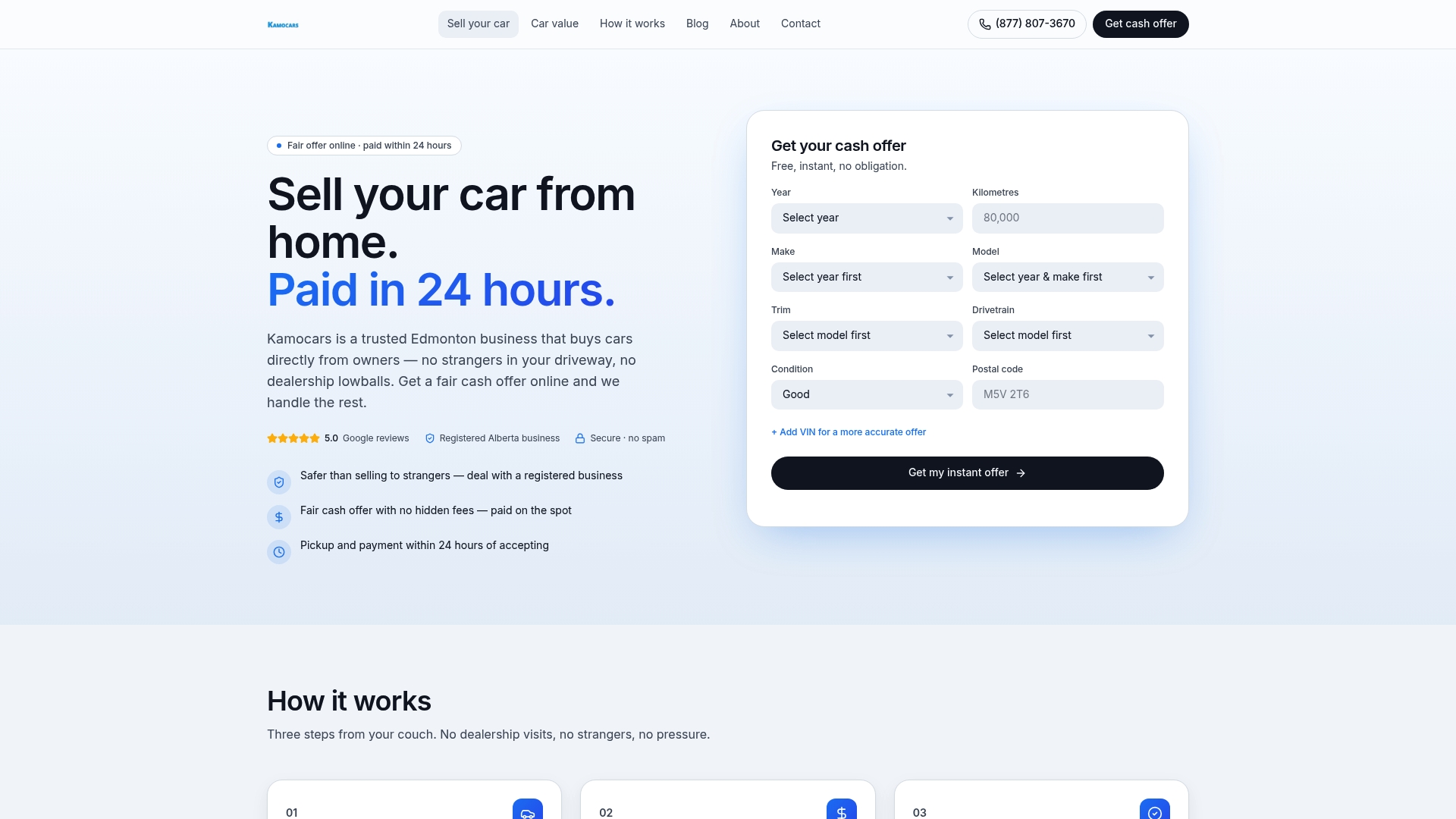
Once you have your VIN, odometer reading, and service file together, The company turns that work into an offer the same day, building instant appraisals from current Canadian market data, so one owner history and documentation show up in the number.
- Offers based on market data
- Home pickup available anywhere in Alberta
- Payment handled within a short timeframe, including lien clearance.
This service is designed for owners with a 2018 or newer running car, truck, or SUV who want a straightforward sale without listing photos, strangers, or haggling. Start with Sell My Car or read how it works before you request your offer.
FAQ
Does being a one-owner car automatically increase its resale value?
No. One owner status supports buyer confidence but Canadian valuation models, including Canadian Black Book, weigh mileage, condition, accident history, and documentation far more heavily than owner count alone. A one owner car with no service records often sells for less than a well-documented multi-owner vehicle.
What is the average price of a car in Canada?
There is no single published national average that applies evenly across models, years, and regions, so the honest answer depends on the specific vehicle. Running your VIN and trim through a Canadian Black Book or dealer appraisal tool gives you a figure specific to your car rather than a misleading national blend.
Where can I find a free car value calculator in Alberta?
Kamocars offers a free car value tool built for Alberta sellers, and Canadian Black Book’s consumer widget is another option worth comparing against it. Running your VIN through both gives you a realistic range before you list or negotiate.
How much car can I afford in Canada?
Affordability depends on your income, existing debt, and the loan or lease terms you qualify for, which varies by lender and vehicle. A practical starting point is comparing your trade-in or sale proceeds against your target purchase price before you shop, so you know your real budget going in.
Are cars cheaper to buy in Canada right now?
Pricing depends heavily on segment and timing rather than a flat yes or no answer. Canadian Black Book’s 2026 market outlook points to continued depreciation pressure in many segments, which can work in a buyer’s favor depending on what they are shopping for.
Sources
- Mastering modern auto valuation: expert tips for data-driven depreciation & strategies in Canada — Canadian Black Book
- Canadian Black Book’s trade-in values — Canadian Black Book
- Researching the vehicle — Alberta Motor Vehicle Industry Council (AMVIC)
- 2026 Canadian Black Book market preview / outlook — Canadian Black Book
Recommended
Get a real cash offer in 2 minutes
Trusted business. Fair price. Paid on the spot when we pick up your car.