
How Official Car Sale Receipts Work: 2026 Guide
Learn how official car sale receipts work to protect buyers and sellers. Understand key components for a smooth transaction in our 2026 guide.
How Official Car Sale Receipts Work: 2026 Guide

An official car sale receipt is the legally recognized record that proves a vehicle sale transaction occurred between two parties, covering payment terms, vehicle identity, and the conditions of transfer. Also called a bill of sale, this document serves as proof of payment, legal evidence of the sale, and a required input for DMV registration and tax calculation in most states. Without it, buyers risk losing ownership claims, and sellers risk liability for incidents that happen after the car leaves their hands. Understanding how official car sale receipts work protects both sides of the deal.
How official car sale receipts work: core components
A complete car sale receipt captures eight critical elements that prevent future legal and financial disputes between buyers and sellers. Each element serves a specific legal or administrative purpose. Missing even one can trigger DMV rejection or open the door to fraud.
Every valid receipt must include:
- Full legal names and addresses of both buyer and seller
- Complete vehicle description: year, make, model, and Vehicle Identification Number (VIN)
- Odometer reading with a federal disclosure statement (required for vehicles under 20 years old)
- Sale price written in both numbers and words to prevent unauthorized changes and tax confusion
- Date and time of the sale
- Payment method (cash, certified check, electronic transfer) and confirmation that funds were received
- As-is condition clause stating the vehicle carries no warranties
- Signatures of both buyer and seller
Legal experts recommend writing the sale price in both numeric and written form. A price written only as “$8,500” can be altered; “Eight Thousand Five Hundred Dollars” cannot be changed without obvious tampering.
Private vehicle sales carry no automatic warranty, so the as-is clause must appear explicitly. Without it, a buyer could argue the seller implied the car was in good working condition. That argument can hold up in small claims court.

Pro Tip: Download your state’s official DMV bill of sale form before writing anything. Official forms are pre-structured to meet local requirements, which reduces the chance of rejection.
What are the state-specific rules for car sale receipts?
State rules on vehicle sale receipts vary significantly, and getting them wrong delays registration. As of 2026, 16 US states mandate a bill of sale to register a used vehicle, while another 12 states strongly recommend it as best practice. That means in nearly half the country, skipping this document blocks the buyer from legally registering the car.
Notarization adds another layer. Five states require the bill of sale to be notarized to be legally binding: Louisiana, Maryland, Nebraska, New Hampshire, and West Virginia. In those states, a receipt signed at a kitchen table is not enough. Both parties must appear before a notary public.
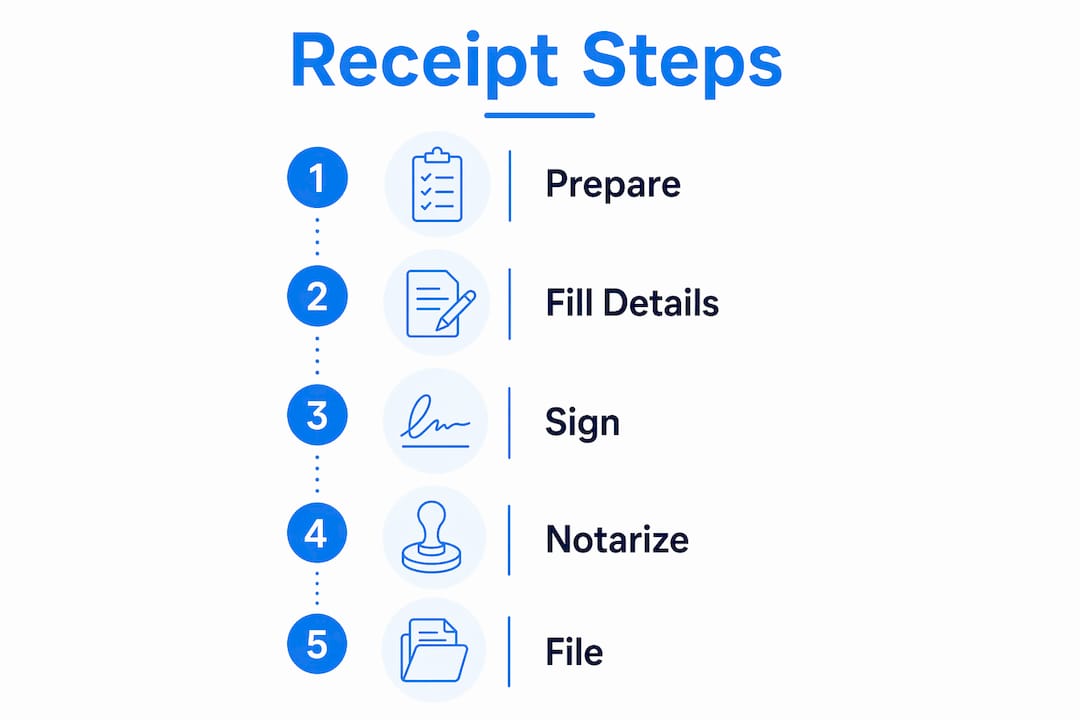
Several states publish their own official forms, and using them is the safest path:
| State | Official Form | Notes |
|---|---|---|
| Texas | Form 130-U | Combines title application and bill of sale |
| California | REG 135 | Required for private party transfers |
| Florida | HSMV 82050 | Covers motor vehicle, mobile home, and vessel sales |
Standard official DMV forms vary by state and are recommended to confirm completeness for vehicle registration. Using a generic template when your state has an official form is a common mistake that causes rejection.
Federal law adds one universal requirement. Federal odometer disclosure laws require nearly all vehicles under 20 years old to include a written odometer disclosure as part of the sale record. Many state DMV forms integrate this disclosure directly into the bill of sale, but if yours does not, you need a separate odometer statement.
Pro Tip: Check your state DMV website before the sale date. Requirements change, and a form that worked two years ago may no longer satisfy current registration rules.
How does a car sale receipt differ from the vehicle title?
Buyers and sellers often confuse the receipt with the title. They are two separate documents with different legal functions. A car sale receipt is not the same as the vehicle title. The title legally proves ownership; the receipt records the transaction terms.
Here is how each document works in the sale process:
- Vehicle title: The seller signs the back of the title over to the buyer. This act legally transfers ownership. Without a signed title, the buyer does not own the car regardless of what the receipt says.
- Car sale receipt (bill of sale): Records the price paid, the vehicle’s condition at the time of sale, and the identities of both parties. It does not transfer ownership on its own.
- Release of liability form: Filed by the seller with the DMV after the sale. This form confirms the seller’s legal separation from the vehicle and protects against parking tickets, accidents, or crimes involving the car after it changes hands.
All three documents work together. A signed title without a receipt leaves the buyer with no written record of the agreed price, which creates tax and dispute problems. A receipt without a signed title means the buyer has no legal ownership. A missing release of liability form leaves the seller exposed to claims tied to the vehicle’s future use.
Filing a release of liability form promptly after the sale is necessary to confirm the seller’s disassociation from the vehicle. Most states allow this to be filed online through the DMV portal the same day as the sale.
Even when a bill of sale is not legally required, obtaining one protects against post-sale liability and supports accurate tax reporting. Skipping it because your state does not mandate it is a risk not worth taking.
Best practices for creating and verifying a valid car sale receipt
A valid receipt starts with the right template. Use your state’s official DMV form when one exists. If your state does not publish one, use a template that covers all eight required fields. Blank fields are the most common reason DMV offices reject submissions.
Follow these steps to create a receipt that holds up:
- Verify the VIN before writing anything. The VIN on the receipt must match the VIN on the title and the VIN plate on the dashboard. A single digit error causes rejection and forces both parties to meet again to re-sign.
- Write the sale price in numbers and words. “$9,200 (Nine Thousand Two Hundred Dollars)” is fraud-resistant and tax-authority-friendly.
- Record the odometer reading at the time of signing. Federal law requires this for vehicles under 20 years old. Both parties must acknowledge the reading in writing.
- Confirm payment before signing. If paying by check, wait for it to clear. If paying by cash, count it in front of both parties. Record the payment method on the receipt.
- Sign in front of a notary if your state requires it. Even if your state does not require notarization, doing it voluntarily adds legal weight to the document.
- Both parties keep a signed copy. Experts recommend retaining signed copies for at least 4 years, which covers most contract dispute statutes of limitations.
- File the release of liability the same day. Do not wait. The moment the car drives away, your exposure begins.
Errors or omissions in the bill of sale often lead to DMV rejection, forcing both parties to re-sign corrected documents. This creates serious problems when the seller has already moved, changed contact information, or is simply unavailable. Getting it right the first time is not optional.
Pro Tip: Take a photo of the completed, signed receipt before handing over the original. Store it in a cloud folder alongside the title copy and release of liability confirmation.
Check the legal checklist for selling a car to confirm you have every document in order before the sale date.
Key Takeaways
A valid car sale receipt requires eight specific elements, state-compliant formatting, and prompt post-sale filing to protect both buyer and seller from legal and financial exposure.
| Point | Details |
|---|---|
| Eight required elements | Every receipt must include VIN, odometer reading, sale price in words and numbers, signatures, and an as-is clause. |
| State rules vary widely | 16 states require a bill of sale to register a vehicle; 5 states require notarization. |
| Receipt is not the title | The title transfers ownership; the receipt records transaction terms. Both documents are necessary. |
| Retain copies for 4 years | Keep signed copies to cover most contract dispute statutes of limitations. |
| File liability release promptly | Submit the release of liability form to the DMV the same day as the sale to close your legal exposure. |
Why I take car sale receipts more seriously than most sellers do
Most sellers treat the receipt as an afterthought. They focus on the price negotiation, the title handover, and getting paid. The receipt gets scribbled on a notepad or downloaded from a random website with no verification that it meets state requirements. I have seen that approach cause real problems.
The most common issue I observe is a mismatched VIN. Someone copies the number from memory instead of reading it directly off the dashboard plate, and one digit is wrong. The buyer shows up at the DMV, gets rejected, and now needs the seller to come back and re-sign. If the seller has moved or is unresponsive, the buyer is stuck. That situation is entirely preventable.
The second issue is sellers who skip the release of liability form because they think the signed title is enough. It is not. A signed title transfers ownership, but the DMV does not know the car changed hands until someone files the paperwork. Parking tickets, toll violations, and worse can land on the seller’s record in the meantime.
My honest advice: treat the receipt and the release of liability form with the same seriousness you give the title. Use your state’s official DMV form, verify every field before signing, and file the liability release the same day. That combination closes every legal gap. For sellers who want the paperwork handled correctly without the back-and-forth, working with a registered buyer like Sellkamocars removes the guesswork entirely. You can also review safe transaction practices to understand what a properly documented sale looks like from start to finish.
— Omar
Selling your car with Sellkamocars means paperwork done right
Handling a car sale receipt correctly takes preparation, and one missed field can set the whole transaction back by days.
Sellkamocars handles the documentation side of the sale so you do not have to track down state forms or worry about notarization requirements. The process is straightforward: get a fair cash offer online based on current market data, schedule a free pickup, and receive payment within 24 hours. Every transaction through Sellkamocars is backed by registered business status, which means the paperwork meets legal standards from the start. With over 500 completed transactions, the process is built to protect sellers at every step. See exactly how it works or get started with a fast cash offer today.
FAQ
What is an official car sale receipt?
An official car sale receipt, also called a bill of sale, is a written record of a vehicle sale that documents the price, vehicle details, and identities of both parties. It serves as proof of payment and supports DMV registration and tax reporting.
What must a car sale receipt include?
A valid receipt must include the buyer and seller names, vehicle VIN, odometer reading, sale price in numbers and words, payment method, sale date, as-is clause, and signatures from both parties.
Do all states require a bill of sale to register a car?
16 states require a bill of sale to register a used vehicle, and 12 more strongly recommend it. Even in states where it is not required, having one protects both parties from post-sale disputes.
Is a car sale receipt the same as the vehicle title?
No. The title legally transfers ownership from seller to buyer. The receipt records the transaction terms, including price and condition. Both documents are needed for a complete, legally sound sale.
How long should you keep a car sale receipt?
Keep signed copies for at least 4 years. That period covers most contract dispute statutes of limitations and protects both buyer and seller if questions arise about the transaction.
Recommended
Get a real cash offer in 2 minutes
Trusted business. Fair price. Paid on the spot when we pick up your car.