
How Offer Comparison Helps Car Sellers Get More Money
Discover how offer comparison helps car sellers maximize profits. Get higher sale prices and better negotiating power by comparing offers!
How Offer Comparison Helps Car Sellers Get More Money

Comparing multiple car sale offers is the single most effective thing you can do to increase what you walk away with. Sellers who collect offers from at least two or three sources before committing routinely see a price difference of several thousand dollars for the exact same vehicle, driven by the varying profit margins, transport fees, and reconditioning costs each buyer bakes into their number. That gap does not close on its own. You have to create the conditions for it.
Here is what offer comparison delivers for you as a seller:
- Higher sale price by exposing the spread between what different buyers will pay
- Stronger negotiating position because you hold real competing numbers, not assumptions
- Protection against undervaluation from accepting the first offer without context
- Clarity on hidden fees that reduce your net proceeds after the sale
- Better method selection by seeing how private buyers, dealers, and online platforms actually stack up
- Timing intelligence because market conditions shift by season, region, and vehicle type
No single buyer always offers the highest price. The right offer depends on your vehicle, your location, and when you sell. That is exactly why gathering multiple offers is not optional if you want the best outcome.
Table of Contents
- 1. How offer comparison helps car sellers maximize profit
- 2. How multiple offers strengthen your negotiating position
- 3. Avoiding undervaluation and uncovering hidden costs
- 4. How to evaluate offers from private buyers, dealerships, and online platforms
- 5. Timing your offers and using online tools to your advantage
- 6. What 2026 market data tells us about offer variation
- Sellkamocars gives you a fair cash offer without the back-and-forth
- Key takeaways
1. How offer comparison helps car sellers maximize profit
Price differences between buyers exist because each one operates on a different business model. A national online platform buys at or near wholesale, subtracts reconditioning costs, transport, and profit margin, then makes you an offer. A local dealer does the same math differently based on their current lot inventory. A private buyer pays closer to retail but requires more of your time. The result is that offers vary widely for the same car, and failing to compare offers can result in a price difference of $2,000 or more for the exact same vehicle due to varying profit margins, transport fees, and reconditioning costs across platforms.
The mechanism is straightforward: when you hold multiple offers, you know what the market actually looks like for your specific car. You are not guessing. You are comparing real numbers.
| Selling method | Typical offer level | Speed | Effort required |
|---|---|---|---|
| Private sale | Closest to retail | Slowest | High |
| Dealer trade-in | Wholesale or below | Fast | Low |
| Online instant offer | Near wholesale | Fast | Low |
| Broker / multi-buyer | Market-driven, competitive | Moderate | Low to moderate |
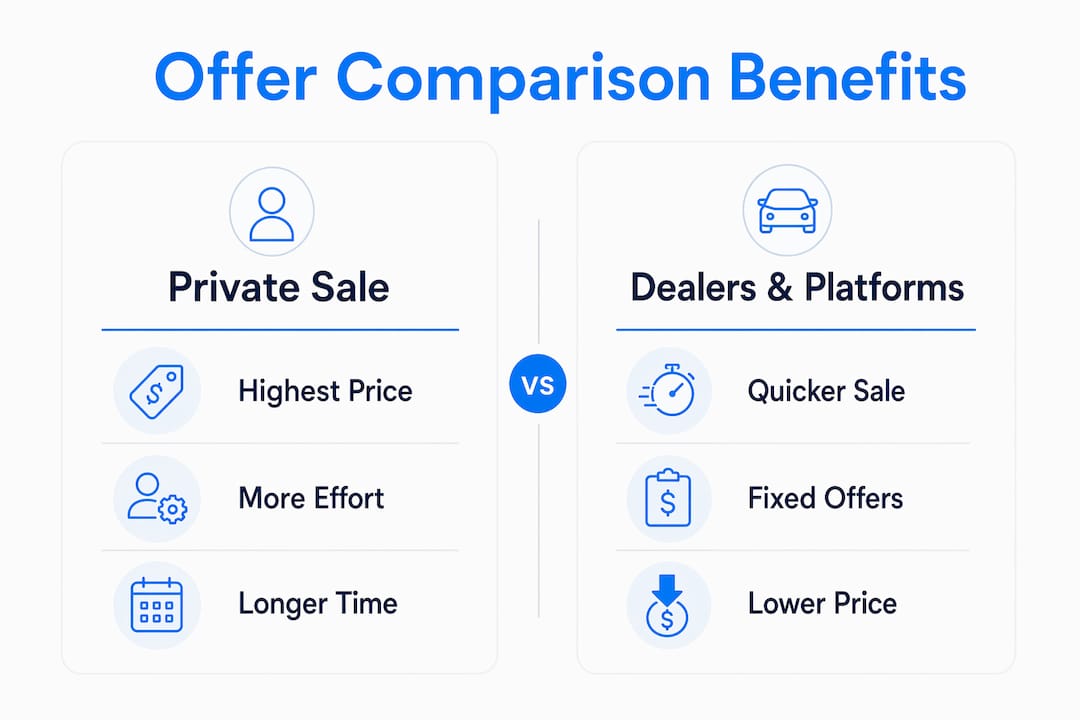
Vehicle condition, trim level, mileage, and local demand all affect which buyer will pay the most for your specific car. A pickup truck commands stronger offers in rural markets. A hybrid or EV tends to get better numbers in urban areas. No algorithm or single appraisal captures all of that variation. Only comparing actual offers does.
2. How multiple offers strengthen your negotiating position
Holding competing offers changes the entire dynamic of a sale. You are no longer a seller hoping a buyer will be fair. You are a seller with documented proof of what the market will pay.

Even on platforms that use a no-negotiation model, the leverage is real. You can decline a low offer without anxiety because you already have a better one in hand. You can push a private buyer toward their best number by mentioning you have other interest. And you can walk away from any deal that does not meet your floor, because you know your floor is grounded in actual market data.
Here is how multiple offers translate into concrete negotiating advantages:
- Decline low offers confidently without second-guessing whether you are leaving money on the table
- Prompt a best-offer scenario with private buyers who have room to move
- Use offer expiration windows strategically by timing competing quotes to expire around the same date
- Identify which buyers are firm vs. flexible based on how their offers are structured
- Set a realistic reserve price before any conversation starts
Pro Tip: Get all your offers within the same 48-to-72-hour window. Market values shift daily, and simultaneous offers give you an accurate, apples-to-apples comparison rather than a sequence of numbers that reflect different market moments.
Negotiation looks different depending on who you are selling to. Dealerships and most online platforms use fixed-offer models, meaning their number is their number. Private buyers, on the other hand, often have flexibility. Knowing which category your buyer falls into before you start talking saves time and sets realistic expectations.
3. Avoiding undervaluation and uncovering hidden costs
Accepting the first offer you receive is the most common and most costly mistake car sellers make. Without a comparison point, you have no way to know whether that offer reflects fair market value or a buyer’s best-case margin. The first offer is almost never the best one.
Hidden costs compound the problem. Many offers that look strong on the surface shrink considerably once you read the fine print.
Watch for these red flags when reviewing any offer:
- Post-inspection deductions for wear, mileage discrepancies, or undisclosed damage
- Processing or administrative fees subtracted from the quoted amount
- Transport or pickup charges that reduce your net proceeds
- Offer expiration pressure designed to prevent you from comparing alternatives
- Condition grading differences where “good” means something different to each buyer
- Conditional language that allows the buyer to revise the number after you have committed
The gap between a headline offer and what you actually receive can be substantial. Offer reliability varies significantly across buyer types. In-person appraisals from established buyers tend to produce firm numbers. Online instant offers are frequently estimates subject to adjustment at pickup. Knowing this distinction before you commit protects your net proceeds.
Understanding why dealers lowball car valuations is part of the same picture. Dealers build their margin into the offer from the start. Comparing across buyer types is the most direct way to counter that.
4. How to evaluate offers from private buyers, dealerships, and online platforms
Not all offers are built the same way, and the right comparison framework looks at more than price. Five dimensions matter: offer price, convenience, speed of sale, trustworthiness of the buyer, and hidden fees.
| Buyer type | Offer price | Convenience | Speed | Trustworthiness | Hidden fees |
|---|---|---|---|---|---|
| Private buyer | Highest potential | Low (meetings, negotiations) | Slowest | Variable | Minimal |
| Dealership | Below market | High | Fast | High (registered) | Trade-in bundling risk |
| Online instant offer | Near wholesale | High | Fast to moderate | High (established platforms) | Inspection deductions |
| Broker / multi-buyer | Competitive | Moderate | Moderate | High | Varies by service |
Before accepting any offer, run through this verification checklist:
- Confirm the buyer is a registered business or verified private party
- Ask whether the quoted price is final or subject to inspection adjustment
- Request an itemized breakdown of any fees or deductions
- Check online reviews for patterns of post-inspection price drops
- Verify the payment method and timeline before signing anything
- Confirm how a lien or loan payoff will be handled if your car is financed
Vehicle condition disclosure directly affects every number on this table. Failing to report existing damage does not protect your offer. It typically results in a larger post-inspection deduction or outright rescindment, which costs you more than the disclosure would have. Accurate condition reporting produces cleaner offers and fewer surprises at closing.
Pro Tip: Use online appraisal tools from multiple platforms on the same day to build your comparison baseline. Then take the top two or three numbers into the final stage of your sale. The five to ten minutes this takes is the highest-return time you will spend in the entire selling process.
5. Timing your offers and using online tools to your advantage
When you sell matters almost as much as how you sell. Seasonal trends create real price swings: convertibles peak in spring and summer, four-wheel-drive vehicles get stronger offers heading into winter, and the February-to-April tax refund window tends to lift demand across most vehicle categories. Selling into a demand peak rather than against one can meaningfully change your final number.

Geographic demand adds another layer. Pickup trucks consistently command stronger offers in rural and suburban markets. Hybrids and EVs get better numbers in cities and coastal markets. Your ZIP code is part of the pricing equation whether you realize it or not.
Online tools and apps make collecting multiple offers faster than ever. You can gather several competitive quotes in under an hour without leaving your house. The key is to run them simultaneously, not sequentially. Offers expire, and a number you received two weeks ago may not reflect today’s market.
For sellers who want to understand the full range of their options before committing, reviewing car selling options compared gives a clear picture of how each method performs across price, speed, and effort. Timing your sale to align with peak demand for your specific vehicle type, combined with simultaneous offer collection, is the most reliable path to a strong final number.
The sell vs. trade-in decision also deserves attention here. Trade-ins bundle your car’s value into a new purchase negotiation, which makes it harder to see what you are actually getting for your vehicle. Keeping the transactions separate and comparing standalone offers gives you a cleaner read on your car’s true market value.
6. What 2026 market data tells us about offer variation
The offer gap for the same vehicle across different buyers is not a minor rounding difference. Competition between multiple buyers consistently produces higher prices than single-buyer transactions, and the structural reason is simple: a buyer who knows they are competing has an incentive to sharpen their number. A buyer who knows they are your only option does not.
Broker models formalize this dynamic. A broker sends your vehicle details to multiple buyers simultaneously, who then bid against each other. You do not negotiate with anyone. The competition does the work. This structure tends to produce stronger numbers than any single-appraisal platform because the price is market-driven rather than set by one company’s internal margin target.
The convenience-versus-price trade-off is narrowing. Multi-buyer platforms are approaching private sale profits with significantly less effort for sellers. That shift makes offer comparison more valuable, not less, because the gap between a well-compared sale and a single-offer sale is now easier to close without sacrificing convenience.
Offer reliability is a separate variable. In-person appraisals from established buyers tend to be firm post-inspection. Online instant offers are frequently conditional, meaning the number you see online may not be the number you receive at pickup. Checking offer reliability before you commit, not after, is what separates sellers who get their quoted price from those who accept a last-minute reduction.
Timing your sale to align with seasonal demand peaks for your vehicle type adds another layer of control over the final number. Sellers who combine good timing with multi-source offer collection consistently outperform those who rely on a single platform at a random point in the year.
Sellkamocars gives you a fair cash offer without the back-and-forth
Most sellers waste time chasing offers that shrink at inspection or waiting on dealerships that have no urgency to pay you fairly. Sellkamocars is built for sellers who want a real number fast, without the negotiation theater.
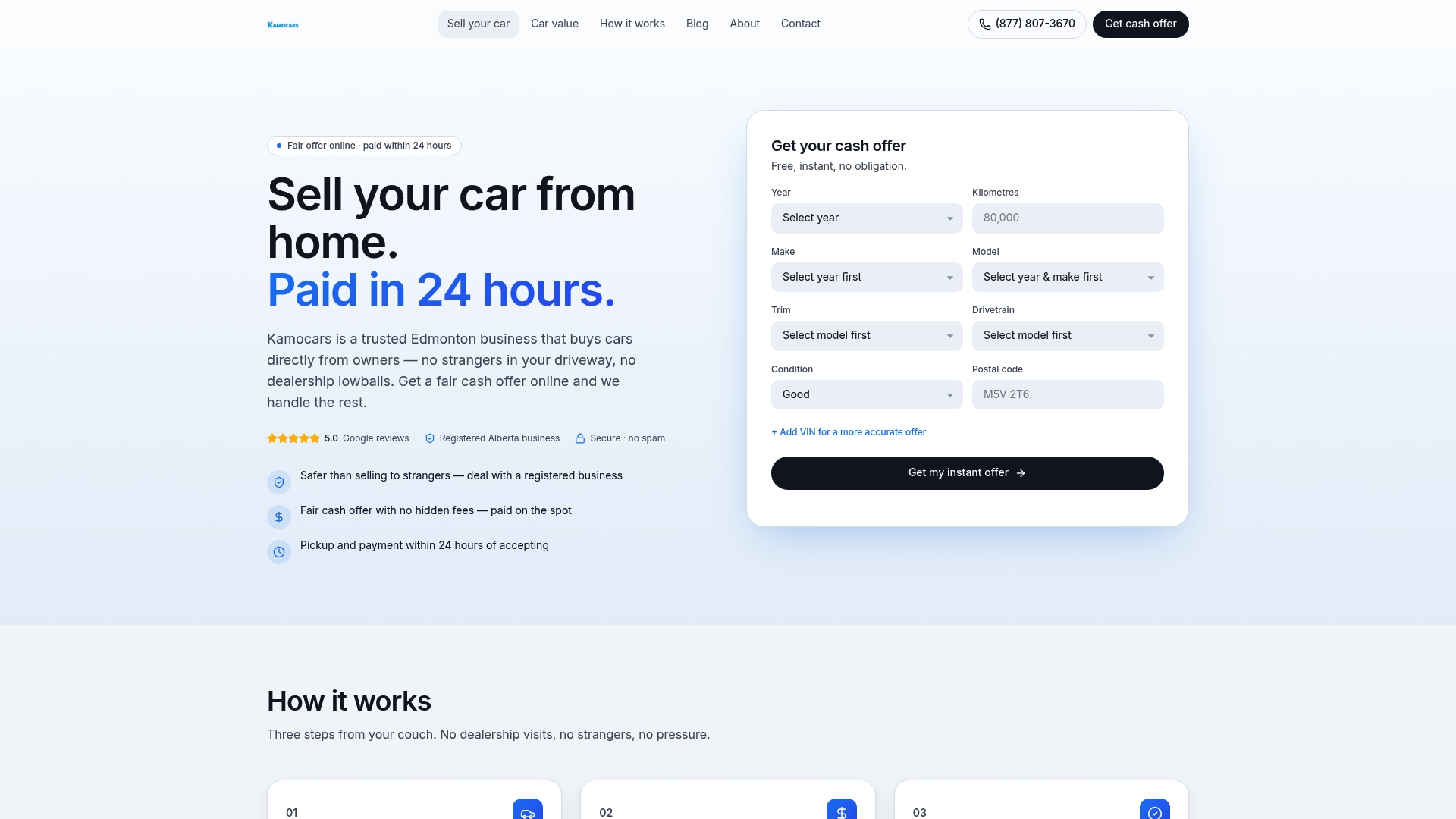
Sellkamocars provides instant appraisals based on current market data, handles pickup, and completes payment within 24 hours. There are no strangers to meet, no haggling, and no surprise deductions after the fact. With over 500 completed transactions and a registered business status that protects you from the risks of informal platforms, Sellkamocars gives you a verified, competitive offer you can actually compare against others in your stack.
If you are collecting offers right now, add Sellkamocars to your comparison. See how it works and get your offer today.
Key takeaways
Sellers who compare multiple offers before committing consistently secure higher prices, avoid hidden fee traps, and make decisions grounded in real market data rather than a single buyer’s margin target.
| Point | Details |
|---|---|
| Offer gap is real | Failing to compare offers can result in a price difference of $2,000 or more for the exact same vehicle due to varying profit margins, transport fees, and reconditioning costs across platforms. |
| Simultaneous beats sequential | Collecting offers within the same 48-to-72-hour window ensures an accurate, same-market comparison. |
| Hidden costs reduce net proceeds | Inspection deductions, processing fees, and transport charges can significantly shrink a headline offer. |
| Timing affects your number | Seasonal demand peaks and regional preferences shift which buyer will pay the most for your specific vehicle. |
| Sellkamocars | Provides a fast, verified cash offer with 24-hour payment and no post-inspection surprises, built for direct comparison. |
Recommended
Get a real cash offer in 2 minutes
Trusted business. Fair price. Paid on the spot when we pick up your car.