
How Car Service Records Help You Get Higher Cash Offers
Discover how car service records help you sell faster and earn higher cash offers by boosting buyer trust and eliminating guesswork.
How Car Service Records Help You Get Higher Cash Offers

Service records help you sell faster and for more money because they remove the guesswork that online cash buyers price into every offer. A car with a full paper trail typically earns more trust from an appraiser than one with none, and documented history can add measurable resale value that a verbal “it’s been well maintained” never will. This guide walks through exactly which documents matter, how to organize them, and what to do if your records have gaps.
Key Takeaways
Complete, organized service records raise cash offers by eliminating repair-risk deductions and cut sale timelines by removing verification delays during inspection.
| Point | Details |
|---|---|
| Records reduce risk deductions | Buyers subtract an assumed repair cost for unknown history; documentation removes that deduction. |
| Prioritize high-impact receipts | Timing belt, transmission, and brake records matter more than routine minor service logs. |
| Organize before you contact a buyer | A one-page summary plus a chronological folder speeds appraisal and reduces follow-up questions. |
| Incomplete history has fallback options | A recent inspection report and honest disclosure notes narrow the trust gap when receipts are missing. |
| Kamocars rewards prepared sellers | Kamocars uses instant appraisals and completes pickup and payment within 24 hours once documents verify condition. |
Table of Contents
- How Online Cash Buyers Use Service Records to Set Your Offer
- What Documents Actually Move the Needle
- How to Organize Records So a Buyer Can Verify Them Fast
- Your Pre-Sale Checklist Before Requesting a Cash Offer
- What to Do If Your Service History Is Incomplete
- How Records Speed Up Your Sale, Pickup, and Payment
- An Editor’s Note on What Sellers Get Wrong About Records
- Ready to Turn Your Records Into a Faster Cash Offer?
- Frequently Asked Questions
- Sources
How Online Cash Buyers Use Service Records to Set Your Offer
When an online buyer appraises your car, they’re running a quiet risk calculation in the background. Every unknown becomes a potential deduction, because a professional buyer has to assume the worst about anything they can’t verify.
This is often called repair-risk deduction, and it’s the single biggest reason two nearly identical cars can get two very different offers. If your appraiser doesn’t know when the timing belt was last done, they assume it’s due and subtract the cost of that job from your offer. Show them a receipt from 8,000 miles ago, and that deduction disappears.
Here’s how specific record types typically affect the appraisal:
- Oil-change logs reduce concerns about short-term engine wear.
- Timing belt or chain receipts remove a major deduction that buyers otherwise assume is coming.
- Brake and tire receipts confirm recent safety-related work instead of leaving it as a guess.
- Transmission service records reduce doubt about a repair that’s expensive to get wrong.
Picture two identical trucks with the same mileage. One seller hands over a binder of dated receipts. The other says, “I’ve kept up with everything, just don’t have the papers.” The buyer with the binder walks away with a stronger offer, because the appraiser isn’t pricing in a hidden repair bill. Marketplace data shows complete maintenance records were tied to an average sale price increase of 8 to 12 percent compared to similar vehicles without documentation, and those cars also sold two to three times faster.
What Documents Actually Move the Needle
Not every scrap of paper matters equally. Here’s what an online buyer weighs most heavily:
- Service invoices that show mileage and date, not just the work performed.
- Timing belt or chain receipts, especially on cars past 100,000 miles.
- Transmission and fluid service records.
- Brake and tire replacement receipts.
- Independent inspection reports.
- Recall completion letters.
- Warranty paperwork, especially for major components.
Invoices without dates or mileage are almost worthless to an appraiser, since they can’t confirm timing; this is why understanding your window tint warranty coverage can be equally important when presenting repair and maintenance documents. Inspection reports and warranty documents carry weight comparable to receipts because they show what a technician actually checked, not just what was paid for. A full legal documents checklist can help you confirm you’re not missing anything before you request an offer.
Pro Tip: If an old invoice is missing mileage, write it on the receipt by hand next to a note of the date you’re confirming it, then photograph it. A buyer would rather see an annotated gap than an unexplained one.
How to Organize Records So a Buyer Can Verify Them Fast
Lead with a summary, not a stack of paper. A one-page overview lets the appraiser see your car’s history in ten seconds instead of digging through a folder.
- Scan every receipt and inspection report, and save each as a PDF or clear photo.
- Name files consistently, for example
VIN_2024-03-12_87500mi_brakes.pdf. - Build a one-page summary listing date, mileage, service type, and shop for each entry.
- Order the folder with the summary first, then receipts in chronological order.
- Save everything to a single, shareable folder rather than scattering files across texts and emails.
Digital records with clear organization can add meaningful credibility during a sale, largely because they signal an owner who actually tracked maintenance rather than hoping for the best.
Pro Tip: Create a read-only cloud link (Google Drive or Dropbox work fine) and share it before your appraisal call. Buyers can review it while they’re on the phone with you instead of waiting for a follow-up email, which is often where deals slow down.

Your Pre-Sale Checklist Before Requesting a Cash Offer
A short list of prep work can raise your offer and cut the time between your first call and getting paid.
- Gather and scan every service record you have, even minor ones.
- Handle small, high-impact services: a fresh oil change, new battery, or worn brake pads if they’re close to needing replacement anyway.
- Run a basic VIN history check so there are no surprises during appraisal.
- Wash the car and take clear photos of the exterior, interior, and engine bay.
- Write short disclosure notes for anything you know is wrong, even if it’s minor.
On the cost side, a $40 oil change or a $150 set of brake pads often pays for itself if it removes a bigger deduction an appraiser would otherwise apply. A step-by-step online valuation guide walks through what happens after you submit this information.
- Don’t spend money on cosmetic detailing beyond a basic wash; it rarely changes an appraisal.
- Do fix anything that would fail a basic safety check, since that gets flagged either way.
What to Do If Your Service History Is Incomplete
Missing records don’t end your sale. They just mean you need to work a little harder to close the trust gap.
- Get a recent independent inspection and keep the dated report, even a short one-page version.
- Document any recent work you did have done, like an oil change, new battery, or brake job, with receipts and photos.
- Add honest disclosure notes when you send your documents or list the car, rather than letting the buyer discover gaps on their own.
Buyers price in assumed deferred maintenance when history is missing, so partial records still narrow that gap even if they don’t close it completely. If a targeted repair costs less than the deduction it would otherwise trigger, it’s usually worth doing before you accept an offer rather than after.
How Records Speed Up Your Sale, Pickup, and Payment
Organized records don’t just raise your offer. They shrink the entire timeline from first call to cash in hand.
- Fewer follow-up questions during the appraisal call.
- No delayed pickup while a buyer tries to verify recent work.
- Faster payment authorization once major repairs are confirmed on paper.
A documented sale often moves in a clean sequence: request an offer, quick appraisal call, streamlined inspection, same-day pickup, payment. An undocumented sale tends to stall at the inspection stage while the buyer tries to confirm details by phone or in person, which can add days. Better disclosure of vehicle history has been shown to reduce information asymmetry in used-car markets, and that same principle plays out at the individual transaction level. The checkpoints where records matter most are the initial offer, the inspection, and final payment authorization. A seller’s guide to vehicle inspections covers what happens at that middle step in more detail.
An Editor’s Note on What Sellers Get Wrong About Records
Omar writes seller guides for the Kamocars blog, focused on helping owners understand what actually moves a cash offer.
Most sellers treat service records as a formality, something to hand over if asked. That’s backwards. The real leverage happens before you ever talk to a buyer, when you decide whether to spend an hour scanning receipts into a folder. Kamocars uses instant appraisals based on current market data, and handling pickup and payment within 24 hours depends heavily on how quickly condition and history can be verified. Sellers who show up with a one-page summary and organized receipts routinely move through appraisal faster than those who show up with a shoebox, or nothing at all.
One recurring pattern: a seller with a car that had a recent major repair, say a transmission service, assumed the receipt “probably didn’t matter much.” It moved the offer meaningfully higher, because the alternative was Kamocars pricing in an assumed future transmission problem. The paperwork didn’t just support the sale. It changed the number.
Ready to Turn Your Records Into a Faster Cash Offer?
If you’ve read this far, you’re already ahead of most sellers who show up with nothing but a set of keys. Kamocars turns organized service records into a faster, higher offer without the back-and-forth of a private sale or the lowball tactics of a trade-in desk.
Before you request your offer, gather three things: your VIN, a one-page service summary, and your key receipts (timing belt, brakes, transmission, tires). Kamocars uses that information to build an instant appraisal from current market data, then handles pickup and payment within 24 hours once the offer’s accepted. If you’re in Edmonton, the Edmonton seller landing page walks through local specifics, or you can see the full process on the how it works page and start your offer today.
Frequently Asked Questions
Does a missing service record automatically lower my offer? Not automatically, but it removes a data point the buyer would otherwise use to justify a higher one. A recent independent inspection report can partially offset that gap.
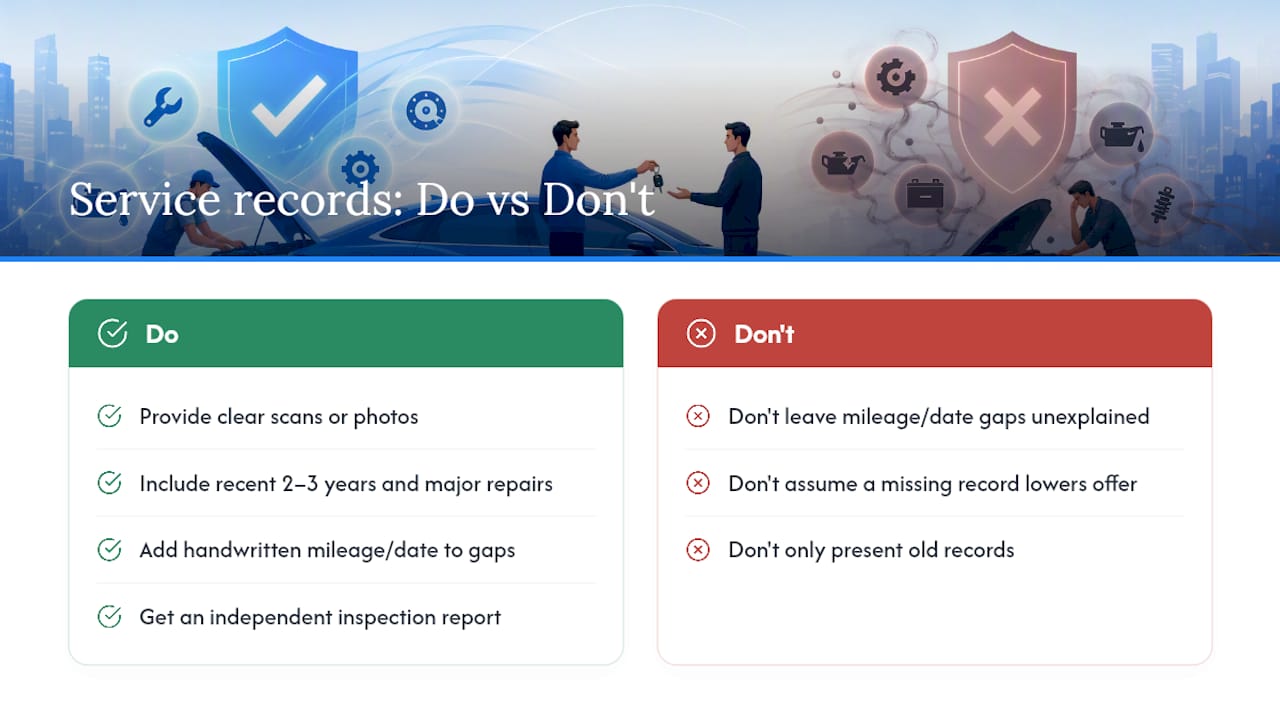
Do I need original paper receipts, or are scans acceptable? Clear photos or scans work fine for most online cash buyers. What matters is that the date, mileage, and service type are legible.
How far back should my service records go? As far back as you have them, but the most recent two to three years and any major component work (timing belt, transmission, brakes) matter most to an appraiser.
Can I add notes to old receipts that are missing mileage? Yes. Handwritten annotations noting mileage or date are better than leaving the gap unexplained, especially when photographed alongside the original receipt.
Will fixing small issues before selling actually raise my offer enough to matter? Often yes, particularly for items like brake pads, a weak battery, or an overdue oil change, since these are common deductions a buyer applies by default when they’re not addressed.
Sources
- How to Keep a Car Service History That Actually Helps at Resale
- Why Your Maintenance Records Are Worth Thousands When You Sell | Zoooom
- How Service History Increases Your Car’s Resale Value by Up to 25% | AutoChain
- How to Keep Maintenance Records That Protect Your Car’s Resale Value - Motorist Assurance Program
- Can You Judge a Car by Its History? Vehicle History Reports and the Efficiency of the Used-Car Retail Market
For help preparing your own documents before requesting an offer, Kamocars’ paperwork guide lists exactly what to gather.
Recommended
Get a real cash offer in 2 minutes
Trusted business. Fair price. Paid on the spot when we pick up your car.