
Close Sale Fast: How Car Pickup Works and Kamocars' 24 Hour Payment
Seller step by step checklist for car pickup: paperwork, safety, and prep, plus how Kamocars' Alberta doorstep service inspects your vehicle and pays...
Close Sale Fast: How Car Pickup Works and Kamocars’ 24 Hour Payment
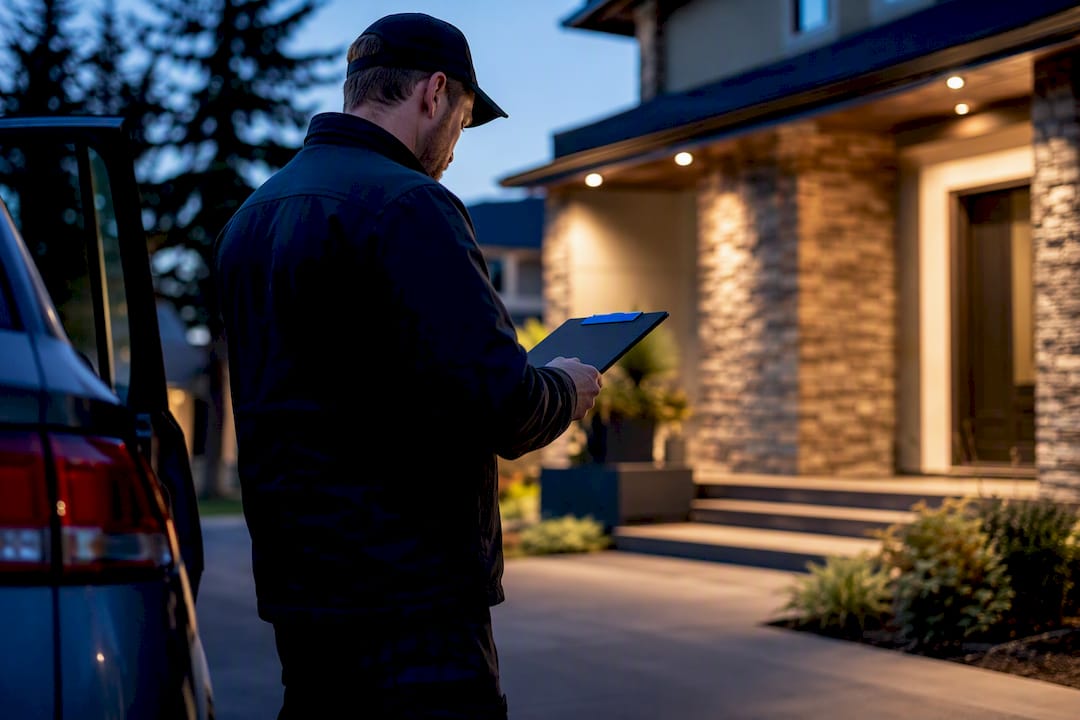
Car pickup is the final step in an online sale: a driver arrives at your address, checks the vehicle against the listing, collects your signed transfer paperwork, and either hands you payment or confirms it’s already sent. The whole exchange usually takes a short amount of time. Before that clock starts, clear out your belongings and have your ownership documents sitting by the door.
TL;DR:
- Confirm the pickup window is flexible within two to four hours and keep your phone nearby for timely communication from the driver.
- Ensure all necessary paperwork, including the title, bill of sale, and ID, is prepared and signed before the vehicle leaves your property.
- Clear out personal belongings, delete data from the infotainment system, and surrender license plates if required by your province before pickup.
- Verify the driver’s identity on arrival, inspect the vehicle during the walk-around, and photograph the signed documents for your records.
- Use a reputable buyer like Kamocars that offers instant online quotes, scheduled doorstep pickup, and documented payment within 24 hours.
Table of Contents
- How Does Car Pickup Work From Start to Finish?
- What Paperwork Do You Need for the Ownership Transfer?
- What Should You Remove Before the Driver Arrives?
- [How Do You Make Your Vehicle Ready for Pickup? For advice on a thorough cleaning, including engine bay care, see our guide to a clean engine bay with ceramic protection.](#how-do-you-make-your-vehicle-ready-for-pickup-for-advice-on-a-thorough-cleaning-including-engine-bay-care-see-our-guide-to-a-clean-engine-bay-with-ceramic-protectionhttpsdiamondbritecoukclean-engine-bay)
- What Happens During the Actual Handover?
- Why Does the Driver Arrive in a Window Instead of an Exact Time?
- How Does a Registered Buyer Like Kamocars Handle Pickup?
- What Safety Steps Should You Take During Pickup?
- Author Perspective: Three Quick Tips From an Experienced Buyer
- How Kamocars Makes Selling and Pickup Simple
- Sources
How Does Car Pickup Work From Start to Finish?
Confirming the details before the truck shows up saves you from awkward surprises on pickup day. This is where most disputes start, not at the curb.
Before pickup day, nail down these specifics with the buyer:
- Price confirmation: is the offer firm, or contingent on a final in-person inspection?
- Payment method and timing: cash on the spot, e-transfer, or a company check, and exactly when it lands.
- Pickup window: a two- or three-hour block, not an exact minute.
- Driver details: name, contact number, and what kind of truck is coming (flatbed, tow dolly, or a driven pickup).
- Access instructions: gate codes, apartment buzzer numbers, or parking restrictions the driver needs in advance.
Ask one more question before you hang up: what happens if the driver spots damage you didn’t disclose? A reputable buyer will explain their adjustment policy upfront rather than negotiating it in your driveway. Many online buyers absorb the cost of pickup transport into their business model, so you shouldn’t be quoted a towing fee unless your access situation genuinely requires extra equipment.
What Paperwork Do You Need for the Ownership Transfer?
Title transfer is the legal core of the sale. Miss a document and you could still be the registered owner weeks after your car is gone.
- Bring the vehicle title or registration permit. This proves you’re the legal owner and it’s the document the buyer signs to accept transfer.
- Have a bill of sale ready, listing price, date, VIN, and both parties’ names and signatures.
- Show valid government ID that matches the name on the title.
- Get a lien release letter if you financed the vehicle and the loan isn’t fully paid off, since the lender technically holds partial ownership until then.
- Complete an odometer statement where your province requires one, confirming the mileage at the time of sale.
- Sign in the driver’s presence. Most pickups don’t require notarization, but some provinces do for specific transfer forms, so check ahead of time.
- Insist on a signed receipt or copy of the bill of sale before the car leaves your driveway. This is your proof the transaction happened and for how much.
A documented handover protects you if a payment issue or title dispute surfaces later. Keep both digital and paper copies. Sellers who skip this step are the ones who end up fielding parking tickets for a car they no longer own. For a full rundown by document type, Kamocars’ legal checklist for selling a car breaks down exactly what varies by province.
What Should You Remove Before the Driver Arrives?
Treat this like moving out, not just cleaning up. Do a full sweep the night before pickup, not the morning of, when you’re rushed.
- Empty the glove box, trunk, center console, and under-seat storage.
- Pull garage door remotes, toll transponders, and parking passes.
- Delete paired phones and saved Wi-Fi or navigation data from the infotainment system.
- Check for hidden personal documents in door pockets and the owner’s manual sleeve.
Whether the license plate stays on the car depends entirely on your province’s rules. Some require you to surrender plates to a registry office; others let them transfer with the vehicle. Keep any plate-surrender receipt with your sale paperwork, since leaving plates on a car you no longer own can create liability if the buyer doesn’t register it right away.
Pro Tip: Do a final walkthrough with your phone’s flashlight in the trunk and under the seats. Loose change and sunglasses are the two items sellers forget most often.
How Do You Make Your Vehicle Ready for Pickup? For advice on a thorough cleaning, including engine bay care, see our guide to a clean engine bay with ceramic protection.
Loading delays almost always trace back to access problems, not paperwork problems. A few minutes of prep on your end keeps the whole appointment on schedule.
- Clear a straight, level path to the vehicle and unlock any gate or garage blocking it.
- Have all keys and fobs in hand, including spares, before the driver arrives.
- Confirm the truck type in advance. A flatbed needs more clearance than a driven pickup, and narrow streets or tight driveways sometimes can’t accommodate one at all.
- Expect a quick walk-around inspection. The driver checks the VIN against your paperwork, notes exterior damage, tests whether the car starts and drives, checks fuel level, and secures loose items if it’s being towed. All of this gets logged on a bill of lading.
- Understand the driver’s actual role. Many pickup drivers are contracted carriers rather than direct employees of the buyer. They’re there to verify and collect the vehicle, not to renegotiate price or terms on the spot.
If your driveway genuinely can’t fit the truck, dense neighborhoods and narrow streets sometimes force a change of plans. A good carrier will suggest the nearest safe alternative, like a wider street or a nearby lot, and note it on the paperwork so there’s no confusion later.
What Happens During the Actual Handover?
This is the moment the sale becomes final, so slow down here even if the driver seems rushed.
- Sign the transfer documents, double-checking that the VIN and odometer reading on the paperwork match your actual dashboard and title.
- Hand over every key and fob, not just the one you’ve been driving with.
- Verify payment before the car leaves. If you’re being paid on-site, confirm the funds. If it’s an e-transfer, watch it land in your account or get written confirmation of exactly when it will.
- Get a signed receipt that states the sale price, date, and both parties’ names.
One habit protects you more than any other at this stage: photograph the signed paperwork and the car being loaded, with a timestamp visible. It costs you thirty seconds and gives you a record if any dispute comes up weeks later. Save the driver’s or buyer’s direct contact information too, in case you need to follow up about a title release or payment confirmation.
Why Does the Driver Arrive in a Window Instead of an Exact Time?
Carriers run multi-stop routes, which is why nobody can promise you a precise arrival time. Expect a window instead, usually two to four hours wide.
Treat the scheduled slot as a range, not a deadline. Transport carriers typically confirm the appointment is a window and will call or text once the driver is close, rather than committing to an exact minute days in advance. Traffic, weather, and other stops on the route all shift timing, sometimes by an hour or more.
A few things reduce the friction:
- Agree on a backup meeting spot before pickup day, in case your address isn’t accessible.
- Ask what the buyer’s policy is for a no-show or a canceled appointment.
- Keep your phone nearby during the window. Missing the driver’s call is the single biggest cause of rescheduled pickups.
How Does a Registered Buyer Like Kamocars Handle Pickup?
Kamocars runs pickup as a structured process, not a loose favor between strangers. You get an instant online appraisal based on market data, schedule a doorstep pickup at a time that works for you, and a representative verifies the vehicle’s condition against your listing on arrival. Payment follows within 24 hours.
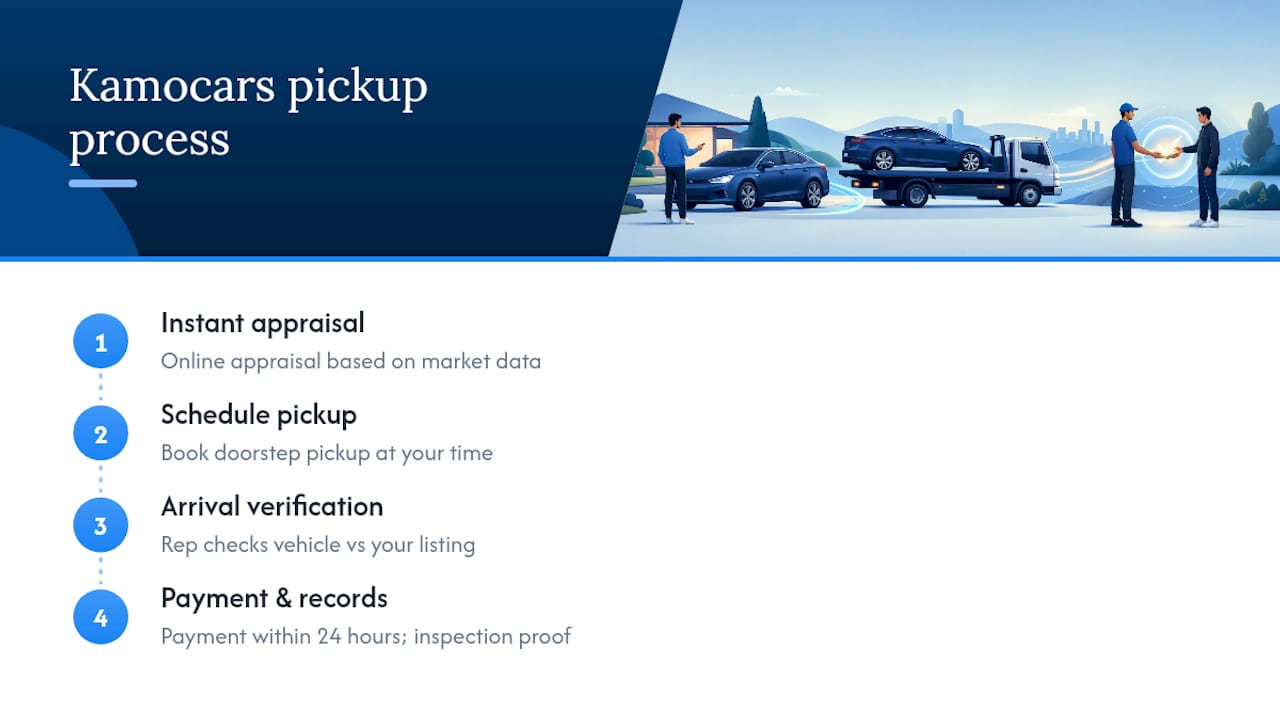
As a registered business, Kamocars documents the inspection, provides proof of payment, and gives you a real point of contact if something needs follow-up after the sale. That combination of speed and paper trail is what separates a professional buyer from an informal stranger-to-stranger deal.
What Safety Steps Should You Take During Pickup?
Handing over a vehicle to someone you’ve mostly dealt with online carries real risk if you skip basic precautions. A little caution costs you nothing and closes most of the gaps that scammers rely on.
Verify who’s actually showing up. Ask for the driver’s name and confirm it matches what the buyer told you in advance. If a company is buying the car, ask for the driver’s ID and check that it lines up with the business name on your paperwork. Legitimate carriers and registered buyers expect this question and won’t hesitate to answer it.
Meet in daylight when you can. If your only available window is after dark, pick a well-lit spot, ideally with a neighbor or family member around, rather than an isolated corner of a parking lot.
Don’t sign anything until you’ve confirmed payment status. If cash is promised on-site, count it before the driver leaves. If it’s an e-transfer, wait for the deposit notification on your phone rather than taking someone’s word for it. Handing over signed title paperwork before funds clear puts you in a weak position if something goes wrong.
Keep your phone charged and let someone know the pickup time and address in advance. Photograph the driver’s ID, the truck, and the license plate if you have any hesitation at all. None of this should feel confrontational. It’s standard practice, and any professional buyer will treat it as routine rather than suspicious.

Author Perspective: Three Quick Tips From an Experienced Buyer
Photograph the car and every signed document before the keys leave your hand. If payment is promised rather than instant, get the timing in writing and never release signed paperwork until funds are verified. Keep a digital copy of everything and the buyer’s contact details on file.
— Omar
How Kamocars Makes Selling and Pickup Simple
Kamocars is the faster route to selling your car when you’d rather skip strangers, haggling, and the uncertainty of a dealership trade-in. You get an instant cash offer built on current market data, free doorstep pickup wherever you’re located in Alberta, and payment within 24 hours, all backed by a registered business that documents the inspection and hands you a real receipt.
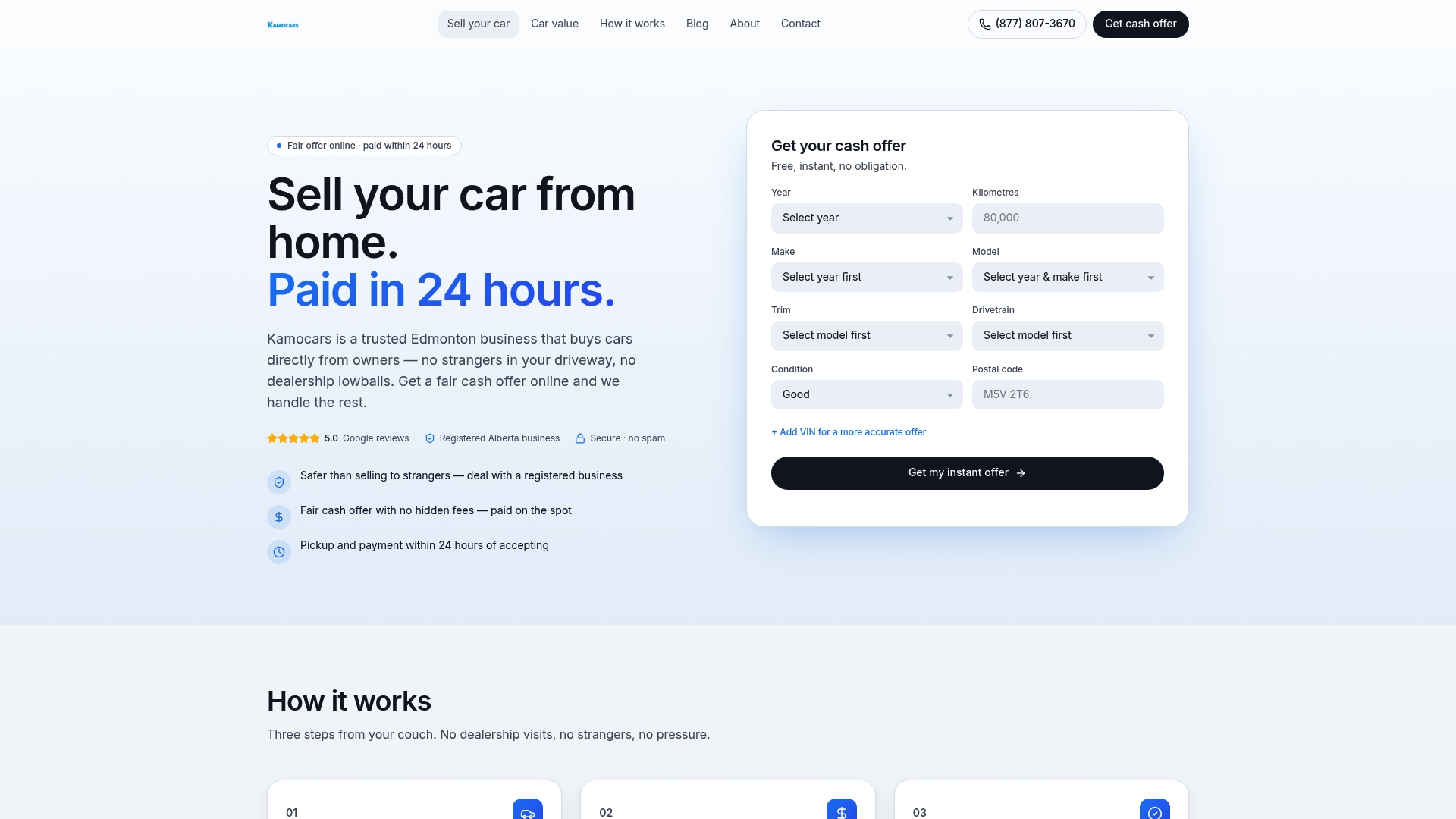
This works best if you want the sale closed fast without listing photos, buyer calls, or test-drive scheduling to manage yourself. If your 2018 or newer car, truck, or SUV is running and ready to go, get your instant appraisal and lock in a pickup time that fits your schedule.
Sources
Recommended
Get a real cash offer in 2 minutes
Trusted business. Fair price. Paid on the spot when we pick up your car.