
How Car Ownership Transfer Works: Step-by-Step Guide
Discover how car ownership transfer works with our step-by-step guide. Ensure a smooth sale and avoid disputes by following the right process.
How Car Ownership Transfer Works: Step-by-Step Guide

A car ownership transfer is the legal process that moves a vehicle title from seller to buyer, and it is complete only when the buyer files the signed title and required forms with the state Department of Motor Vehicles (DMV). Before you hand over keys or accept payment, verify the title is clean and lien-free. That single check prevents most of the delays and disputes that derail private-party sales. Under federal odometer disclosure rules, accurate mileage must be recorded on the title at transfer, and failing to do so can be a federal offense. Sellkamocars handles this paperwork on behalf of sellers every day, and the steps below reflect what actually works.
Table of Contents
- How does car ownership transfer work, step by step?
- What documents do you need to complete a title transfer?
- How do liens and loans affect the transfer?
- Who pays taxes and what fees should you expect?
- How do state rules vary and how do you find your DMV requirements?
- What extra steps apply when buying across state lines?
- How do family transfers, inheritance, and co-owner removal work?
- How long does the title transfer process take?
- Common mistakes and red flags to watch for
- Key Takeaways
- What experienced sellers know that first-timers often miss
- Authoritative sources and where to find your state’s forms
How does car ownership transfer work, step by step?
The car title transfer process splits cleanly into seller actions and buyer actions. Follow them in order.
Seller checklist:
- Confirm your payoff balance and lien status with your lender before listing the vehicle.
- Sign the title assignment area exactly as your name appears, no white-out, no corrections.
- Complete the odometer disclosure section on the title or on a separate federal form.
- Remove your license plates if your state requires it (most do).
- File a transfer notice or release-of-liability form with your DMV after the sale.
Buyer checklist:
- Verify the seller’s government ID matches the name printed on the title.
- Collect the signed title, a completed bill of sale, and a lien-release letter if applicable.
- Obtain proof of insurance before driving the vehicle off the lot.
- Submit all documents to the DMV, in person or through an authorized online workflow, and pay title and registration fees.
- Request a paper title if your state defaults to an electronic record and you want a physical copy.
According to LendingTree’s title transfer guide, the DMV issues the new title after fees and taxes are paid, and the process can take up to six weeks depending on the state.
Pro Tip: Run a lien check through your state DMV’s online portal or a service like the National Motor Vehicle Title Information System (NMVTIS) before you pay. A lien you missed becomes your debt once the title is in your name.
What documents do you need to complete a title transfer?
Arrive at the DMV with the right paperwork and the process moves fast. Show up missing one item and you make a second trip.
Core documents for every transfer:
- Original signed title with the assignment area fully completed
- Government-issued photo ID matching the name on the title
- Bill of sale showing date, sale price, odometer reading, and both parties’ signatures
- Proof of current insurance
- VIN verification or safety inspection form where the state requires it
- Lien-release letter or payoff confirmation if a loan existed
| Transaction type | Required documents |
|---|---|
| Private sale | Signed title, bill of sale, photo ID, proof of insurance, lien release (if applicable) |
| Dealer sale | Signed title or MCO, dealer-prepared bill of sale, proof of insurance |
| Inherited vehicle | Death certificate, executor documentation, probate court order or affidavit of heirship, photo ID |
Sample bill-of-sale fields to include:
- Full legal names and addresses of buyer and seller
- Vehicle year, make, model, and VIN
- Sale price (write “gift” if no money changes hands)
- Odometer reading at time of sale
- Date of sale
- Signatures of both parties
A bill of sale should also include damage disclosures where required by state law. Some DMVs provide a state-specific template, so check your state’s motor vehicle agency website before drafting your own. Sellkamocars provides sellers with a legal document checklist that maps each required form to the transaction type.
How do liens and loans affect the transfer?
If a lender has a lien on the vehicle, that lender legally holds an interest in the title until the loan is paid in full. The DMV will block a title transfer without a lien release.
Three common workflows:
- Lender coordinates release — Some lenders work directly with the buyer’s DMV to transfer the title after payoff confirmation. Ask your lender whether they use this workflow before scheduling the sale.
LendingTree confirms that without a lien release, the DMV will block the transfer entirely, leaving the buyer with a vehicle they cannot legally register.
Pro Tip: Ask your lender whether the lien is recorded electronically or on a paper title. An electronic lien requires a digital release, not a mailed letter. Get the lender’s direct payoff department contact in writing so there are no surprises on closing day.
Who pays taxes and what fees should you expect?
The buyer almost always pays sales tax or use tax at the time of title and registration. Most states assess the tax as a percentage of the purchase price stated on the bill of sale, which is one reason accurate pricing on that document matters.
Key cost categories:
- Dealer collection: — When buying from a dealer, the dealer typically collects and remits sales tax. In a private sale, the buyer pays directly at the DMV.
| Scenario | Who pays tax | Where paid |
|---|---|---|
| Private sale | Buyer | At DMV during registration |
| Dealer sale | Buyer (via dealer) | At dealership |
| Gift or family transfer | Varies by state | At DMV; exemptions may apply |
Pro Tip: Keep every receipt from the title and tax transaction. If you later dispute a registration error or need to prove ownership for insurance purposes, those receipts are your fastest path to resolution. Also confirm whether the dealer filed the title on your behalf or whether you must do it yourself.
How do state rules vary and how do you find your DMV requirements?
No two states handle the car registration transfer guide the same way. The differences that catch buyers and sellers off guard most often:
- Notarization: Some states require a notary’s signature on the title assignment or bill of sale. Others do not. Check before your appointment.
- Transfer deadlines: Most states set a 15–30 day window for the buyer to title the vehicle. Texas requires titling within 30 days and recommends that sellers file a Vehicle Transfer Notification to avoid liability for future tickets or tolls.
- E-title systems: Arizona’s eTitle Transfer program lets eligible buyers and sellers complete transfers online, but only for lien-free passenger vehicles and within a short eligibility window.
- Emissions and VIN inspections: California, Colorado, and several other states require a smog or emissions check before registration. Some states require a physical VIN inspection for out-of-state vehicles.
- Plate rules: Some states let you transfer plates to a new vehicle; others require new plates at every transfer.
To find your exact state requirements:
- Search “[your state] DMV title transfer” to reach the official motor vehicle agency page.
- Download the state’s title application form before your visit.
- Look for a “seller’s notice of sale” or “release of liability” form and file it the same day you sell.
- Confirm whether your county or city adds a local fee on top of the state fee.
New Jersey, for example, requires certain transfers to be completed in person at a motor vehicle agency and sets short deadlines for reassigned titles, with specific procedures for probate and transfers on death.

What extra steps apply when buying across state lines?
Buying a vehicle titled in another state adds a layer to the transferring vehicle title process, but it is manageable with the right sequence.
Immediate steps after an out-of-state purchase:
- Secure a temporary transit permit or trip permit from the selling state before driving home. Dealers handle this routinely; private sellers may not, so ask before you leave.
- Confirm whether the selling state collected sales tax. If not, you will owe use tax when you register in your home state.
- Schedule a VIN inspection if your home state requires one for out-of-state vehicles.
- Submit the out-of-state title, bill of sale, and inspection results to your home DMV within the deadline.
- Pay your home state’s title and registration fees.
For guidance on completing a remote or cross-jurisdiction sale, Sellkamocars has a practical remote car sale guide that covers documentation and tax handling across borders.
Pro Tip: If the vehicle needs a safety or emissions check before you can register it at home, consider using a transport service rather than driving it. Driving an unregistered out-of-state vehicle can result in fines, and some states will not issue a transit permit for vehicles that fail inspection.
How do family transfers, inheritance, and co-owner removal work?
These situations follow the same legal logic as a standard sale but with different paperwork.
Family transfers: Many states offer a tax or fee exemption when a vehicle transfers between spouses, parents, and children. You typically need to complete an exemption affidavit at the DMV and show proof of the relationship (marriage certificate, birth certificate). The title still must be signed and submitted.
Inherited vehicles: When the owner is deceased, the process depends on whether the estate went through probate.
- With probate: the executor signs the title using their legal authority, attaches a copy of the death certificate and letters testamentary, and submits everything to the DMV.
- Without probate (small estates): many states allow an affidavit of heirship or a small-estate affidavit to substitute for a court order.
- New Jersey provides specific guidance for transfers on death and probate situations, including exemptions that may apply.
Removing a co-owner: Treat it as a sale. The co-owner being removed signs the title over to the remaining owner. Some states require a correction affidavit if the title already lists both names with “AND” rather than “OR.” If the co-owner is deceased, a death certificate replaces their signature.
Pro Tip: If you are removing a name because of a divorce, check whether your divorce decree specifies who keeps the vehicle. Some states accept the decree as a transfer document, which can simplify the DMV visit considerably.
How long does the title transfer process take?
Temporary documents are typically issued the same day you file at the DMV. The permanent title is typically mailed to the buyer within up to six weeks, depending on the state and whether a lien is recorded on the new title.
What to expect after filing:
- Same day: Temporary registration or operating permit so the buyer can legally drive the vehicle.
- 2–8 weeks: Permanent paper title mailed to the buyer or, if a lien exists, to the lender.
- E-title states: Some states never mail a paper title by default. The record is held electronically. Request a paper title at the DMV if you need one for financing or storage.
- If the title does not arrive: Contact the DMV after the expected window. Common causes include a name mismatch, an unpaid fee, or a lien that was not released before filing.
Immediate follow-ups after the sale:
- Seller: file the release-of-liability or notice of sale with the DMV that same day.
- Buyer: update your insurance policy to reflect the new vehicle.
- Both: keep copies of the signed title, bill of sale, and all fee receipts.
Common mistakes and red flags to watch for
The car title transfer process fails most often because of small, avoidable errors.
Top seller mistakes:
- Signing on the wrong line or using white-out. Errors in the title assignment area void the document and force a duplicate-title application, which delays the sale by weeks.
- Not filing a seller notice of sale after handing over the keys.
- Accepting a personal check and signing the title before the funds clear.
Red flags for buyers:
- The VIN on the title does not match the VIN plate on the dashboard or door jamb.
- The title shows a “salvage,” “rebuilt,” or “flood” brand that the seller did not disclose.
- No lien-release documentation despite the seller claiming the car is paid off.
- The seller refuses to sign in front of a notary when the state requires it.
Practical checks before payment:
- Run the VIN through NMVTIS or a comparable history service to confirm title brand and ownership history.
- Verify the seller’s ID matches the title name exactly, including middle initials if listed.
- Confirm cleared funds before signing. Cars.com recommends verifying payment has cleared before signing the title, and suggests cashier’s checks or verified wire transfers over personal checks.
Pro Tip: For high-value transactions, use an escrow service or meet at your bank so a teller can verify the cashier’s check on the spot. It adds 30 minutes and removes the risk entirely. For a full buyer verification checklist, Sellkamocars has a trusted buyer verification guide worth reviewing before any private-party sale.
Key Takeaways
A clean title transfer requires the signed title, a complete bill of sale, a lien release if applicable, and timely DMV filing, all verified before money changes hands.
| Point | Details |
|---|---|
| Verify lien status first | Confirm the title is lien-free or obtain a written lien release before accepting payment. |
| Sign the title correctly | Use no white-out and sign exactly as your name appears; errors void the document. |
| File seller notice of sale | Submit a release-of-liability form to your DMV the same day you hand over the keys. |
| Know your state deadline | Most states require the buyer to title the vehicle within 15–30 days; Texas sets a 30-day limit. |
| Keep all receipts | Retain copies of the signed title, bill of sale, and fee receipts for insurance and tax records. |
What experienced sellers know that first-timers often miss
Most title-transfer problems are not legal problems. They are sequencing problems. The seller signs before the funds clear, or the buyer drives off before the lien release arrives, and suddenly a routine transaction becomes a weeks-long dispute.
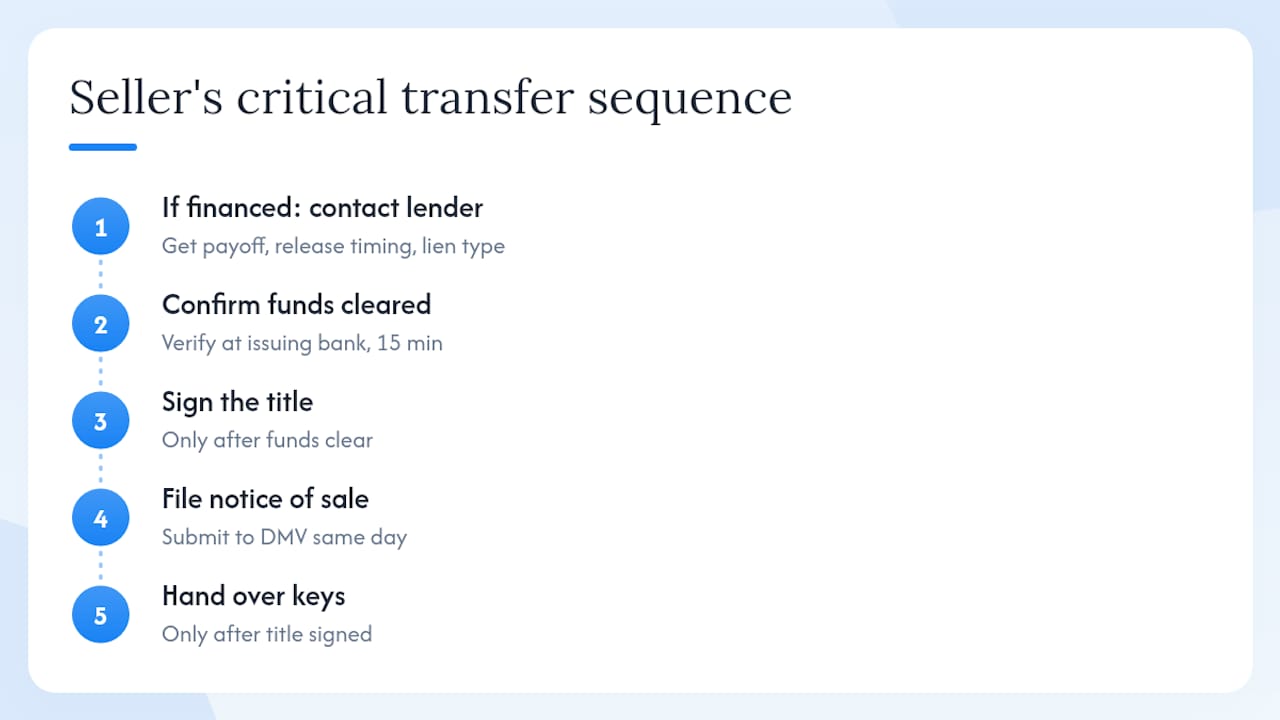
The sequence that works: confirm cleared funds first, then sign the title, then hand over the keys. Not the other way around. A cashier’s check feels safe, but counterfeit cashier’s checks exist. Meeting at the issuing bank to verify the check takes 15 minutes and removes all doubt.
What sellers commonly forget is the notice of sale. Filing it with your DMV the same day you sell is a low-effort step that protects you from parking tickets, toll violations, and worse, if the buyer drives recklessly before registering the vehicle. Texas makes this explicit with its Vehicle Transfer Notification, but most states offer an equivalent form.
If you have a financed vehicle, contact your lender before you list it. Get the exact payoff figure, ask how long the lien release takes to process, and confirm whether the lien is electronic or paper. Sellers who skip this step often discover on closing day that the lender needs 10 more business days, and the buyer walks.
Sellkamocars handles payoff coordination, lien releases, and same-day pickup for sellers who want to skip the back-and-forth entirely. If you want a faster path, getting an instant offer through Sellkamocars means the paperwork is handled for you.
Ready to skip the DMV line? Sellkamocars provides a free instant car valuation and handles title transfer paperwork, lien payoffs, and pickup within 24 hours. No haggling, no strangers, no second trips to the DMV.
Authoritative sources and where to find your state’s forms
Before your DMV visit, download your state’s title application form and any required bill-of-sale template directly from the official motor vehicle agency website. Forms, deadlines, and notarization rules vary by state, and the official source is always current.
Key resources:
- How to transfer a car title | LendingTree
- How to Change Ownership of a Car: Title Transfer Steps — LegalClarity
- Transferring Ownership of a Vehicle (eTitle Transfer) | Department of Transportation
- Buying or Selling a Vehicle | TxDMV.gov
- How to Transfer Ownership When You Sell Your Car | Cars.com
- NJ MVC | Transferring Vehicle Ownership
For Texas-based buyers, a state vehicle inspection may be required before you can complete registration. Confirm with your county tax office whether an inspection is needed for your specific vehicle and transaction type.
This article is general information, not legal or financial advice. Confirm current rules, fees, and deadlines with your state DMV or a qualified professional before completing a transfer.
Recommended
Get a real cash offer in 2 minutes
Trusted business. Fair price. Paid on the spot when we pick up your car.