
How Car Equity Is Calculated: A Straightforward Formula
Learn how to accurately calculate your car equity with a simple formula. Discover the key numbers needed to understand your vehicle's worth.
How Car Equity Is Calculated: A Straightforward Formula

Your car equity equals its current market value minus the loan payoff amount. Positive means cash in your pocket. Negative means you owe more than the car is worth. That’s the whole formula, and getting it right depends on two exact numbers.
- Market value: what your car would actually sell for right now, checked against at least two sources
- Payoff amount: the exact figure your lender quotes to close the loan on a specific date, not the balance printed on last month’s statement
Skip either step and your equity number is a guess. Nail both, and you know precisely where you stand before you talk to a dealer, list your car privately, or take an offer from a direct buyer.
Key Takeaways
Car equity comes down to one subtraction: an accurate market value minus an accurate loan payoff, checked against both trade-in and private-party figures before you commit to a sale.
| Point | Details |
|---|---|
| Use payoff, not balance | Request a lender payoff quote tied to a specific date; it includes accrued interest your statement balance doesn’t show. |
| Check multiple valuations | Compare trade-in and private-party estimates from at least two sources before trusting a single number. |
| Expect a real dollar gap | Dealer offers often run 10 to 20 percent below private-party value, a $1,500 to $3,000 swing on many vehicles. |
| Depreciation front-loads risk | Vehicles can lose 20 to 30 percent of value in year one, which is why negative equity is common early in a loan. |
| Fast, verified option exists | Sellkamocars gives instant appraisals and pays within 24 hours for sellers who want speed and certainty over maximum private-sale price. |
Table of Contents
- Exactly Which Numbers You Need and Where to Get Them
- Step-by-Step: Calculate Your Car Equity
- Trade-In Value, Private-Party Value, and Dealer Offers Aren’t the Same Thing
- Why Depreciation and Loan Terms Push So Many Owners Underwater
- What to Do With Positive Equity, and What to Do If You’re Underwater
- How a Verified Buyer Converts Equity Into Cash Fast
- What the Numbers Actually Tell You
- Turn Positive Equity Into Cash Without the Listing Hassle
- Sources
Exactly Which Numbers You Need and Where to Get Them
Getting an accurate equity assessment starts with a phone call, not a website. Ask your lender directly for a payoff quote, and note the payoff date they use, since interest keeps accruing daily.
- Call or log into your lender’s account and request a payoff quote (not your current balance).
- Confirm the payoff date the quote is valid through. Payoffs often include a 10-day interest window, so a quote from last week may already be stale.
- Pull trade-in and private-party estimates from two or three tools, such as Kelley Blue Book and J.D. Power, plus a scan of local listings for your exact trim.
- Adjust for condition, mileage, and options. A well-kept truck with low kilometers and a desirable trim package can sit thousands above a base valuation.
Pro Tip: Save your lender’s payoff quote as a PDF or screenshot the moment you get it. Payoff amounts shift daily, and having a dated record protects you if a dealer or buyer disputes the number later.
Step-by-Step: Calculate Your Car Equity
Once you have both numbers, the math takes thirty seconds. Here’s the sequence that keeps you from second-guessing yourself.
- Gather two or three market value estimates. Check a trade-in figure and a private-party figure separately. They will not match, and that gap matters.
- Get your lender’s payoff quote and confirm it’s valid through the date you plan to sell. Ask whether any early-payoff fees apply.
- Subtract the payoff from each market value. Run the math twice, once against trade-in value and once against private-party value.
Here’s what that looks like with real numbers. Say your truck’s trade-in value comes back at $22,000 and your private-party estimate is $24,500. Your loan payoff quote is $19,000.
- Trade-in equity: $22,000 − $19,000 = $3,000 positive
- Private-sale equity: $24,500 − $19,000 = $5,500 positive
That $2,500 difference isn’t random. Auto equity calculators consistently show a gap of roughly $1,500 to $3,000 between what a dealer offers and what a private buyer will pay, because dealers price in resale margin and reconditioning costs.
Now flip the scenario. If your payoff sits at $26,000 against that same $22,000 trade-in value, you’re $4,000 underwater. Running the calculation against both market figures, rather than just one, is what tells you whether you’re actually stuck or just looking at the wrong number.
Trade-In Value, Private-Party Value, and Dealer Offers Aren’t the Same Thing
Three different numbers get used almost interchangeably by people shopping around, and confusing them is where most equity math goes wrong.
- Trade-in value is what a dealer credits toward a new purchase. It’s lower because the dealer absorbs resale risk and reconditioning costs.
- Private-party value is what an individual buyer would pay you directly, closer to the top of the market since there’s no dealer margin baked in.
- Dealer cash offer (buying your car outright, no trade required) usually lands somewhere between the two, sometimes lower if the dealer isn’t confident about reselling that specific model.
Dealers typically pay 10 to 20 percent less than private-party value, and on a $20,000 vehicle that’s a $2,000 to $4,000 swing in your equity, just based on which number you use. To triangulate a defensible figure, check at least two valuation tools, scan five to ten local listings for comparable trims and mileage, and factor in current demand. Trucks and SUVs, for instance, often hold value better than sedans in colder markets where buyers want ground clearance and towing capacity.
Why Depreciation and Loan Terms Push So Many Owners Underwater
Depreciation is the quiet force working against your equity from day one, and it front-loads hard. New vehicles can lose 20 to 30 percent of their value in the first year alone, and by year five that number climbs toward 60 percent. Meanwhile your loan balance drops slowly, especially early on when most of each payment goes to interest rather than principal.
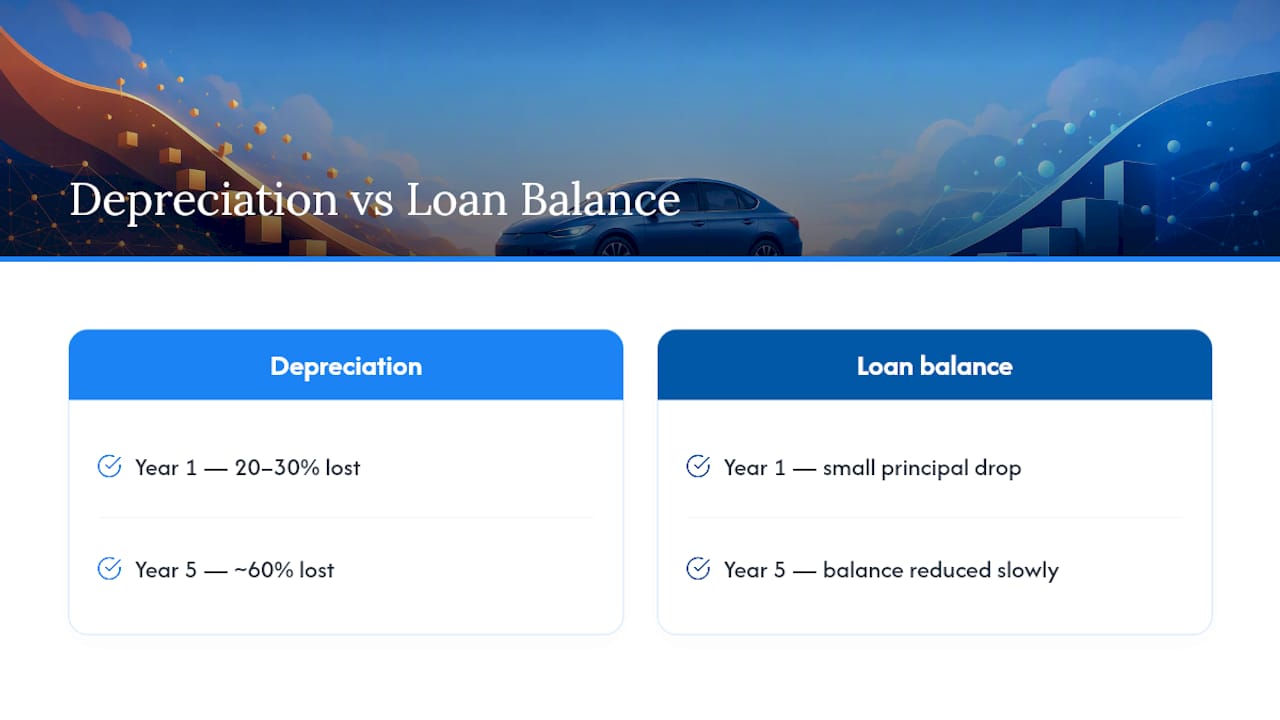
That mismatch is exactly why roughly a quarter to a third of trade-in vehicles carry negative equity at the time they’re traded. A long loan term or a small down payment stretches out the gap between what you owe and what the car is worth, sometimes for years.
The 20/4/10 rule is the simplest guardrail against this: put down at least 20%, finance for no more than 4 years, and keep total vehicle costs under 10% of your gross income.
Pro Tip: If you’re shopping for your next vehicle now, a shorter loan term beats a lower monthly payment almost every time when it comes to staying above water on equity.
What to Do With Positive Equity, and What to Do If You’re Underwater
Your equity position determines which door makes the most sense.
If you’re positive:
- A private sale usually nets the most cash, but it means listing, screening buyers, and handling paperwork yourself.
- A dealer trade-in is simpler and faster, though it typically leaves money on the table.
- A direct buyer offers a middle path: speed and certainty close to private-sale pricing, without the hassle of strangers and negotiations.
If you’re underwater:
- Pay the shortfall out of pocket before selling, if you can.
- Roll the negative balance into a new loan, though this stacks debt on debt and deepens the next equity hole.
- Negotiate with a dealer to absorb part of the payoff as part of a trade, though this usually means a worse deal on the new vehicle.
Leasing works differently. Your lease equity is market value minus the lease buyout price listed in your contract. If the car is worth more than the buyout, you can capture that difference by buying out the lease and selling or trading the car yourself.
| Situation | Best Move |
|---|---|
| Positive equity, want maximum cash | Private sale |
| Positive equity, want speed and no hassle | Direct buyer or trade-in |
| Negative equity, can cover shortfall | Pay the difference before selling |
| Negative equity, must sell now | Negotiate payoff into new deal, understand added debt |
How a Verified Buyer Converts Equity Into Cash Fast
When speed and certainty matter more than squeezing out the last few hundred dollars, a verified buyer solves a real problem: listing risk and timing uncertainty disappear.
- Sellkamocars provides instant online appraisals built on current Canadian wholesale data, so you see a real number before committing to anything.
- Offers convert to pickup and payment within 24 hours, which matters if you’re managing a loan payoff deadline.
- Sellkamocars is a registered business with over 500 completed transactions, handling financed and leased vehicles directly rather than leaving you to sort out payoff logistics with a private buyer.
For sellers who’ve already calculated positive equity and just want it in hand without haggling, that combination of speed and verified legitimacy is hard to match with a private listing.
What the Numbers Actually Tell You
Most advice on car equity treats the formula like the hard part. It isn’t. Subtraction is easy. The real skill is in trusting the right inputs, and that’s where most sellers get tripped up.
The payoff quote is the one number people consistently get wrong. They check their loan app, see a balance, and run with it, not realizing that number is often stale by a few hundred dollars once accrued interest and a real payoff date get factored in. That gap sounds small until it’s the difference between “I have equity” and “I need to write a check.”
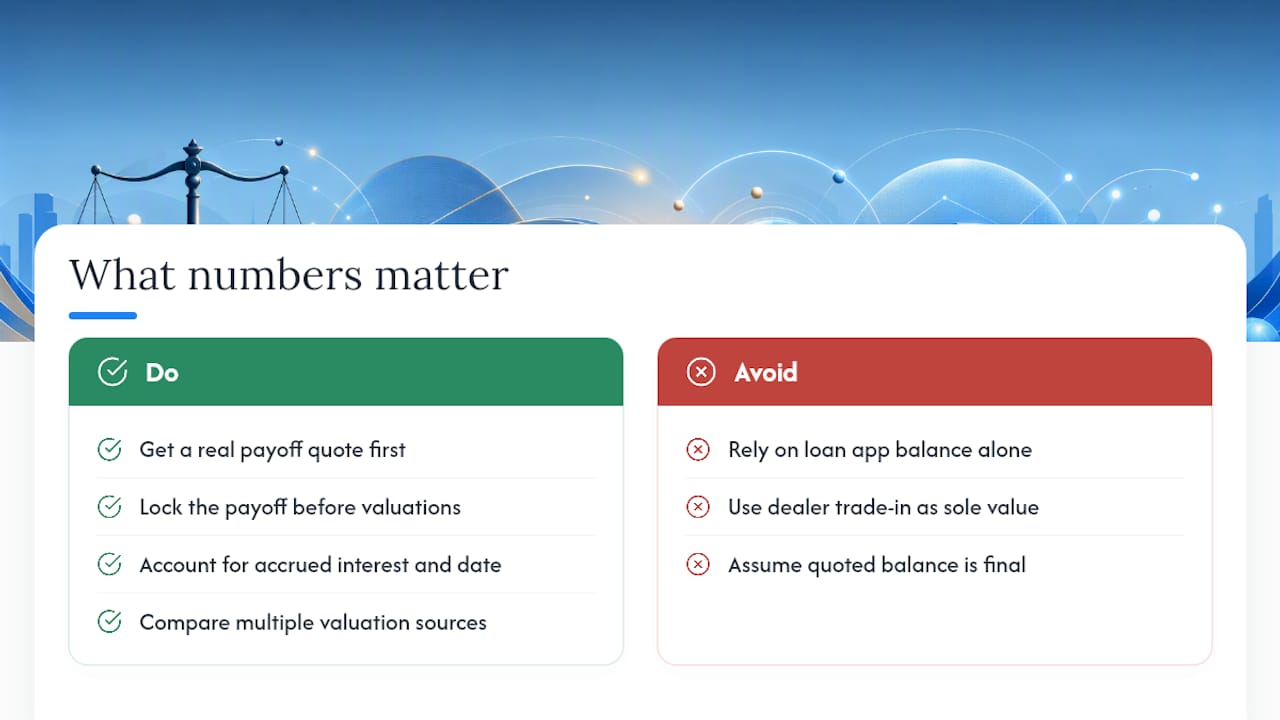
The other blind spot is treating trade-in value as the only number that matters. It’s the easiest to get, since every dealer will hand you one, but it’s rarely the most accurate reflection of what your car is worth. If you only check one value, you’re negotiating from a position of ignorance, not strength.
What I’d prioritize first: get the real payoff quote before you check a single valuation site. Everything else in this calculation is easy once that number is locked down.
— Omar
Turn Positive Equity Into Cash Without the Listing Hassle
If you’ve run the numbers and landed on positive equity, the next question is how to capture it without weeks of strangers, test drives, and price haggling. Sell My Car Online gives you a fair cash offer based on current market data, free pickup, and payment within 24 hours, no dealer trade-in markdown involved.
Compared to listing privately, you skip the back-and-forth negotiations and buyer no-shows. Compared to a dealer trade-in, you avoid the 10 to 20 percent haircut dealers typically apply. If you want to understand exactly how private sale and trade-in outcomes compare before deciding, our breakdown of selling versus trading in walks through the tradeoffs in more detail. Alberta vehicle owners with a 2018 or newer car, truck, or SUV in running condition can get an instant appraisal and know their real number today.
Sources
- Auto Equity Calculator — Car Trade-In & Loan Payoff Tool | Toolzie
- What does it mean to have equity in your car? | Experian
Recommended
Get a real cash offer in 2 minutes
Trusted business. Fair price. Paid on the spot when we pick up your car.