
Fair Car Offers in Canada: Check Liens, Fees, and Provincial Rules
Check market value, liens, and provincial rules before negotiating a car offer in Canada; see when an Alberta cash offer beats a private sale for sellers.
Fair Car Offers in Canada: Check Liens, Fees, and Provincial Rules

A fair car offer in Canada matches verified market value, accounts for the vehicle’s history and any liens, and shows up as an all-in, pre-tax total rather than a vague monthly payment. Before you accept or make any offer, pull a valuation from a source like Canadian Black Book and run a vehicle history report. Those two checks tell you almost everything you need to negotiate with confidence.
TL;DR:
- Compare at least three valuation sources, including Canadian Black Book, CARFAX history signals, and regional listings, to establish a realistic target range.
- Get an independent history report for accidents and recalls, verify the VIN through CPIC, and search the provincial registry because liens remain attached until paid.
- Ontario dealers must include mandatory fees in advertised prices, with HST and licensing exempt; compare the bill of sale’s pre tax total, not monthly payments.
- An Alberta Mechanical Fitness Assessment is not a pass or fail test; get an independent inspection and written repair estimate before agreeing to a price.
- A registered cash buyer can suit sellers prioritizing speed and certainty, while private sales can bring more money but require time and careful payment verification.
Table of Contents
- How to Estimate a Fair Market Value for Your Car in Canada
- Vehicle History, Liens and Why They Change a Fair Offer
- All-In Pricing and the Bill of Sale: What Makes an Offer Legally Fair
- Step-by-Step Negotiation Checklist to Get a Fair Offer
- Inspections and the Mechanical Fitness Assessment: What to Check Before Accepting an Offer
- Verifying Buyer Credibility and Avoiding Scams in the Canadian Market
- When a Fast Cash Offer Beats a Private Sale
- How Kamocars Helps You Get a Fair, Fast Cash Offer in Alberta
- FAQ
- Sources
How to Estimate a Fair Market Value for Your Car in Canada
A car can be viewed in terms of wholesale value, retail value, and the advertised dealer price. Wholesale is what a dealer or buyer pays to acquire the car. Retail is what a dealer lists it for after reconditioning. The advertised price sits somewhere in between, shaped by local demand and how fast a dealer wants to move inventory. Knowing all three helps you spot where an offer actually lands.
Start by gathering numbers from a few Canadian sources:
- Check a baseline estimate from a valuation tool like Canadian Black Book.
- Look at CARFAX Canada valuation signals tied to your vehicle’s specific history.
- Pull a provincial Vehicle Information Report (VIR) to confirm registration and ownership history.
- Compare recent advertised listings for the same year, trim, and mileage in your region.
From there, adjust for mileage, trim level, factory options, and condition. A truck with low kilometers and a desirable trim can sit well above average book value, while higher mileage or cosmetic damage pulls it down. Regional demand matters too: trucks tend to command stronger prices in Alberta and Saskatchewan than in dense urban markets.
A simple three-point method works well: take the wholesale estimate, compare it against similar advertised listings, and check a trade-in figure from a dealer. The overlap between those three numbers gives you a realistic target range rather than a single guess.
Pro Tip: Always compare at least three sources before settling on a target price. A single tool can skew high or low depending on how it weights regional demand.
Vehicle History, Liens and Why They Change a Fair Offer
A clean-looking car can still carry a lien, an unreported accident, or an open recall, and any of those will change what a fair offer looks like. A vehicle history report from CARFAX Canada reveals accident records and recall status, and AMVIC recommends running this check independently rather than relying on what the seller provides. A VIN check through CPIC confirms the car isn’t reported stolen.
Liens are the bigger risk. A car lien is a registered claim against the vehicle that stays attached until the debt is paid, and it can be registered by a lender or even a garage. Searching the personal property security registry by VIN shows whether one exists, and an outstanding lien should lower any offer until it’s cleared.
Before closing a deal, request:
- A recent CARFAX Canada vehicle history report.
- Proof of lien removal or a lien search confirming a clear title.
- VIN verification matching the vehicle, the registration, and the bill of sale.
A vehicle history check and a lien search can help you identify whether a car is encumbered before you buy it.
All-In Pricing and the Bill of Sale: What Makes an Offer Legally Fair
In Ontario, all-in price advertising rules require the advertised price to include every mandatory fee, with HST and licensing as the only allowed exceptions. OMVIC explains that this differs from MSRP, which is only a manufacturer’s reference point, not what you’re expected to pay.
Once you have a written offer, check it against the bill of sale:
- Confirm the pre-tax total on the bill of sale matches the advertised all-in price.
- Treat monthly payment framing as a distraction from the real out-the-door cost.
- Push back or walk away if a mandatory fee appears that wasn’t disclosed upfront.
- Know that rules vary slightly by province, so confirm the current guidance from OMVIC in Ontario or AMVIC in Alberta before signing.
If a dealer tacks on an undisclosed fee after the fact, you have grounds to challenge it under Ontario’s advertising rules, and similar consumer protection principles apply across other provinces.
Step-by-Step Negotiation Checklist to Get a Fair Offer
Getting a fair deal comes down to preparation, not charm. Here’s the order that works:
- Gather your valuation range, a vehicle history report, and three to five comparable listings for the same trim and mileage.
- Get pre-approved financing or decide your cash ceiling before you walk in, so no one can steer the conversation toward a monthly payment you haven’t actually calculated.
- Open negotiations from your researched range, not the sticker price, and ask for an itemized bill of sale before you agree to anything.
- Use timing to your advantage: end-of-month and slower sales periods often bring more flexibility on price.
- Be ready to walk away. A seller who won’t move on an unfair number usually will once you stand up to leave.
- If repair issues surfaced during inspection, bring documented estimates to the table and use them to justify a lower number.
- When selling to an instant-cash buyer instead of negotiating privately, confirm payment timing, pickup logistics, and how any existing lien gets cleared before you sign anything.
Pro Tip: Keep your researched price range on your phone during the conversation. Reciting exact comparable numbers carries far more weight than a vague “I think it’s worth more.”
Private sellers sometimes undervalue their own vehicle out of uncertainty, which is exactly why having comparable data in hand matters more than confidence alone.
Inspections and the Mechanical Fitness Assessment: What to Check Before Accepting an Offer
A Mechanical Fitness Assessment (MFA) is an assessment, not a pass or fail test. Licensed sellers in Alberta are expected to provide one, and a vehicle can still be sold even if it doesn’t meet every item on the list, as long as the buyer is informed.
That distinction matters when you’re deciding how to act on an inspection’s findings:
- Order an independent pre-purchase inspection whenever the MFA flags anything beyond routine wear.
- Get a written repair estimate so you can use a specific dollar figure, not a general impression, when negotiating.
- Add conditional terms to any offer, such as a price adjustment tied to confirmed repair costs, rather than accepting a flat number before the inspection results are in.
A written brake repair estimate is a far stronger negotiating tool than simply saying the brakes feel soft.
Verifying Buyer Credibility and Avoiding Scams in the Canadian Market
Private sales and online marketplaces bring a different kind of risk: the buyer disappearing with your car, paying with a fraudulent cheque, or never showing up with the agreed funds. A few habits cut that risk dramatically.
Meet in a public, well-lit location whenever possible, and never hand over the keys before payment clears. E-transfers and certified bank drafts confirmed directly with the issuing bank are safer than personal cheques, which can bounce days after a buyer has already driven away. If a buyer insists on wiring funds from overseas or offers to pay more than your asking price “by mistake” and asks for a refund of the difference, treat it as a red flag: that pattern is a known scam format.
Verify the buyer is who they say they are before agreeing to a test drive, and ride along rather than handing over keys to a stranger alone. If you’re selling through a dealership trade-in or a licensed buyer, confirm registration status: in Alberta, AMVIC maintains a licensing portal, and Ontario buyers can check OMVIC’s registry the same way. A legitimate business will have no issue confirming its licensing details on request.
Finally, keep a paper trail. A signed bill of sale, a copy of the buyer’s ID, and a record of how payment was sent all protect you if a dispute comes up later, whether that’s over the vehicle’s condition or the transaction itself.

When a Fast Cash Offer Beats a Private Sale
Selling privately can net a higher price, but it costs time, exposes you to scam risk, and leaves financing or lien payoff details on your shoulders. Trading in at a dealership is fast but often undervalues the car. A binding cash offer from a registered buyer splits the difference: less than private-sale money, but far less hassle and risk. For sellers who need to move quickly, who’d rather skip test drives with strangers, or who just want certainty, that tradeoff makes sense. A registered Alberta buyer like Kamocars illustrates how that option works in practice.
— Omar
How Kamocars Helps You Get a Fair, Fast Cash Offer in Alberta
If you’d rather skip the back-and-forth entirely, we built Kamocars to give Alberta owners a straightforward alternative: an instant appraisal based on current market data, a binding cash offer, free home pickup, and payment handled promptly.
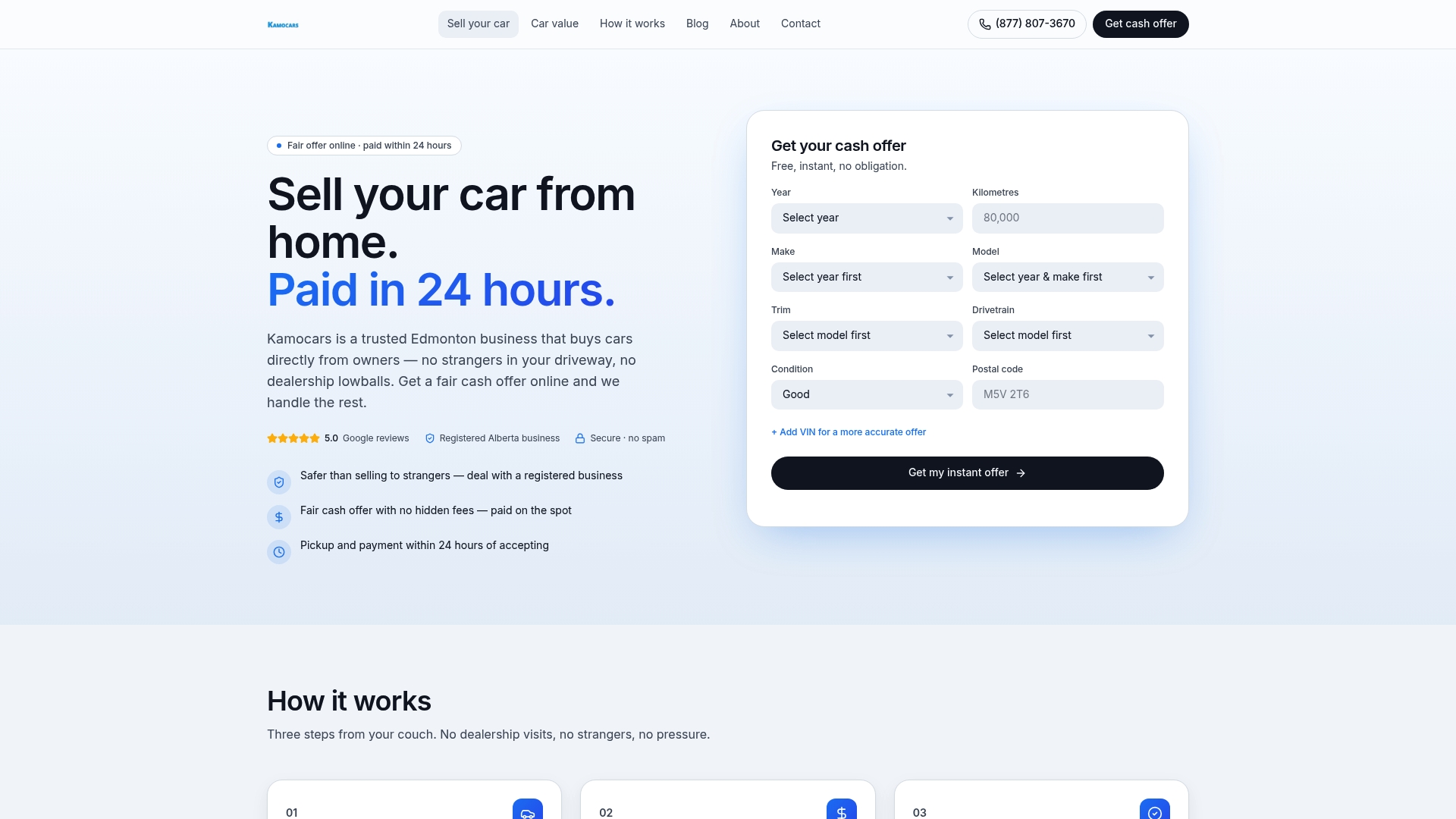
This works best for owners of newer cars, trucks, and SUVs in running condition who value speed and safety over squeezing out the last few hundred dollars through private negotiation. We’re a registered Alberta business, which means you’re not handing your car to a stranger off a classifieds site.
- Get an instant online appraisal through our Sell My Car page.
- See exactly how pickup, payment, and lien clearance work on our How It Works page.
FAQ
Who gives the best offer for cars?
The best offer typically comes from whoever has verified your vehicle’s market value, history, and condition most accurately rather than a single “best” buyer type. Comparing a dealership trade-in, a private sale, and a registered cash buyer side by side, using the same valuation data, usually reveals which route nets you the strongest number for your specific situation.
What is the best way to negotiate with a car dealership?
Walk in with your own researched price range, a vehicle history report, and comparable listings rather than relying on the dealer’s number. Insist on comparing the out-the-door, pre-tax total instead of a monthly payment, and be willing to leave if the itemized bill doesn’t match what was advertised.
Why are cars from Canada cheaper?
Pricing in Canada reflects regional wholesale and retail data rather than a single national number, so a car’s price depends heavily on local demand, trim availability, and seasonal factors in that specific market. Comparing wholesale, retail, and advertised prices for your exact year, trim, and region gives a clearer picture than assuming a flat “Canadian price.”
What is the best website to buy used cars in Canada?
There’s no single platform that works best for every buyer since marketplaces, dealership sites, and registered buying services each serve different needs. Checking a vehicle history report through CARFAX Canada and confirming any seller’s licensing status through AMVIC or OMVIC matters more than which site you use.
Sources
Before finalizing any offer, review guidance directly from OMVIC or AMVIC, run a CARFAX Canada and VIN/CPIC check, and search your province’s personal property security registry for liens.
Recommended
Get a real cash offer in 2 minutes
Trusted business. Fair price. Paid on the spot when we pick up your car.