
Skip Facebook Marketplace in Alberta: Sell to Kamocars, Paid in 24 Hours
Sell your car in Alberta without risky Marketplace meetups. Get a binding cash offer, free pickup, and payment within 24 hours from Kamocars.
Skip Facebook Marketplace in Alberta: Sell to Kamocars, Paid in 24 Hours

If you want to avoid meeting strangers on Facebook Marketplace, the safest fast option in Alberta is selling to a licensed online buyer that offers a binding cash offer, secure payment, and home pickup. Kamocars is one such buyer: it provides guaranteed payment and free pickup, so you skip the private meetup entirely. Before you start, have your bill of sale template, VIN, and registration ready.
TL;DR:
- Selling to a licensed buyer ensures payment through traceable accounts and scheduled pickups, significantly reducing the risk of fraud compared to private Facebook meetups.
- Verify all documents, including a completed bill of sale, VIN, registration, and lien status, before handing over the vehicle and confirm payment has cleared in your bank account.
- Conduct in-person meetings in well-lit public spaces, take photos of the vehicle beforehand, and avoid giving access or keys until payment is confirmed.
- Always check the buyer’s registration and business credentials for licensed buyers, and be cautious of suspicious profiles with little online presence.
- If fraud seems imminent, halt the process immediately, report to authorities, and keep all messages and proof of transaction for investigations.
Table of Contents
- Why a licensed buyer beats a private Facebook Marketplace meetup
- Step-by-step: selling your 2018+ vehicle safely to a licensed buyer
- What you must provide and what happens at handover
- How Kamocars handles the sale from offer to payment
- Choosing a safe meeting spot for inspections and test drives
- Confirming who you are actually dealing with
- What to do if you suspect fraud during the sale
- Checking the vehicle’s condition before you finalize anything
- A few things I always tell sellers before pickup day
- Get an instant cash offer and free pickup from Kamocars
- Sources
- FAQ
Why a licensed buyer beats a private Facebook Marketplace meetup
Selling on Facebook Marketplace means dealing with strangers, unverified payment methods, and no formal contract until you draft one yourself. That gap is exactly where fraud happens. The Canadian Anti-Fraud Centre warns sellers that fraudsters commonly use fake e-transfer notifications, QR-code scams, and forged payment confirmations to trick sellers into releasing a vehicle before funds actually land.
A licensed buyer removes most of these fraud vectors because the transaction runs through a registered business rather than an anonymous chat thread.
- Payment moves through traceable corporate accounts rather than personal e-transfers.
- The offer is written and binding, minimizing the risk of last-minute price renegotiation.
- Pickup is scheduled and documented, reducing the need for informal meetups.
- The buyer is a registered business with verifiable contact details, unlike anonymous online profiles.
A common Facebook Marketplace fraud tactic is the fake e-transfer or QR-code notification, which the Canadian Anti-Fraud Centre flags as a way scammers get sellers to hand over a vehicle before any money actually clears.
Sellers should also know that tax treatment on a vehicle sale is not always straightforward. CRA guidance on motor vehicle sales explains that GST/HST and provincial tax rules can differ depending on whether the seller is a registrant and where the vehicle is delivered or registered, so it is worth checking your own situation rather than assuming a private sale is automatically tax-free.
Step-by-step: selling your 2018+ vehicle safely to a licensed buyer
Selling to a licensed buyer follows a clear sequence, and skipping a step is usually where sellers run into trouble.
- Request a binding offer online and confirm it in writing before you agree to anything. A legitimate offer names the amount, the vehicle by VIN, and a pickup window, not just a verbal number.
- Gather your documents: the Alberta standard bill of sale with sections 1 and 2 completed, your current registration, government ID, proof of insurance, and any lien paperwork if the vehicle is financed.
- Verify the vehicle’s own standing before handover. A registry agent can run a Vehicle Information Report and lien search by VIN, and a stolen-status check through the police-linked CPIC system adds another layer of confidence for both sides.
- Confirm payment method before pickup. Accept only traceable corporate payments and confirm the funds have actually landed in your account, never a screenshot or a payment notification alone.
- At handover, sign the bill of sale, give the buyer the original, and keep a copy for your own records. Confirm the buyer understands they need to register and insure the vehicle themselves.
Our internal guide on what documents you need to sell a car in Alberta walks through the exact paperwork checklist if you want more detail before your appointment.
Pro Tip: Never hand over the keys until the payment has actually cleared in your bank account, a text or e-mail confirmation is not the same thing as cleared funds.
What you must provide and what happens at handover
Alberta registry agents will not process a vehicle transfer without a properly completed bill of sale. The Government of Alberta’s standard bill of sale requires the VIN, make, model, year, colour, both parties’ names and addresses, the sale price, the date, and both signatures. Sections 1 and 2 must both be filled in or the registry agent can reject the form outright.
- Complete both sections of the bill of sale and make two copies, one for you and one for the buyer.
- Know that the buyer is expected to register the vehicle within 14 days of the purchase date.
- Confirm the vehicle carries valid insurance, since Alberta requires proof of insurance before a registry agent will register it.
- If the vehicle is financed, ask the buyer in writing how the lien will be cleared, either paid directly to the lienholder or held until the lien is released.
- If the vehicle came from outside Alberta, check whether an out-of-province inspection is needed before it can be registered here.
Our detailed guide on transferring vehicle registration in Alberta covers the registry timeline step by step if you want to walk the buyer through what happens next.
How Kamocars handles the sale from offer to payment
Kamocars builds its process around removing the exact risks that make private Facebook Marketplace sales stressful. The company provides instant appraisals based on current market data and completes pickups and payments within 24 hours, according to Kamocars. It has also completed over 500 successful transactions with a strong customer rating, which reflects a track record sellers can check before they commit.
- You get a binding cash offer online, so the number does not change when the buyer shows up.
- Kamocars manages the bill of sale, lien clearance, and pickup logistics directly instead of leaving you to coordinate paperwork with a stranger.
- Payment is handled within 24 hours through a documented, traceable process rather than a personal e-transfer.
- You should still keep your own signed copy of every document and ask for a payment confirmation or receipt for your records.
If you want the exact mechanics of how funds move after a sale, our page on how payment is processed after the sale breaks down what to expect before pickup day.
Choosing a safe meeting spot for inspections and test drives
If you do end up meeting anyone in person, whether a licensed buyer’s pickup agent or someone helping with an inspection, the location matters. Pick a busy, well-lit public space during daylight hours, such as a large retail parking lot or a police station lot where these are designated for exactly this purpose in many Alberta cities.
Bring a second person along whenever possible, and tell a friend or family member where you will be and roughly how long the meeting should take. Keep the test drive route short and familiar, and always ride along rather than handing over keys and letting someone drive off alone. Photograph the odometer reading and the vehicle’s condition before the drive starts, so there is a clear record of its state going in.
Avoid meeting at your own home or workplace if you can help it, since that gives an unknown party your address for no real benefit. A licensed buyer’s scheduled pickup removes this step almost entirely, since the appointment, location, and time are agreed in advance rather than negotiated on the spot with a stranger.

Confirming who you are actually dealing with
Before you commit to any buyer, take a few minutes to check whether they are who they claim to be. A profile created days ago, with no photos, no mutual connections, and a name that does not match the payment account they later use, is a warning sign worth pausing on.
Ask for a phone call, not just messages, since scammers often avoid real-time conversation. Search the person’s name alongside words like “review” or “complaint” to see if anything surfaces. For a licensed buyer, verification is simpler: check that the business is registered, look for a physical address, and see whether it has a public track record you can independently confirm rather than taking a single message at face value.
Consumer-protection guidance from Service Alberta recommends verifying a business’s registration and never sharing multi-factor authentication codes with anyone claiming to need them to “verify” a payment, a tactic often used to hijack banking access mid-transaction.
What to do if you suspect fraud during the sale
If something feels off, stop the transaction before you hand over keys, a signed bill of sale, or personal financial details. Do not proceed on the promise that payment is “on its way” or that a screenshot is proof enough.
If you believe you have already been targeted or scammed, report it to your bank immediately so they can flag or reverse suspicious activity where possible, then file a report with local police and with the Canadian Anti-Fraud Centre. Keep every message, payment notification, and screenshot as evidence, even the fake ones, since they help investigators identify patterns.
Change any passwords or banking credentials you may have shared, and monitor your account for unauthorized activity in the days that follow. Selling through a licensed buyer sidesteps most of this risk from the outset, since payment runs through a documented business process rather than a one-time exchange with someone you will likely never deal with again.
Checking the vehicle’s condition before you finalize anything
Even as the seller, it pays to document your vehicle’s condition before any inspection or pickup, since disputes over pre-existing damage are one of the most common friction points in a sale. Walk around the vehicle in daylight and photograph every panel, the tires, the windshield, and the interior.
Start the engine cold if possible and note anything unusual: rough idling, warning lights, or fluid stains under where it was parked. Check that the VIN on the dashboard, the door jamb, and the registration all match, since a mismatch can signal a previous accident rebuild or, in rarer cases, tampering. A Vehicle Information Report from a registry agent can confirm the vehicle’s registration history and help you back up your own documentation if a buyer later disputes the car’s condition.
Keeping a dated photo record protects you just as much as it protects a buyer, and it gives you something concrete to point to if any condition dispute comes up after pickup.

A few things I always tell sellers before pickup day
The mistake I see most often is releasing the keys before the payment has actually cleared, not when a text says it is coming. A close second is not keeping a signed copy of the bill of sale, which becomes a real problem if a registration question comes up weeks later.
Schedule pickups earlier in the day when banks and registry offices are open, so any payment or paperwork issue can be resolved the same day rather than over a weekend. A five-minute final walkaround with the buyer, matching the VIN and confirming the odometer, saves both sides a dispute later.
— Omar
Get an instant cash offer and free pickup from Kamocars
Skip the stranger meetups altogether and get a binding cash offer online in minutes. Kamocars provides free home pickup anywhere in Alberta and completes payment within 24 hours, so your 2018 or newer car, truck, or SUV sells without the back-and-forth of a private listing.
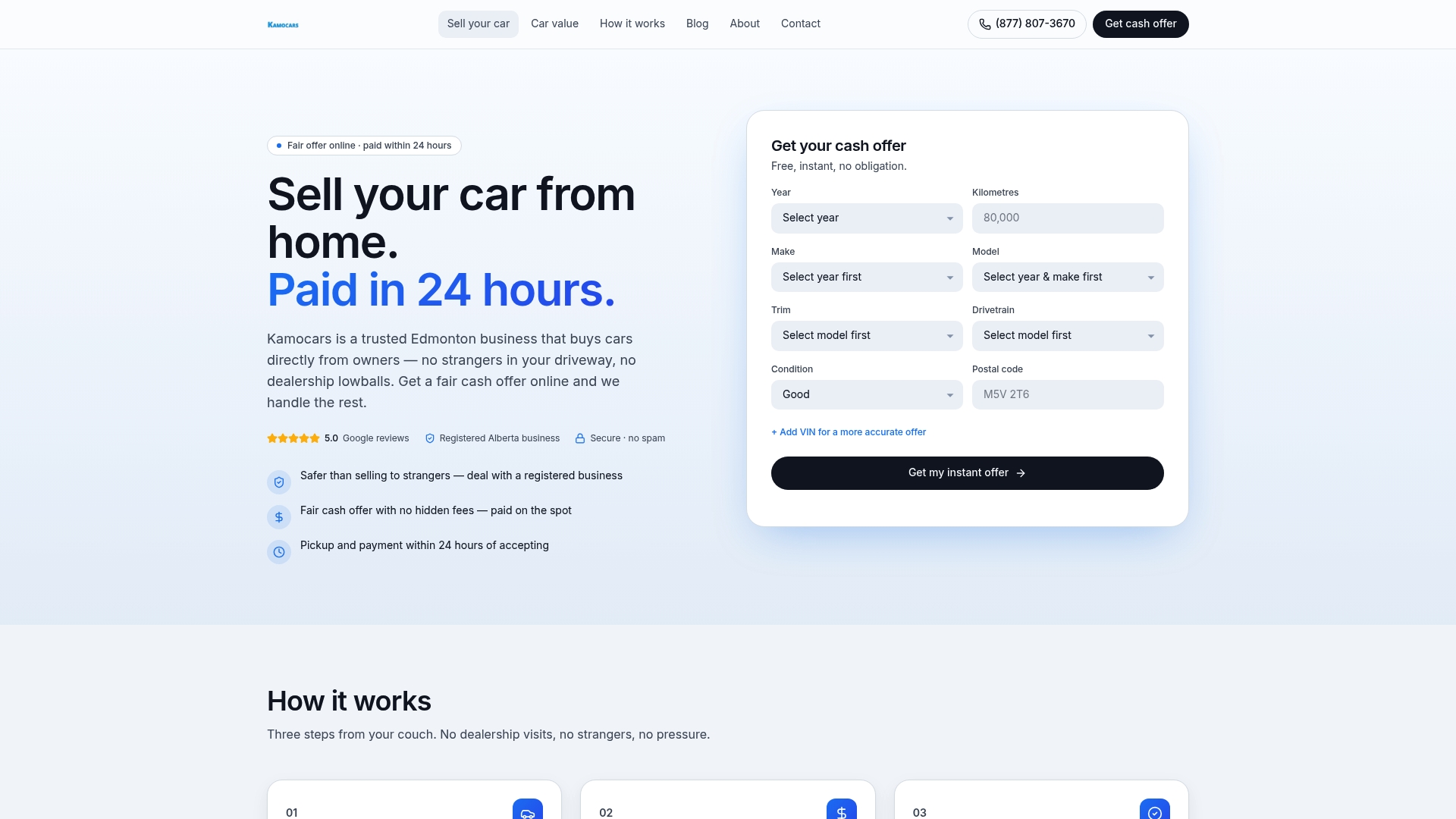
- Request your instant offer through Sell My Car and confirm the number in writing.
- Have your VIN, current registration, and lien information ready if the vehicle is financed.
- Review the full process on how it works before your pickup appointment.
Sources
- Alberta
- Merchandise — Canadian Anti-Fraud Centre
- Canada
- Bill of Sale — Edmonton Registry (form and guidance PDF)
FAQ
Is selling to a licensed online car buyer safer than Facebook Marketplace?
Yes, a licensed buyer uses traceable corporate payments and scheduled pickups instead of an anonymous in-person meetup, which removes most of the fraud tactics the Canadian Anti-Fraud Centre warns sellers about. You avoid negotiating with a stranger and get a binding offer in writing before anyone shows up.
What documents do I need to sell my car in Alberta?
You need a completed Alberta standard bill of sale with sections 1 and 2 filled in, your current registration, government ID, proof of insurance, and lien documents if the vehicle is financed. Our documents checklist walks through each item in more detail.
How long does the buyer have to register a vehicle in Alberta?
A buyer is expected to register the vehicle within 14 days of the purchase date, and they will need valid insurance and the original bill of sale to do so. Our guide on transferring vehicle registration covers the full registry process.
How much does Kamocars pay for a car?
Kamocars does not publish fixed prices since each offer is based on an instant appraisal using current market data for your specific vehicle. You can request a free, no-obligation offer directly through Sell My Car.
What should I do if I think I’m being scammed while selling my car?
Stop the transaction immediately, do not hand over keys or a signed bill of sale, and contact your bank if any payment information was shared. Report the incident to local police and the Canadian Anti-Fraud Centre, and keep every message or screenshot as evidence.
Recommended
Get a real cash offer in 2 minutes
Trusted business. Fair price. Paid on the spot when we pick up your car.