
Don't Let a $3,000 E-Transfer Cap Stop Your Car Sale in Canada
Compare Canadian banks' e-Transfer caps: common $3,000 personal limits, larger business ceilings, and safer payment options for car sellers.
Don’t Let a $3,000 E-Transfer Cap Stop Your Car Sale in Canada
The typical Interac e-Transfer default in Canada is usually a few thousand dollars per transfer for personal accounts, with receiving limits commonly much higher. Business accounts often allow sending larger amounts per transfer. Your exact numbers depend entirely on your bank and account type, so check your bank’s help page or app settings before you count on a specific figure.
TL;DR:
- Interac e-Transfer limits are set by individual banks and vary by account type, verification status, and account age, with some allowing higher limits after verification.
- The 24-hour, 7-day, and 30-day transfer limits stack and apply simultaneously, so exceeding any of these caps blocks additional transfers even if individual ones are within limits.
- Most banks stick closely to a $3,000 per-transfer default, but some like EQ Bank and Desjardins offer defaults up to $5,000, with possibilities for limit increases through verification.
- Business accounts often permit much higher transfer limits, sometimes up to $25,000 per transaction, reflecting their larger transaction needs and additional verification requirements.
- For high-value transactions exceeding transfer limits, options like bank drafts and wire transfers become necessary, as e-transfers are often too limited.
Table of Contents
- E Transfer Limits Canada: A Bank-by-Bank Snapshot
- How Rolling Limit Windows Actually Work
- Which Banks Allow Higher Limits (and Which Don’t Budge)
- Business Accounts Get More Room to Move
- When E-Transfer Isn’t Enough: Bank Draft vs E-Transfer and Other Options
- How to Check Your Real Limit and Ask for More
- What E-Transfers Actually Cost
- Red Flags and a Quick Safety Checklist
- Why Payment Method Matters More Than People Think
- Where to Verify Your Own Limits
- Sources
E Transfer Limits Canada: A Bank-by-Bank Snapshot
Every bank sets its own ceiling, and Interac itself hands that authority to the financial institution rather than fixing one number nationwide. That’s why two people at different banks with identical account types can have wildly different caps on the same afternoon.
The figures below reflect commonly published defaults as of early 2026. They vary by account tier, verification status, and how long you’ve held the account, so treat this as a starting map, not a guarantee.
These are aggregated defaults, not personal guarantees — your account age, verification level, and package can push your real number higher or lower. Last verified for this article in early 2026. When in doubt, your bank’s app almost always beats any published table, including this one.
How Rolling Limit Windows Actually Work
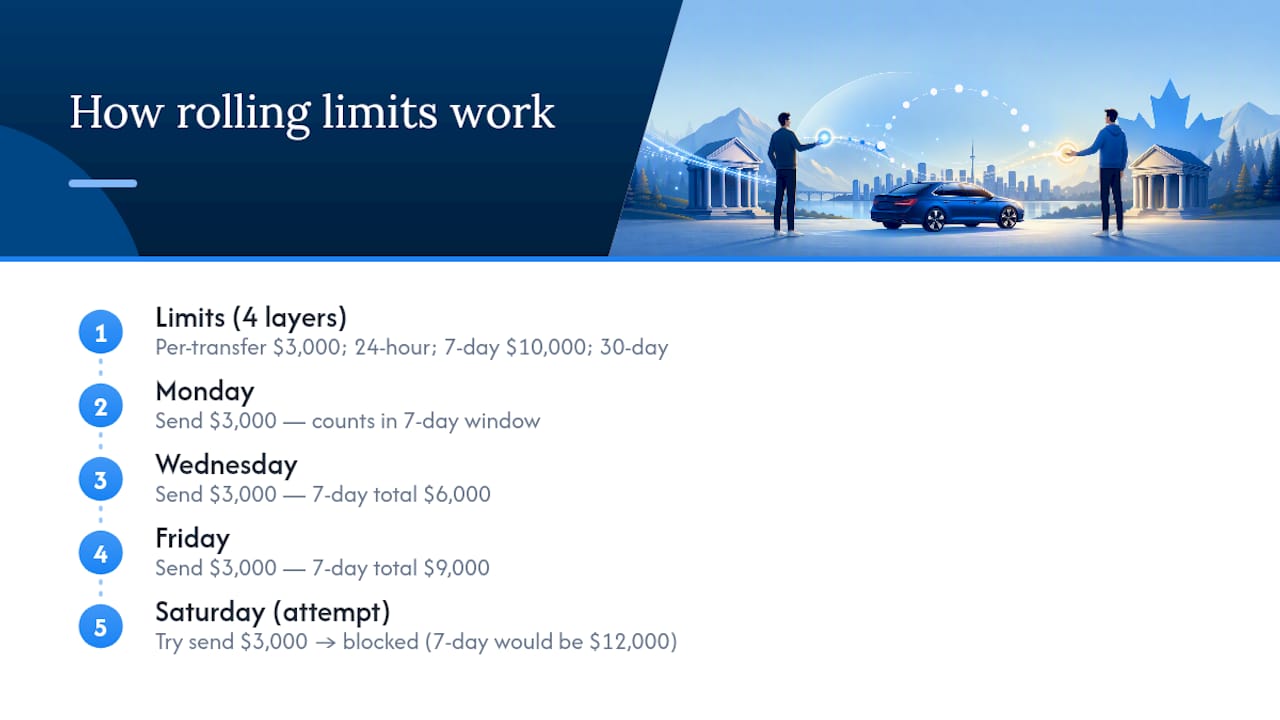
Interac and most Canadian banks don’t just cap a single transfer. They stack four layers on top of each other: the per-transfer maximum, a 24-hour limit, a rolling 7-day limit, and a rolling 30-day limit. All four apply simultaneously, and the tightest one wins.
Here’s where people get tripped up. Say your bank allows $3,000 per transfer and $10,000 over 7 days. You send $3,000 on Monday, $3,000 on Wednesday, and $3,000 on Friday. That’s $9,000, still under the weekly cap. Try to send another $3,000 on Saturday and the system blocks it, even though each individual transfer was within the per-transfer limit. The 7-day window doesn’t reset at midnight Sunday. It rolls forward continuously, so Monday’s transfer only drops out of the count once seven full days have passed.
Some banks also tie your e-Transfer cap to your debit card daily limit or your account verification tier, meaning a newly opened account or an unverified profile can face a lower ceiling than a long-standing customer with the same account type.
Which Banks Allow Higher Limits (and Which Don’t Budge)
Not every bank treats $3,000 as gospel. A few consistently publish higher defaults, and a few make it clear they’re not moving.
- RBC commonly reports the standard $3,000 per-transfer default but has been known to allow daily sending up to $10,000 through verified in-app channels, and RBC generally requiring identity verification and account history before granting any increase.
- TD, Scotiabank, BMO, and CIBC stick closely to the industry-standard $3,000 per-transfer and per-day figure, with weekly caps around $10,000 and monthly caps around $20,000 for most personal accounts.
- Tangerine mirrors the big banks at $3,000 per transfer and per day, which makes sense given it operates as Scotiabank’s digital arm.
- EQ Bank, Desjardins, and Wealthsimple run noticeably higher, often defaulting to $5,000 per transfer and $5,000 daily, with 30-day caps reaching $30,000 for eligible account holders.
- National Bank sits in between, commonly listing a $4,000 per-transfer default, a step up from the traditional big-five figure but short of the digital-bank tier.
On whether you can push past these numbers: some banks, including EQ Bank and certain Desjardins accounts, will consider raising your limit after a phone call or branch visit and a verification check. Others, like RBC and Desjardins in specific account tiers, have been reported to hold firm regardless of tenure or balance. There’s no universal rule here, which is exactly why calling your bank directly beats relying on any published chart, including the one above.
Business Accounts Get More Room to Move
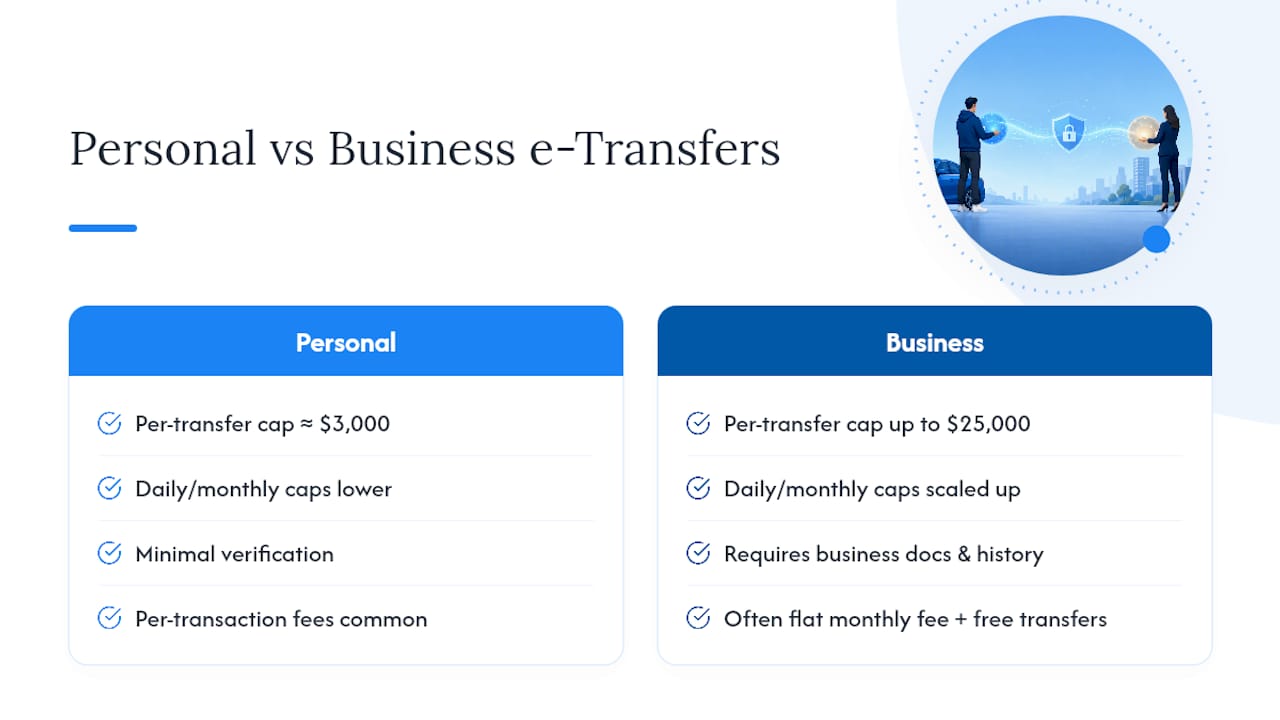
If you’re running a business, your Interac e-Transfer ceiling usually looks nothing like your personal account. Many banks extend business accounts up to $25,000 per transfer, with daily and monthly caps scaled up to match. That gap exists because business accounts typically require more documentation upfront, business registration, banking history, sometimes a minimum balance, and banks treat that verification as license to raise the ceiling.
Business accounts also tend to carry different fee structures, sometimes a flat monthly cost that bundles in a set number of free transfers rather than per-transaction charges. If you’re a sole proprietor who regularly moves payments above $3,000, whether from invoicing clients or selling equipment, upgrading to a business account is often worth the paperwork. For a one-off large payment, though, it’s rarely worth opening a new account just to unlock a higher cap.
When E-Transfer Isn’t Enough: Bank Draft vs E-Transfer and Other Options
When a payment exceeds what your account allows, whether you’re buying a vehicle, closing a real estate deposit, or settling an estate matter, e-transfer stops being the right tool. Comparing bank draft vs etransfer options matters here: three alternatives cover most high-value Canadian transactions.
- Bank draft: issued and guaranteed by the paying bank, a bank draft carries no standard maximum amount, making it the go-to for vehicle purchases and large private sales. Get one directly from a teller and confirm authenticity before handing over keys or goods.
- Wire transfer: fast and traceable, especially for large domestic or international moves, but banks typically charge $15 to $50 per wire, well above e-transfer fees.
- Certified cheque or money order: certified cheques still work at most banks, but Canada Post money orders cap out at CAD $999.99, making them useless for anything beyond small transactions. Some banks have also scaled back certified cheque availability in recent years.
Pro Tip: Never mail a bank draft. Meet the recipient at a branch, or hand it over in person, so both sides can verify the instrument before anyone walks away. For a deeper walkthrough of secure payment steps specific to vehicle sales, see this Canada seller’s guide.
How to Check Your Real Limit and Ask for More
Published tables give you a ballpark. Your actual number lives in your online banking portal or mobile app.
- Log into your bank’s app and look under “Send Money,” “Interac e-Transfer,” or a settings menu labeled “Limits” or “Maximum Amounts.”
- If it’s not visible there, check your bank’s official help page, most major banks publish a dedicated e-Transfer limits article.
- To request an increase, call your bank or visit a branch with government ID; business owners should bring incorporation documents and recent account statements.
- If the bank won’t budge, split the payment into two transfers across different days, use a second account at another institution, or switch to a bank draft or wire for the full amount.
What E-Transfers Actually Cost
Fees vary more than people expect. Some accounts include free transfers as part of the monthly package; others charge per send.
CIBC and Scotiabank commonly charge $1.00 to $1.50 per transfer on no-fee or basic chequing accounts, while premium packages at the same banks often bundle in unlimited free transfers. National Bank follows a similar pattern, fee-free on higher-tier accounts, small charge on entry-level ones. Digital banks like Tangerine, EQ Bank, and Wealthsimple typically don’t charge at all.
Before you send anything sizable, check your specific fee schedule. Incoming transfers are usually free everywhere, but international sends, expedited transfers, and stop-payment requests can carry separate charges that don’t show up in the standard fee list.
Red Flags and a Quick Safety Checklist
Vehicle sales are where e-transfer fraud shows up most often, mainly because both strangers and large sums are involved.
Watch for a buyer who pushes urgency, offers to overpay “by mistake” and asks for a refund, or insists on an unusual acceptance method for the transfer. These are classic overpayment scam patterns.
- Meet at a bank branch for anything over your comfort threshold and request a bank draft on the spot.
- Confirm the sender’s name matches the account holder before releasing a vehicle or goods.
- Wait for the funds to actually clear, not just “arrive,” before handing over keys or documents.
Pro Tip: If you’re accepting an e-transfer for a vehicle sale, have the buyer send it while you’re both still together, then confirm it landed in your account before they leave. More on structuring a safe handoff is covered in this Canada seller’s checklist.
Why Payment Method Matters More Than People Think
Most guides treat e-transfer limits as a technical curiosity. They’re not. When you’re selling a car worth $12,000 or $20,000, hitting your bank’s cap mid-transaction is a real problem, not a footnote.
I’ve watched the payment method become the actual bottleneck in vehicle sales more than the price negotiation itself. A buyer with a $3,000 limit trying to pay for a $15,000 truck either needs five days of rolling transfers or a bank draft. That’s the gap most sellers don’t plan for until they’re standing in a driveway.
That’s part of why Kamocars structures its own process around guaranteed same-day payment rather than leaving sellers to sort out transfer limits with a private buyer. As a registered business that has completed over 500 transactions, Kamocars issues instant cash offers based on current market data and handles pickup and payment within 24 hours, sidestepping the entire e-transfer ceiling question for sellers who’d rather not gamble on a stranger’s daily cap.
— Omar
Where to Verify Your Own Limits
For account-specific numbers, go directly to Interac’s official e-Transfer guidance and your bank’s help page. Aggregated tables, including the one in this article, are a starting reference only. Your bank’s app remains the final word.
Sources
- How to send money with Interac e-Transfer
- Biller
- A guide to e-Transfer limits and fees when using Interac | Wise
- Bank drafts in Canada — what they are and how they work
Recommended
Get a real cash offer in 2 minutes
Trusted business. Fair price. Paid on the spot when we pick up your car.