
Keep the Offer: Car Offer Expiry in Canada for Alberta 2018+ Vehicles
Alberta owners of 2018+ vehicles: how long cash offers typically stand in Canada, what can void them, and quick steps to lock your quoted price with a...
Keep the Offer: Car Offer Expiry in Canada for Alberta 2018+ Vehicles

A quoted cash offer for your car, truck, or SUV typically stays valid for a limited period defined by the buyer’s policy, rather than by any legal requirement. Canadian provincial rules generally don’t force a cooling-off period on either side of a vehicle sale, so once you accept, you’re accepting a moving target. Some buyers structure their offers around fast verification and prompt pickup and payment to minimize uncertainty for sellers.
TL;DR:
- Offers typically last only a few days and depend on verification steps, market conditions, scheduling capacity, and accurate vehicle information.
- Immediate written acceptance, timely documentation, and scheduled pickup are crucial to lock in the quoted price before expiration.
- Extensions are possible if delays are due to logistical reasons and requested before the deadline, but new offers usually reflect current market values.
- Canada lacks a legal cooling-off period for vehicle sales, so the binding nature of offers relies on buyer practices and specific provincial rules.
- Choosing a registered and transparent buyer increases the chances of securing and maintaining your initial offer without unnecessary risk.
Table of Contents
- How Car Offer Expiry Works Under Canadian Law
- What Actually Sets an Offer’s Expiry Window
- What to Do When Your Offer Is About to Expire
- Can You Extend or Renew an Expired Car Offer?
- How Kamocars Protects Your Offer From Expiring Unfairly
- An Editor’s Take on Offer Deadlines
- Sources
How Car Offer Expiry Works Under Canadian Law
There’s a persistent myth that Canadians get a 48 or 72-hour window to back out of any car deal. It’s false. Ontario’s own consumer guidance confirms there’s no automatic cooling-off period for vehicle purchase contracts, whether you’re buying from a dealership or selling to one. Once you sign, the deal is binding in most cases, and that principle applies broadly across the country.
An online cash offer typically becomes binding through a short sequence:
- You submit vehicle details and receive a preliminary quote.
- You accept the offer, confirming the terms in writing or through the buyer’s platform.
- The vehicle passes inspection or photo verification, confirming the condition matches what you reported.
- Payment and pickup are scheduled, closing the transaction.
That inspection step matters. Most legitimate buyers treat the initial number as conditional until they’ve confirmed the car matches its description. If it doesn’t, the offer can shrink or disappear entirely, not because of any legal loophole, but because the original price was never guaranteed against undisclosed problems.
Some provinces do carve out narrow protections for distance or electronic sales contracts. British Columbia’s Vehicle Sales Authority explains that certain distance sales contracts allow cancellation, but only under specific conditions, like when required contract information wasn’t disclosed before you agreed. That’s a far cry from a blanket right to walk away from any online car sale. If a buyer clearly states its terms upfront, as a compliant Canadian buyer should, these narrow exceptions rarely apply.
Voluntary satisfaction guarantees are a different animal. Some dealers advertise return policies as a marketing feature, but those are business choices, not statutory rights. Knowing the difference protects you from assuming you have more time or leverage than you actually do.
What Actually Sets an Offer’s Expiry Window
Buyers don’t pick expiry windows out of thin air. A few operational and market realities drive how long a quote can realistically stand.
- Verification requirements. VIN checks, lien searches, and title confirmation take time, and a buyer won’t hold a price indefinitely while paperwork clears.
- Market movement. Wholesale values for used vehicles shift week to week, sometimes faster during seasonal demand swings, so a price locked too long stops reflecting current value.
- Scheduling capacity. Payment processing and pickup logistics are finite. A buyer offering 24-hour turnaround needs the offer window short enough to match its own booking calendar.
- Listing accuracy. An offer built on your reported mileage, trim, and condition can be shortened or voided if an inspection turns up undisclosed damage or inaccurate details.
Industry-wide, published offer windows typically last from same-day up to a few business days, depending on how much verification the buyer requires before committing funds. That’s a policy choice rather than a rule, which is exactly why comparing buyers matters before you assume any quote is fixed in place.
Pro Tip: Take clear, well-lit photos of every panel, the odometer, and the interior before requesting a quote. Sellers who submit accurate photos upfront tend to see fewer last-minute revaluations.
What to Do When Your Offer Is About to Expire
If your quote has a deadline attached, moving fast protects the number you were promised. Work through these steps in order:
- Confirm acceptance in writing. Reply to the offer through whatever channel the buyer specifies, and get written confirmation the terms are locked.
- Gather your documents. Have your vehicle registration, government-issued ID, and, if the car is financed or leased, a lien or payoff letter ready before pickup day.
- Verify payment method and timing. Ask exactly how you’ll be paid, whether by certified check or e-transfer, and when funds actually clear versus when the vehicle changes hands.
- Check the buyer’s registration. A registered business is easier to hold accountable than an informal buyer working off a classifieds ad.
- Lock a pickup time immediately. Scheduling inspection and pickup as soon as possible prevents the offer from sliding back into re-valuation.
- If the timeline still doesn’t work, ask directly whether same-day pickup is available. Some buyers can move faster than their standard window suggests when asked.
Missing documentation is one of the most common reasons offers lapse, so having your paperwork sorted before you even accept saves you from losing a good number over a paperwork delay.
Can You Extend or Renew an Expired Car Offer?
Sometimes, yes. Buyers commonly grant short extensions when you can show the delay is logistical, not a stalling tactic, like waiting on a lien payoff letter or a scheduling conflict on their end.
To request one, contact the buyer before the deadline passes, not after. State the specific reason for the delay and give a realistic new date. A simple message works: “My original offer expires tomorrow, but I’m waiting on my payoff letter from my lender. Can you extend the offer to Friday?” Buyers are far more flexible with a concrete reason and timeline than with a vague “can I have more time.”
If the offer does lapse, expect a new number, not a rubber stamp of the old one. A regenerated offer will typically reflect current wholesale data and may account for any new inspection findings. That’s not a penalty. It’s the buyer recalculating against the market as it stands that day.
A few things worth knowing before you ask:
- Extensions are far more likely when you’ve already been responsive and provided documents promptly.
- Asking early, rather than at the deadline, gives the buyer room to say yes.
- A revised offer isn’t always lower. If the market has firmed up, it can land higher than the original.
How Kamocars Protects Your Offer From Expiring Unfairly
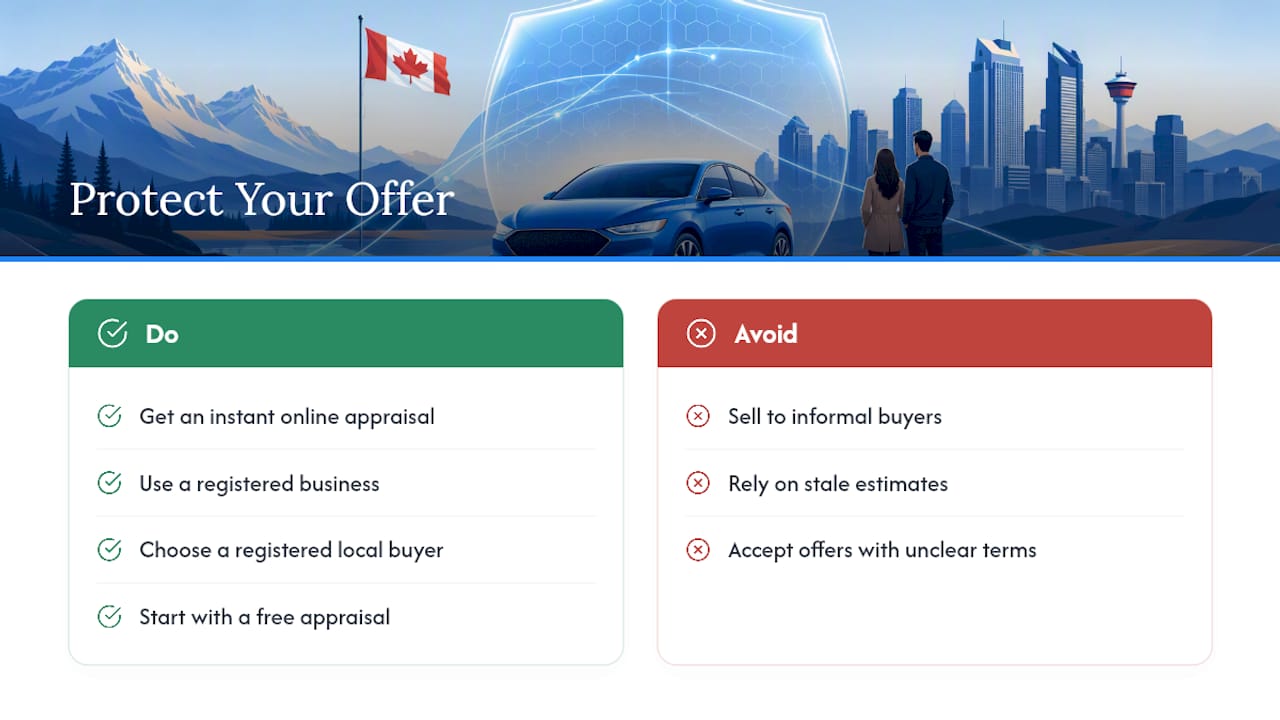
Losing a fair price to a missed deadline is avoidable, and that’s the exact problem Kamocars is built to solve. The process starts with an instant online appraisal based on Canadian wholesale data, so the number you see reflects current market conditions rather than a stale estimate.
Using a registered business can provide additional accountability when selling your vehicle. A registered business with completed transactions generally offers more accountability than informal buyers. Offer terms are usually stated clearly upfront, verification is handled promptly, and pickup and payment can often be completed within a short timeframe after acceptance. Some buyers assist with lien payoff details as part of the transaction when dealing with financed or leased vehicles.
If your priority is avoiding the stress of a ticking clock, getting a quote from a registered local buyer that can move on your timeline is the most reliable way to keep the number you were quoted. Start with a free appraisal and see how quickly you can turn your vehicle into cash.
An Editor’s Take on Offer Deadlines
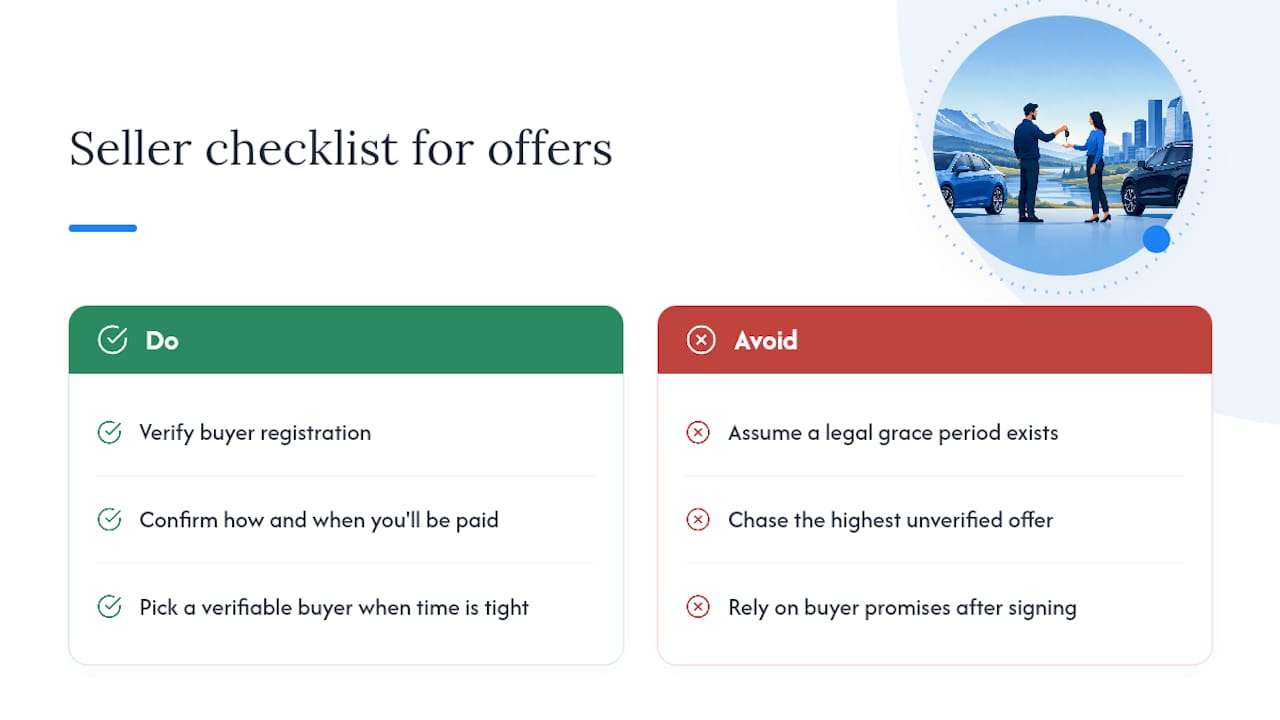
The biggest mistake sellers make isn’t missing a deadline. It’s assuming they have legal protection they don’t. Canada’s provincial consumer rules simply don’t guarantee a grace period on a signed vehicle sale, so the real protection comes from picking a buyer who’s transparent about terms before you sign anything.
Verify the buyer’s registration status and confirm exactly how and when you’ll be paid before you agree to a pickup time. Those two checks catch the overwhelming majority of problems sellers run into. When time is tight, a registered, verifiable buyer with a track record of completed transactions is a far safer bet than chasing the highest number from an unverified source.
— Omar
Sources
Recommended
Get a real cash offer in 2 minutes
Trusted business. Fair price. Paid on the spot when we pick up your car.