
Car Market Value vs Dealer Offer: Know the Real Gap
Discover the gap between car market value vs dealer offer. Learn how to maximize your trade-in with expert tips and strategies!
Car Market Value vs Dealer Offer: Know the Real Gap

Dealer trade-in offers are typically below your car’s open-market value because dealers price for wholesale resale costs, reconditioning, and profit margin — see more advice on how to get the best trade-in in Review Us - MEDAUTO™. A dealer quote is a reseller’s purchase price, not the retail market price. Once you understand that distinction, you can stop feeling shortchanged and start negotiating from a position of knowledge.
Here’s what to do right now:
- Check your KBB trade-in range at Kelley Blue Book before any dealer conversation. That range is your baseline, not your ceiling.
- Get 2–3 written offers from independent sources. Competing written bids can increase your final trade-in by $1,000–$2,500 on average.
- Negotiate the new-car price first, then introduce your trade-in. Blending both conversations in one lets the dealer absorb your trade-in value into the new-car discount.
- Consider a fast cash buyer like Sellkamocars if speed and a written offer matter more than squeezing every last dollar from a private sale.
Pro Tip: The Federal Trade Commission has pursued enforcement actions against dealer groups for deceptive pricing practices, including bait-and-switch trade-in tactics. You have the right to a written, itemized offer before signing anything.
Table of Contents
- What “market value,” “private-party value,” and “dealer offer” actually mean
- How dealers actually calculate a trade-in offer
- Factors that make a dealer offer higher or lower for your specific car
- Step-by-step checklist to compare your market value with a dealer offer
- What to expect: timeline, fees, and hidden costs when trading or selling
- Insider dealer tactics you need to know before your appraisal
- How to use online car valuation tools correctly
- Key Takeaways
- The trade-in conversation most sellers have too late
- Sellkamocars gives you a written cash offer without the back-office games
- Useful sources and tools
What “market value,” “private-party value,” and “dealer offer” actually mean
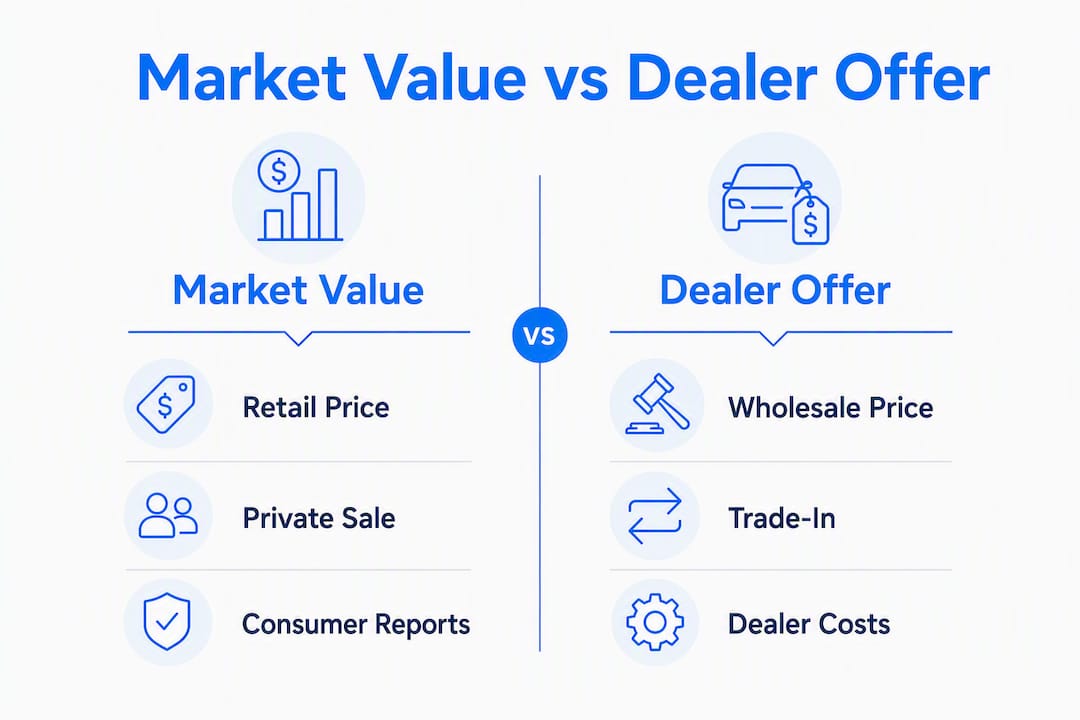
These three terms describe three different transactions, and mixing them up is the single most common mistake sellers make.
- Retail market value is what a buyer pays on an open market or a dealer lot for a comparable vehicle. It reflects the highest price in the chain.
- Private-party value sits between wholesale and retail. It’s what one private individual pays another, with no dealer overhead factored in.
- Dealer trade-in offer is essentially a wholesale purchase price. The dealer is buying your car to resell it, so the offer reflects auction pricing, reconditioning costs, and required margin.
| Value Type | Who Sets It | Typical Position | Example Transaction |
|---|---|---|---|
| Retail market value | Market / dealer lot | Highest | Buyer purchases from dealer lot |
| Private-party value | Negotiated between individuals | Middle | Owner sells to private buyer via listing |
| Dealer trade-in offer | Dealer (wholesale basis) | Lowest | Dealer buys your car as part of a new purchase |
Consumer Reports’ car value estimator makes this explicit: trade-in estimates align more closely with auction and wholesale pricing, while private-party values sit in the middle of the range. Knowing which number you’re looking at changes everything about how you evaluate an offer.
How dealers actually calculate a trade-in offer
The math behind a dealer’s number is more systematic than most sellers realize. Understanding it lets you reverse-engineer any offer and spot where the deductions are hiding.
- VIN lookup and wholesale baseline. The dealer pulls your VIN through a proprietary or industry tool (such as Black Book or J.D. Power’s valuation data) to establish a wholesale baseline, which reflects recent auction results for your year, make, model, and trim.
- Adjustments for mileage, trim, and regional demand. A vehicle with 95,000 miles in a market flooded with similar inventory gets adjusted down. A low-mileage truck in a region with strong pickup demand gets adjusted up.
- Reconditioning cost estimate. Dealers subtract an estimated reconditioning cost covering detailing, mechanical inspection, minor repairs, and sometimes certification. This number is often $500–$2,500 and is rarely shown to the seller unprompted.
- Dealer margin and carrying costs. Floorplan interest (the cost of financing inventory on the lot) and expected lot time get factored in. The dealer needs to sell your car at a profit after all those costs.
- Final offer. Wholesale baseline, minus reconditioning, minus margin buffer, equals the number on the sheet.
A simple example: if comparable retail listings for your car sit at a certain value, a dealer might establish a wholesale baseline somewhat lower, subtract estimated reconditioning costs, and hold margin, landing at a trade-in offer that undershoots retail by several thousand dollars. This spread reflects dealer costs and margins.
| Step | Example Amount |
|---|---|
| Dealer trade-in offer | $16,000 |

For a deeper look at how dealers price your car, Sellkamocars breaks down the valuation inputs a direct cash buyer uses compared to a dealer’s wholesale math.
Factors that make a dealer offer higher or lower for your specific car
Not every car gets the same treatment. These are the variables that move the number most:
- Mileage thresholds. Crossing certain mileage thresholds can notably drop an offer. Deciding when to sell around these points can impact financial outcomes.
- Vehicle condition. Dents, worn interiors, cracked windshields, and check-engine lights all trigger reconditioning deductions. Dealers price risk, not potential.
- Service history documentation. A complete service record from a dealership or certified shop signals lower reconditioning risk. Missing records do the opposite.
- Title status. Clean titles get full value. Salvage or rebuilt titles can substantially reduce an offer, and some dealers won’t buy such vehicles at all.
- Trim level and factory features. Higher trims with popular packages (towing, tech, safety) hold value better than base models.
- Accident history. A CARFAX or AutoCheck report showing prior accidents reduces the dealer’s confidence in resale value and drives the offer down.
- Local demand and dealer inventory. If a dealer’s lot is already full of your model, they have less incentive to pay top dollar. A dealer short on popular SUVs will pay more for yours.
- Market timing. End-of-quarter pushes sometimes produce better offers as dealers chase volume targets. Convertibles fetch more in spring; 4WD trucks fetch more heading into winter.
Pro Tip: Clean the car thoroughly and bring your full service history folder to the appraisal. A well-documented, clean vehicle signals lower reconditioning risk, and that translates directly into a higher offer.
Step-by-step checklist to compare your market value with a dealer offer
Follow this sequence before you sign anything. It takes a few hours but can recover thousands of dollars.
- Run three benchmarks. Pull your KBB trade-in range (use your actual mileage, condition, and zip code). Get a written bid from an independent cash buyer. Search local private-party listings for the same trim and mileage to establish a ceiling.
- Get the dealer’s written offer before discussing a new vehicle. Many dealers prefer to bundle the trade-in into the new-car deal. Separate them. Ask for a written, locked trade-in figure before any new-car pricing conversation begins.
- Negotiate the new-car price first. Once you have a locked trade-in number, negotiate the purchase price of the new vehicle to its floor. Then add the trade-in credit. This prevents the dealer from adjusting one number to absorb the other.
- Calculate the tax-savings offset. In many U.S. states, sales tax is calculated on the net price after the trade-in credit is subtracted, which can make a lower trade-in offer more competitive than it first appears. Many states apply sales tax after subtracting trade-in credits, which can lead to meaningful tax savings compared to private sales.
- Compare net proceeds across options. Use this framework:
| Selling Route | Gross Proceeds | Estimated Costs/Deductions | Tax Savings | Net Outcome |
|---|---|---|---|---|
| Dealer trade-in | $16,000 | Reconditioning risk at signing | Potential sales tax savings | Effective net outcome higher than offer |
| Private sale | Higher gross proceeds | Listing fees, time, safety risk | No sales tax savings | Net outcome close to gross proceeds |
| Direct cash buyer | Moderate gross proceeds | Minimal fees | No sales tax savings | Net outcome close to gross proceeds |
- Choose based on your priority. If timeline and tax savings matter, a trade-in may be the right call. If maximum net proceeds matter, a private sale or direct cash buyer typically wins. For a full comparison of selling options, Sellkamocars lays out the pros and cons of each route.
Pro Tip: Always convert a trade-in credit to its cash-equivalent before comparing. A $16,000 trade-in credit is not the same as $16,000 cash — factor in the tax savings your state allows, then compare.
What to expect: timeline, fees, and hidden costs when trading or selling
Each selling route has a different clock and a different set of deductions. Here’s what to plan for:
Timelines:
- Dealer trade-in: same day, but you’re buying a new vehicle at the same time.
- Direct cash buyer (like Sellkamocars): 24–72 hours from offer to payment.
- Private sale: typically 2–6 weeks, depending on pricing, platform, and buyer availability.
Common deductions to watch for:
- Reconditioning charges added at paperwork, sometimes higher than the verbal estimate.
- “Market adjustment” line items that appear on the deal sheet but weren’t discussed during negotiation.
- Title and transfer fees that vary by state.
- Transport or inspection fees if the dealer plans to wholesale your car out of the region.
F&I and back-office risks:
- Finance and insurance (F&I) managers sometimes roll negative equity from your trade into a new loan, which inflates your monthly payment without you realizing the trade-in shortfall is being absorbed there.
- Extended warranties and add-ons can be bundled in ways that obscure the true trade-in credit.
Documentation checklist to speed closing and avoid last-minute deductions:
- Title (or payoff information if the car is financed)
- Current registration
- All sets of keys and remotes
- Service records
- CARFAX or AutoCheck report (pulling your own report first removes surprises)
- Any warranty documentation still in effect
Insider dealer tactics you need to know before your appraisal
Dealers use well-documented psychological and financial tactics during trade-in negotiations. Knowing them in advance is the most effective counter.
Anchoring. Dealers commonly open with a low initial number, then present a marginally higher “revised” offer that feels generous by comparison. The second number is still below market. The counter: bring a written competing offer and use it as your anchor instead.
Blending trade-in and new-car negotiations. When both conversations happen simultaneously, the dealer can adjust the new-car discount to absorb a higher trade-in, or vice versa. You never know which lever moved. Separate them completely.
Payment packing. Monthly payment discussions obscure the true cost of the deal. A dealer can offer a “better” trade-in credit while extending the loan term or adding back-office products, leaving you paying more overall. Always negotiate on total price, not monthly payment.
Last-minute reconditioning deductions. Appraisals can change at the final paperwork stage. A verbal figure given during the test drive may shrink by the time you’re at the finance desk. Insist on a firm written offer before you commit to anything.
Red flags that warrant walking away: The dealer refuses to show the reconditioning breakdown on paper. The trade-in credit changes between the sales desk and the finance office. The salesperson insists on discussing monthly payments before agreeing on a purchase price. Any of these signals that the deal structure is designed to obscure, not clarify.
For a full list of common dealership appraisal tactics, Sellkamocars has documented the most frequent red flags sellers encounter in 2026.
Pro Tip: Bring two competing written offers to your dealer appointment. Written bids from independent buyers change the negotiation dynamic immediately — the dealer knows you have a real alternative and can’t anchor low without losing the deal.
How to use online car valuation tools correctly
KBB and similar tools are useful starting points, not final answers. Here’s how to get the most out of them.
- Start with your VIN. Entering your VIN (rather than year/make/model alone) captures your exact trim, factory options, and package codes, which can shift the estimate by hundreds of dollars.
- Record the full KBB trade-in range, not just the midpoint. KBB provides a range reflecting condition and regional market variation. The low end approximates what a dealer might offer; the high end reflects a well-documented, clean vehicle in strong local demand.
- Pull the private-party estimate separately. Consumer Reports’ car value estimator and KBB both offer private-party figures. That number is your ceiling for a private sale and your reference point for how much you’re giving up in a trade.
- Check local retail listings. Search your zip code for the same year, trim, and mileage range on major listing platforms. The gap between those retail prices and your KBB trade-in range is roughly what the dealer expects to earn.
- Get one live written offer from an independent buyer. Tools give estimates; a written offer from a direct cash buyer gives you a real floor. Use that floor in dealer negotiations.
Pro Tip: Tools default to “Good” condition, which most sellers assume applies to their car. Read the condition definitions carefully — “Good” typically means no mechanical issues and only minor cosmetic flaws. If your car has any warning lights or visible damage, select “Fair” for an accurate estimate.
Key limitations to keep in mind:
- Consumer tools use retail-facing data; dealers use wholesale and auction data, which can differ meaningfully.
- Regional adjustments in tools are broad; a dealer in your specific market may see different auction results.
- No tool produces a firm offer. Only a written bid from a buyer does that.
For a step-by-step walkthrough of the online car valuation process, Sellkamocars covers how to validate an instant appraisal against live market data.
Key Takeaways
The single most important rule: dealer trade-in offers reflect wholesale purchase economics, not retail market value, so always benchmark against at least two independent sources before accepting any number.
| Point | Details |
|---|---|
| Dealer offers are wholesale prices | Expect 10–20% below open-market value due to reconditioning, margin, and carrying costs. |
| Written competing offers recover value | Getting 2–3 written bids can increase your final trade-in by $1,000–$2,500 on average. |
| Tax savings can close the gap | In many U.S. states, trade-in credits reduce the taxable purchase price, which can offset a lower offer. |
| Separate your negotiations | Always lock in a written trade-in figure before discussing new-car pricing to prevent margin blending. |
| Sellkamocars offers a written cash alternative | For sellers who want speed and a fixed offer with no reconditioning deductions at signing, Sellkamocars provides an instant appraisal and 24-hour payment. |
The trade-in conversation most sellers have too late
Most sellers walk into a dealership hoping the dealer will be fair. That hope is the problem. Dealers are not adversaries, but they are running a business with specific cost structures, and their trade-in offer reflects those costs, not your car’s retail potential.
The advice I keep coming back to, after writing seller-facing guides through 2026, is this: the seller who arrives with a written competing offer is in a completely different negotiation than the seller who arrives empty-handed. The written offer changes the dealer’s calculus. It signals that you’ve done the work, that you have an alternative, and that the conversation is about matching or beating a real number, not anchoring from zero.
When a dealer gives you a low initial figure, here’s the script that works: “I have a written offer for $[X] from another buyer. Can you match or beat that in writing before we talk about the new vehicle?” Two sentences. No emotion. The dealer either engages on your terms or confirms they can’t compete, which tells you exactly where to take your business.
The sellers who get the best outcomes treat the trade-in as a separate transaction, document everything, and never sign until the written offer matches the verbal one.
Sellkamocars gives you a written cash offer without the back-office games
Skip the anchoring, the reconditioning surprises at the finance desk, and the payment-packing. Sellkamocars buys your car directly, with an instant appraisal based on current market data and a written cash offer you can hold in your hand before committing to anything.
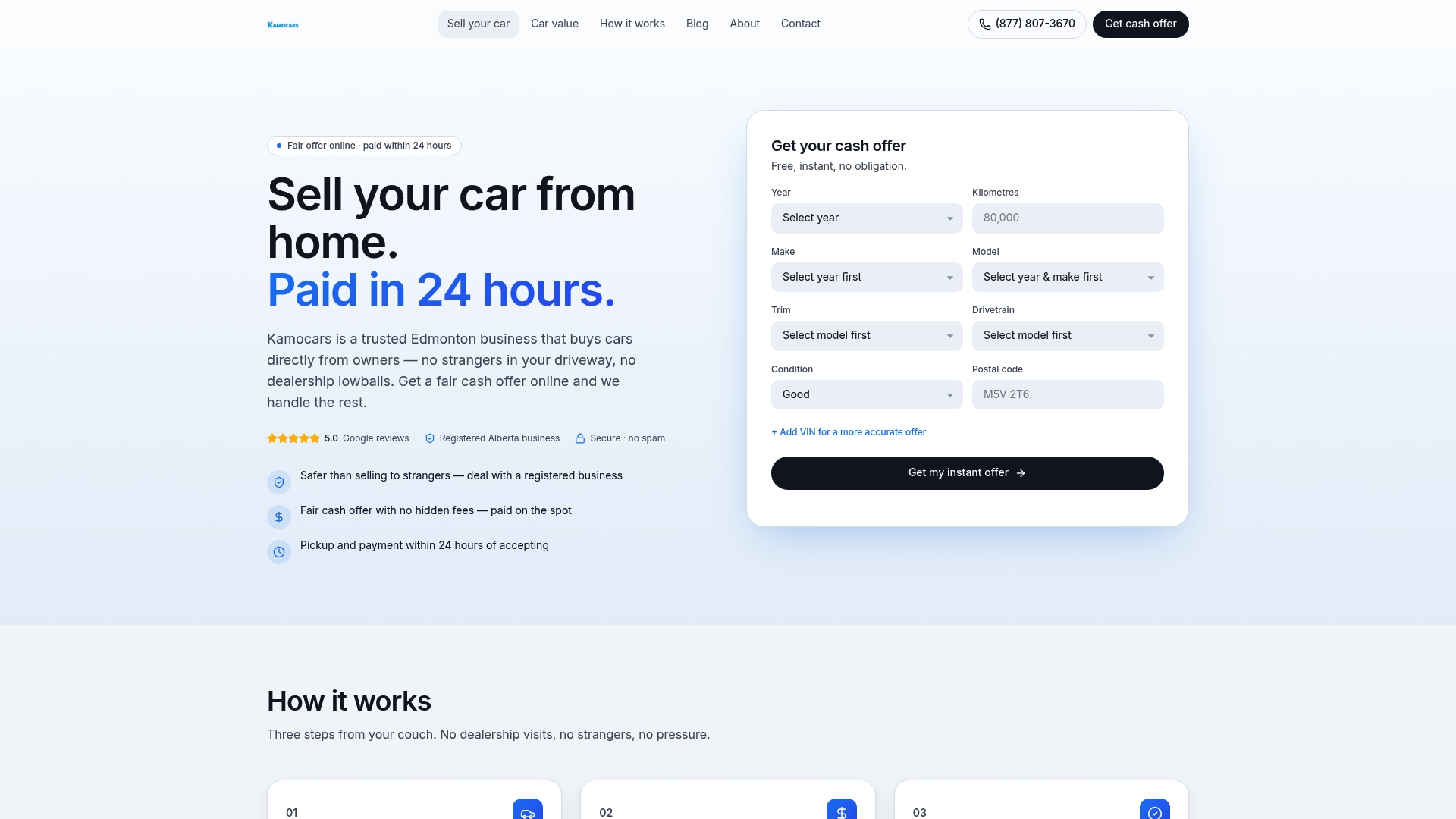
The process takes three steps: enter your vehicle details to get an instant appraisal, review your written cash offer, and schedule free pickup at your home or office. Payment arrives within 24 hours of pickup. No haggling, no last-minute deductions, no F&I office. Sellkamocars handles financed and leased vehicles too, so a lien on the title isn’t a barrier.
If your priority is maximum net proceeds, a private sale may edge out any other option. But if you want a fair, documented offer without the time cost of a private listing or the back-office risk of a dealer trade-in, get your instant cash offer at Sellkamocars or use the free car value tool to see what your vehicle is worth right now.
Useful sources and tools
- Kelley Blue Book (KBB) — The primary consumer benchmark for trade-in ranges and private-party estimates; start every valuation here.
- Consumer Reports Car Value Estimator — Useful for cross-referencing KBB figures and understanding where trade-in estimates sit relative to private-party values.
- NADA Consumer Vehicle Values — Industry-standard book values used by lenders and dealers; good for verifying wholesale baselines.
- FTC Consumer Information on Car Buying — The Federal Trade Commission’s guidance on dealer pricing practices and your rights as a buyer or seller.
- Sellkamocars Car Value Tool — Instant appraisal tool for Alberta and nearby markets; generates a written cash offer you can use as a negotiation floor.
- Sellkamocars Sell My Car Page — Start the selling process and get a written offer within minutes.
Recommended
Get a real cash offer in 2 minutes
Trusted business. Fair price. Paid on the spot when we pick up your car.