
How to Avoid Lowball Offers: Practical Steps for Sellers
Learn how to avoid lowball offers with practical steps like setting a minimum price and using market data to strengthen your sales.
How to Avoid Lowball Offers: Practical Steps for Sellers

The fastest way to avoid lowball offers is to set clear price guards before you list and re-anchor with market data the moment a low bid arrives. Three actions cover most situations:
- Set a minimum or reserve price on any platform that supports it.
- Include comparable sales data directly in your listing description.
- Prepare a scripted re-anchor response before the first offer comes in.
Do those three things and you eliminate the majority of low-bid attempts before they start.
Key Takeaways
The most effective way to avoid lowball offers is to combine pre-listing price guards with a scripted, data-backed response ready before the first offer arrives.
| Point | Details |
|---|---|
| Set your floor before listing | Decide your minimum price in advance and state a negotiation policy in the listing. |
| Publish comparable sales | Include 3–5 recent comps in your listing to remove the buyer’s low-anchor argument. |
| Pause before responding | Never reply to a lowball immediately; buy 24 hours to prepare a specific, data-backed counter. |
| Counter above your target | Price your counter 10–20% above your actual floor so a split-the-difference result still works for you. |
| Spot red flags early | Lowball plus urgency plus odd payment requests is a fraud pattern, not a negotiation. |
Table of Contents
- 1. Why buyers make lowball offers in the first place
- 2. Pre-listing defenses that stop most lowball offers before they start
- 3. How to respond when a lowball offer lands in your inbox
- 4. Counteroffer tactics that actually improve your outcome
- 5. Red flags that signal a scam or an unserious buyer
- 6. What percentage gap actually makes an offer a lowball?
- 7. Platform-specific settings that reduce lowball volume
- 8. Car sellers: how to avoid dealer lowballs and when to use a faster option
- 9. A seller’s perspective on staying firm without burning bridges
- Sources
1. Why buyers make lowball offers in the first place
Understanding the motive behind a low offer tells you which counter-strategy to use. Buyers lowball for one of three reasons: anchoring psychology, genuine budget constraints, or pure opportunism.
Anchoring research from the Harvard Program on Negotiation shows that the first number stated in a negotiation shapes every response that follows. Sellers who respond immediately, without pausing to re-anchor, often end up splitting the difference closer to that low number than to their actual target.
Opportunistic lowballers are different. They are not budget-constrained; they are testing whether you will panic-sell. They scan listings for vague descriptions, absent comps, and sellers who look eager to close fast. A listing that says “priced to sell” or “open to offers” is an invitation.
Two quick examples show how this plays out:
- Online listing: A seller posts a used camera for $800 with no comparable prices cited. First message: “$400, firm.” The seller, caught off guard, counters at $650. They split at $525, well below the $700 they would have accepted.
- Private vehicle sale: A seller lists a 2020 truck at $28,000 with full service records and a clean Carfax. First offer: $21,000. Because the listing already cited three comparable sales at $27,500–$29,000, the seller confidently countered at $27,500. They closed at $26,800.
The difference between those two outcomes is preparation, not luck.
2. Pre-listing defenses that stop most lowball offers before they start
Most low bids are preventable. The goal is to make your listing so well-documented that a lowballer has no rational opening.
Research and publish your comps. Pull three to five recent comparable sales from platforms like AutoTrader, Kijiji, or eBay Sold Listings and include the price range in your description. When buyers see “comparable units sold for $X–$Y in the past 30 days,” they lose the argument before they make it.

Use platform controls. eBay’s seller tools let you set a minimum accepted offer, a reserve price, and a Buy It Now price. Poshmark lets you set bundle pricing and decline offers below a threshold. Facebook Marketplace and Kijiji do not have automated controls, but a firm price label and a written policy in the description (“Firm price. No offers below $X considered”) filters out casual lowballers.
Make the listing airtight. Condition details, repair history, high-quality photos from multiple angles, and an honest description remove the “disparagement rationale” buyers use to justify low bids. If a buyer cannot point to a real flaw, they have no credible anchor below your price.
State your negotiation policy explicitly. A line like “Priced at market value. Counteroffers will be considered only above $X” signals that you have done your homework and sets a floor in the buyer’s mind before they type a number.
- Verify condition claims with photos or documentation.
- List every value-adding feature (recent service, new tires, original packaging).
- Specify what is and is not included in the sale.
- State your preferred payment method upfront to screen out payment-method scammers.
Pro Tip: Forbes research on negotiation anchoring suggests that the party who names the first number often controls the range. Price your listing at the top of the defensible market range, not the middle, so you have room to negotiate down to your actual target without going below it.
3. How to respond when a lowball offer lands in your inbox
Pause before you type anything. An immediate emotional response is the single most common mistake sellers make, and it almost always costs money.
Indeed’s counteroffer guidance recommends asking for time, then responding with one specific figure backed by market research. That sequence works for goods and property just as well as it does for salary negotiations.
Here are three scripts you can adapt immediately:
Script A — Polite deferral (buy yourself time): Script B — Re-anchor with data: Script C — Polite decline with next steps: When to ignore, reply, or counter:
- Ignore if the offer is more than 40% below asking with no explanation and the buyer’s profile is new or empty.
- Reply if the offer is 10–30% below asking and the buyer seems genuine. Use Script B.
- Counter if the offer is within 15% of your floor and the buyer has engaged with your listing details.
LegalClarity notes that a formal counter-offer can legally terminate the original offer if not worded carefully. Frame your response as an inquiry rather than a rejection: “I’m still interested in working with you. My price is $X. Does that work for you?” That phrasing keeps the original offer alive while you negotiate.
Once you have re-anchored on price, shift the conversation toward value-based trade-offs: faster pickup, included accessories, extended warranty documentation, or flexible payment timing. Price-only haggling is a zero-sum game; adding variables gives both sides room to move.
4. Counteroffer tactics that actually improve your outcome
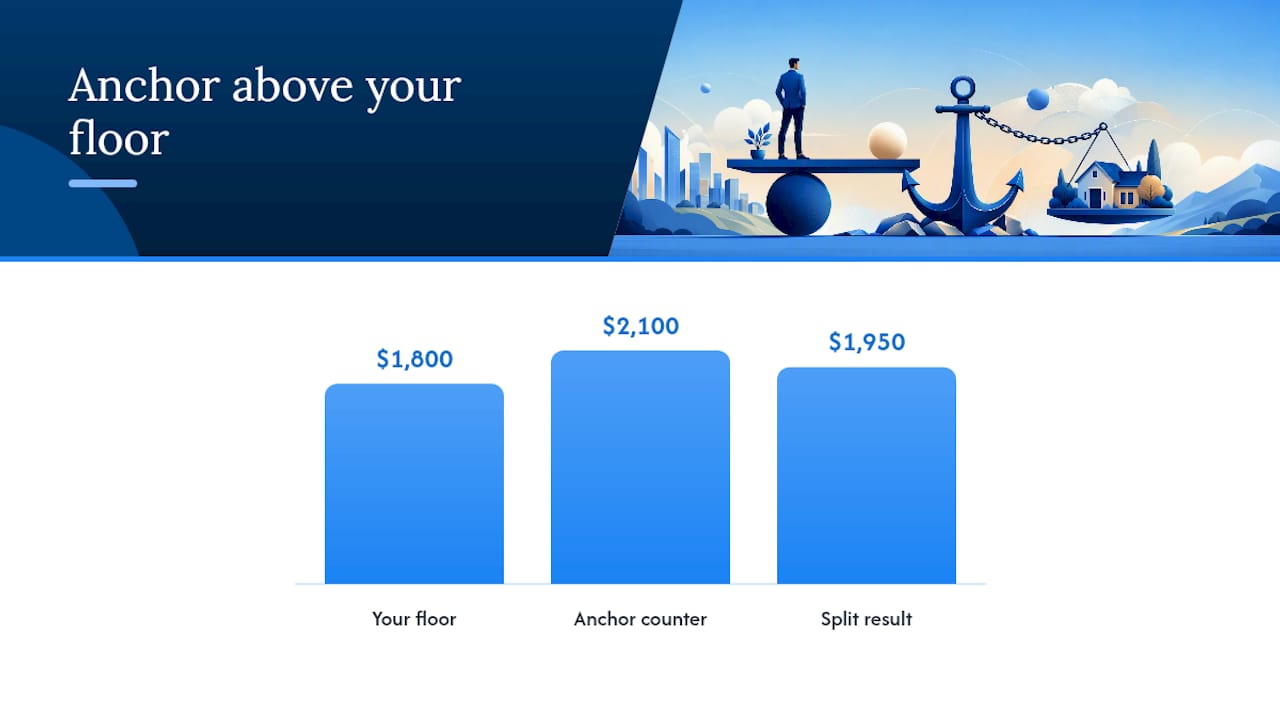
Re-anchoring is the core skill. When you counter, go above your target by enough that a split-the-difference result still lands where you want. If your floor is $1,800, counter at $2,100. A buyer who proposes meeting in the middle lands at $1,950, which is above your floor.
Multiple simultaneous counteroffers are one of the most underused seller tools. Harvard PON research shows that offering a buyer two or three equally valued packages reveals their priorities and creates trade-off space. For example:
- Option 1: $2,000, item only, pickup within 3 days.
- Option 2: $1,900, item plus accessories, pickup within 7 days.
- Option 3: $1,850, item only, buyer arranges pickup.
The buyer’s choice tells you what they actually value, and you close faster because they feel in control.
Constraint rationales beat disparagement rationales. Harvard PON experiments found that when buyers explain a low offer by citing their own budget limits (“I only have $X available right now”), sellers respond more constructively than when buyers criticize the item to justify the low price. As a seller, you can use this in reverse: if a buyer disparages your item to anchor low, acknowledge the point briefly and redirect to market data rather than defending the item emotionally.
Timing matters. Send your counter within 24 hours. Waiting longer signals indifference or desperation depending on context. If you set a deadline (“This price is available until Friday”), stick to it. Backing down from a stated deadline destroys your credibility for the rest of the negotiation.
Pro Tip: Indeed’s guidance recommends countering with a single specific number rather than a range. A range (“$1,800 to $2,000”) tells the buyer your floor is $1,800. One number (“$2,050”) keeps your actual floor private.
5. Red flags that signal a scam or an unserious buyer
Not every lowball offer is just aggressive negotiating. Some are the opening move in a fraud attempt.
Watch for these patterns:
- Lowball + urgency: “I’ll take it right now for $X, cash, but I need an answer tonight.”
- Odd payment requests: Cashier’s checks from out-of-state banks, e-transfers from unfamiliar services, or requests to use an “escrow” service you have never heard of.
- Shipping-only buyers: A buyer who cannot meet in person and insists on shipping for a local-market item is a common fraud vector.
- Inconsistent information: Name, location, or story changes between messages.
- Overpayment offers: A buyer who offers more than asking and asks you to refund the difference is running a check-fraud scheme.
Safety checklist for private sales:
- Meet in a public place or a police station parking lot for high-value items.
- Accept cash, certified bank transfer, or verified e-transfer only. Never accept personal checks.
- Verify payment has cleared before handing over the item or title.
- For vehicles, confirm the buyer’s ID matches the name on any financing or transfer documents.
- Report suspicious buyers to the platform and to the BBB if the behavior suggests fraud.
For car sale fraud prevention, the risks are higher because the transaction value is larger. Require a test drive only after verifying ID, and never sign over a title before payment clears.
6. What percentage gap actually makes an offer a lowball?
The threshold varies by category, but practical negotiation guidance points to a consistent range.
Several factors shift that threshold:
- Market heat: In a hot seller’s market, even 10% below asking can be a lowball. In a slow market, 20% below may be the opening of a real negotiation.
- Item scarcity: Rare or hard-to-find items command tighter gaps. Common items attract wider lowball attempts.
- Seller urgency: A seller who needs to close in 48 hours has a weaker position than one with no deadline.
- Buyer type: Dealers and resellers always offer less than private buyers because they need margin. A dealer offering 20% below private-market value is not lowballing; that is their business model.
Negotiation coaches commonly recommend anchoring your counter 10–20% above your actual target so that a split-the-difference result still lands in your favor.
Three quick scenarios:
For vehicles specifically, check Canadian Black Book or AutoTrader’s market value tool before listing.
7. Platform-specific settings that reduce lowball volume
Different marketplaces give you different tools. Use every one available to you.
eBay offers the most control. You can set a reserve price (the minimum you will accept at auction), a Buy It Now price, and a minimum accepted offer for Best Offer listings. When a buyer submits an offer below your minimum, eBay automatically declines it without you having to respond. That automation alone eliminates a significant share of low-bid friction.
Poshmark lets you set bundle discounts and respond to offers with a counter. While Poshmark does not have a hard auto-decline floor, you can set your lowest acceptable price privately and decline anything below it with one tap. Listing at a slight premium above your target gives you room to accept a “discounted” offer that still hits your number.
Facebook Marketplace and Kijiji have no automated offer controls. Your best tools here are a firm price label, a written policy in the description, and fast response times. Listings that go stale attract lowballers; refreshing your listing every few days keeps it near the top of search results and signals an active seller.
When no platform controls exist, consider a timed listing strategy: post at a firm price for the first 7–10 days, then adjust only if you receive no serious inquiries. Dropping the price too quickly signals desperation and invites lower offers.
8. Car sellers: how to avoid dealer lowballs and when to use a faster option
Dealers lowball for a structural reason: they need to buy low enough to cover reconditioning, lot costs, and profit margin on resale. A dealer offering $18,000 for a vehicle worth $24,000 on the private market is not being dishonest; they are doing math. Understanding why dealers lowball car valuations helps you decide whether to negotiate harder or walk away entirely.
Three steps reduce dealer lowballing before you walk into a showroom:
- Pull your own comps from AutoTrader, Kijiji, and Canadian Black Book before any conversation. Walk in with printed or screenshot evidence of what comparable vehicles are selling for.
- Bring your service records. A documented maintenance history reduces a dealer’s reconditioning estimate and removes one of their most common justifications for a low offer.
- Present the vehicle clean and detailed. First impressions affect appraisal numbers. A clean vehicle signals care; a dirty one invites condition-based discounts.
For sellers who want to skip the dealer negotiation entirely, Sellkamocars offers instant cash offers based on current Canadian wholesale data, home pickup, and payment within 24 hours. With over 500 completed transactions and a registered business status, it is a verifiable alternative to the private-market grind.
When evaluating any instant-sale buyer, ask these questions:
- Is the business registered and verifiable (BBB, provincial registry)?
- Do they provide a written offer before you commit?
- Is payment secured before title transfer?
- Do they handle financed or leased vehicles, or only clear titles?
Sellkamocars handles financed and leased vehicles, manages the paperwork, and pays within 24 hours of pickup. For sellers who have already dealt with one too many lowball offers on Kijiji, that combination is worth knowing about. You can also read how offer comparison helps car sellers get more money before deciding which route fits your situation.
9. A seller’s perspective on staying firm without burning bridges
Price negotiations are business conversations, not personal confrontations. The moment you treat a lowball offer as an insult, you lose the emotional high ground and make worse decisions.
The sellers who consistently get fair prices share one habit: they decide their floor before any offer arrives, they write it down, and they do not move below it without a concrete reason. Not because a buyer pushed harder, not because the conversation got uncomfortable, but only when new market information justifies it. That discipline is what separates sellers who get what their item is worth from those who rationalize a bad deal after the fact.
Firmness and fairness are not opposites. You can hold your price, treat the buyer with respect, and walk away from a deal that does not work, all in the same conversation. The scripts in this guide are designed to do exactly that. For car sellers who want to skip the negotiation entirely, Sellkamocars is a registered, reputable option that removes the lowball dynamic from the equation.
Sources
These are the primary sources behind the tactics in this guide:
- How to Counteroffer in Business Negotiation - PON - Program on Negotiation at Harvard Law School
- How to counter an offer — Indeed
- How to Counter an Offer Letter: Salary, Benefits & Equity - LegalClarity
- Four Ways To Avoid A Lowball Job Offer - Forbes
Recommended
Get a real cash offer in 2 minutes
Trusted business. Fair price. Paid on the spot when we pick up your car.