
10–25% Drop: How to Sell a Car After an Accident in Canada
Accidents often cut resale value 10–25% in Canada (30–50% with salvage). Verify the VIN and provincial branding, or get a fast cash offer from Kamocars.
10–25% Drop: How to Sell a Car After an Accident in Canada

A single reported accident typically knocks 10 to 25 percent off a car’s resale value in Canada, and structural or salvage damage can push that discount to 30 to 50 percent. The exact number swings on three things: how bad the damage was, how well it was repaired and documented, and which province is writing the title. Before you price a car to sell or buy, pull a VIN Verify report from the Insurance Bureau of Canada, check Transport Canada’s recall listings, and book a mechanic’s inspection. If certainty matters more than chasing top dollar, Kamocars offers a fast cash alternative to the private-sale grind.
TL;DR:
- Most accident claims in Canada reduce a vehicle’s resale value by 10 to 25 percent, with structural or salvage damage causing discounts of 30 to 50 percent.
- Canadian VIN reports pull from multiple sources but can miss unreported repairs or damage from cross-provincial imports, so they should be verified with receipts and inspections.
- Damage type and repair documentation significantly influence discount levels, with cosmetic repairs having less impact than structural or airbag-related issues.
- When selling, obtaining a VIN report, lien check, mechanic inspection, and thorough repair documentation helps avoid overpaying or underselling, especially for accident-affected vehicles.
- Using services like Kamocars allows sellers to receive a quick cash offer based on wholesale data, bypassing the typical bargaining cycle associated with accident history.
Table of Contents
- What Canadian Vehicle History Reports Actually Show
- How Much Value an Accident Actually Costs You
- The Factors That Move the Discount the Most
- What Buyers and Sellers Should Actually Do
- Where Kamocars Fits for Sellers With Accident History
- An Accident on the Report Is a Starting Point, Not a Sentence
- Get a Cash Offer Without the Accident-History Guessing Game
- Where to Verify Any Claim on a History Report
- Sources
- FAQ
What Canadian Vehicle History Reports Actually Show
A Canadian VIN report pulls from several sources at once, and knowing where the data comes from tells you how much to trust it. Most commercial reports blend provincial insurance and registry filings, insurer-submitted claims routed through the Insurance Bureau of Canada, stolen-vehicle flags from the CPIC police registry, safety recall data from Transport Canada, and lien records tied to the VIN.
What you’ll typically see on a report:
- Accident or claim entries with approximate dates and provinces
- Reported repair or claim dollar amounts
- Title brand status (rebuilt, salvage, non-repairable)
- Lien or outstanding loan flags
- Odometer readings tied to service or claim events
The gaps matter as much as the entries. Reports often miss repairs paid out of pocket with no insurance claim filed, minor collisions never reported to police, and damage history from vehicles imported across provincial or national borders before they entered the Canadian system. A clean report is reassuring, but it’s not proof of a clean past.
That’s why the report is a starting point, not a verdict. Cross-check it against physical repair receipts, body-shop invoices, and an independent inspection before you treat the number on the page as final.
How Much Value an Accident Actually Costs You
The dollar impact depends heavily on how the damage is categorized, and the ranges are wide enough that a single “accident equals X percent off” rule doesn’t hold up. Industry analysis on Canadian pricing patterns puts a single reported accident at a typical 10 to 25 percent haircut for a straightforward repair with no structural involvement. Push into frame damage, airbag deployment, or a rebuilt/salvage brand, and vehicles commonly sell 30 to 50 percent below a clean-title equivalent.
A $25,000 example: a three-year-old sedan worth $25,000 clean gets rear-ended, the bumper and trunk are replaced, and the claim is properly documented with a body-shop invoice. Expect a private-sale buyer to knock off somewhere around $2,500 to $6,250, landing the realistic asking price closer to $19,000 to $22,500. If the same accident bent the frame and the car carries a rebuilt title, the discount could easily double.
Private-sale buyers tend to negotiate harder against accident history than dealers do, mostly because they’re carrying all the risk themselves with no warranty backstop. Dealers price branded or accident-flagged trade-ins more mechanically, often applying a standard deduction regardless of repair quality, because resale-lot buyers expect a discount on anything with a claim history. That discount compounds for buyers financing the purchase, since some lenders restrict loans on branded-title vehicles, and insurers frequently charge higher premiums once a vehicle carries a rebuilt or salvage designation, tightening the buyer pool further.
The Factors That Move the Discount the Most
Two cars with identical claim amounts can sell for very different prices once you look past the dollar figure on the report. What actually moves the needle:
- Damage type: cosmetic panel damage barely dents value if repaired properly, while structural or airbag-related damage cuts much deeper, even at the same repair cost.
- Repair documentation: a body-shop invoice with parts, labor, and a warranty on the work reassures buyers and shrinks the discount they’ll demand; an unexplained claim with no paperwork invites the opposite.
- Provincial branding rules: Ontario’s disclosure framework through OMVIC sets clearer salvage thresholds and dealer obligations than some other provinces, which means the same damage can carry a different stigma depending on where the title was branded.
- Vehicle-specific economics: rare trims, low-mileage examples, and models with expensive parts (certain European imports, for instance) see steeper percentage losses because repair costs eat up more of the car’s total value.
If you’re evaluating a vehicle with a branded history, particularly on collector or specialty models, a salvage-title guide on verifying paperwork and inspection steps is worth a read before you commit.
What Buyers and Sellers Should Actually Do
Knowing the ranges is one thing. Acting on them is another. Here’s the sequence that keeps you from overpaying or underselling.
- Pull a VIN-based history report and cross-reference it against IBC’s VIN Verify tool for branding and total-loss flags.
- Run a lien check to confirm there’s no outstanding loan attached to the vehicle before money changes hands.
- Book an independent mechanic inspection that checks frame alignment, paint consistency, and suspension geometry, not just a visual walk-around.
- Take it for a real test drive on a highway and through turns, listening for alignment pulls or unusual noise under load.
- Request every repair receipt and body-shop invoice the seller has, and verify the shop is a real, licensed business.
Sellers should flip the same checklist: gather every repair invoice before listing, get a pre-sale inspection done so you can show a clean bill of health, photograph the repaired panels, and price realistically for whichever channel you’re using, since private-sale, dealer trade-in, and instant-offer buyers all price accident history differently.
Pro Tip: If you’re selling and the accident was minor with good documentation, lead with the paperwork in your listing rather than waiting for a buyer to ask. It signals confidence and usually shortens the negotiation.
Buyers with strong documentation in hand have real leverage to negotiate down from asking price. Sellers who want to skip that back-and-forth entirely sometimes prefer a direct buyer who prices the accident history once, transparently, and closes fast.
Where Kamocars Fits for Sellers With Accident History
Selling a car with a claim on record privately can mean weeks of buyers asking questions, requesting discounts, then disappearing. There are services based in Edmonton built around cutting that uncertainty out entirely.
- Online appraisals based on current Canadian wholesale market data
- Home pickup and full payment completed within a day across Alberta
- Handles financed or leased vehicles, including lien payoff coordination
- A large number of completed transactions to date
If your car qualifies (2018 or newer, running condition), the Alberta Car Value Tool gives you a real number without the private-sale back-and-forth, and without a dealership quietly padding its margin into the “accident deduction.”
An Accident on the Report Is a Starting Point, Not a Sentence

Too many sellers treat a claim entry on a history report like a fixed penalty, and too many buyers treat it like a reason to walk away entirely. Neither instinct holds up once you look at how these deals actually close. A report tells you an event happened. It doesn’t tell you how well the repair was done, whether the frame is true, or whether the province’s branding rules make the title a bigger problem than the damage itself.
The vehicles that sell closest to clean-title value are the ones where the seller did the boring work: kept every invoice, got the inspection done before listing, and priced the discount honestly instead of hoping nobody would ask. Buyers who skip the inspection step because “the report looked fine” are the ones who end up overpaying for damage nobody verified. Treat the VIN report as the opening move, not the closing argument, and negotiate from what the inspection and paperwork actually show.
— Omar
Get a Cash Offer Without the Accident-History Guessing Game
Some services provide an alternative to haggling over accident deductions with private buyers or low dealer trade-in offers by offering a binding cash offer based on Canadian wholesale data, with no last-minute price cuts.
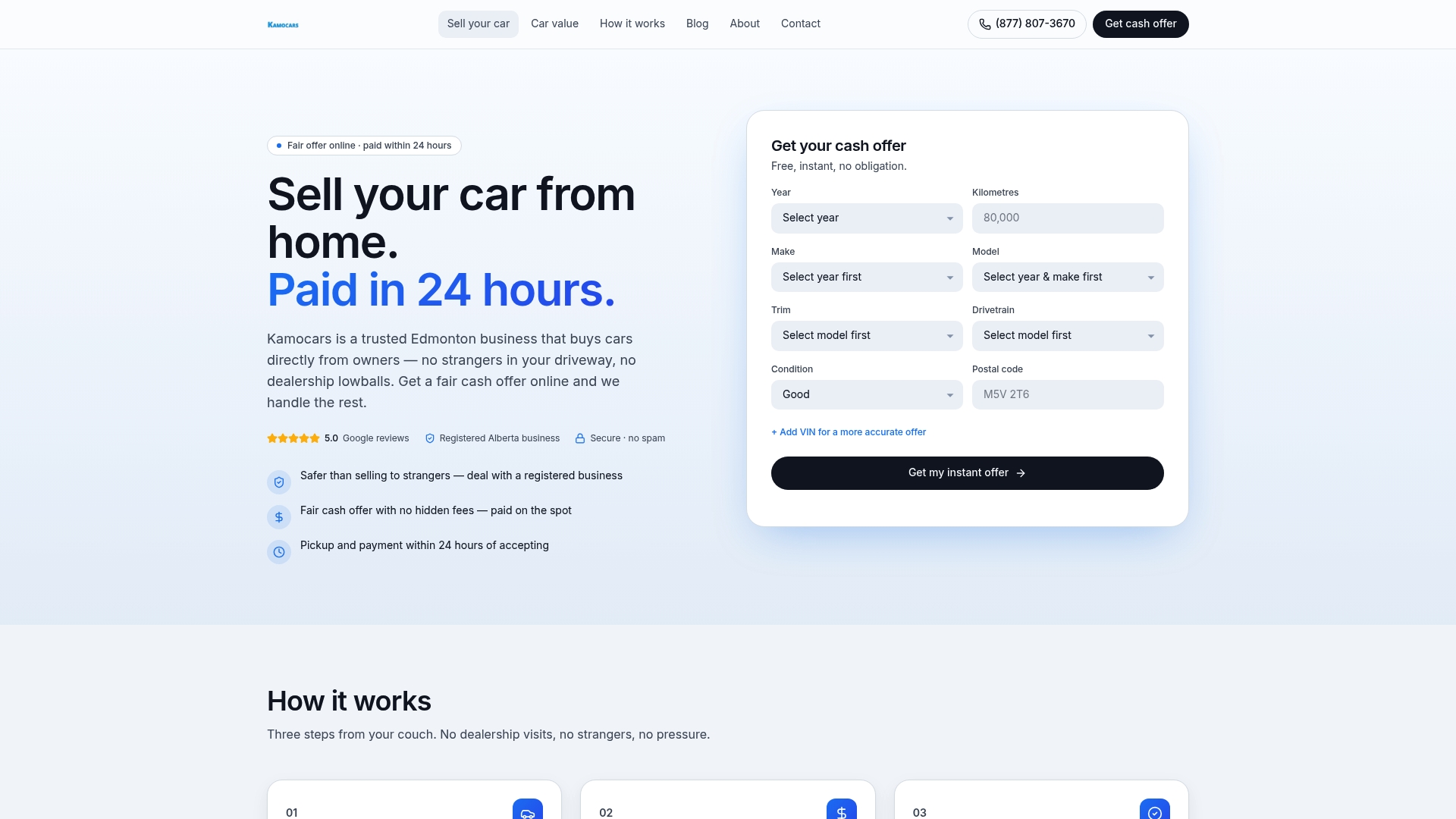
Getting an offer typically involves submitting your vehicle details for an online appraisal, accepting the number if it works for you, and scheduling pickup, with payment completed within a day in Alberta. Such services often handle financed or leased vehicles directly, sorting out lien payoff to ease the process. Being a registered Alberta business with BBB accreditation provides additional trust compared to dealing with anonymous online strangers.
If your accident-affected vehicle is a 2018 model or newer and still runs, start with the Sell My Car page to see your offer, or check the how it works page for the full pickup and payment breakdown.

Where to Verify Any Claim on a History Report
Before you trust a number on a paid report, confirm it against the source. Run the VIN through IBC’s VIN Verify for branding status, check Transport Canada’s recall database for open safety issues, and verify with your provincial registry for lien or stolen-vehicle flags through CPIC.
Sources
- Insurance Bureau of Canada — VIN Verify
- How accident history changes used car pricing in Canada — RIDEZ
FAQ
How Do I Check a Car’s Accident History for Free in Canada?
Start with the Insurance Bureau of Canada’s VIN Verify tool, which is free and shows non-repairable or total-loss branding in participating provinces. It won’t show every claim a paid report might, but it’s the fastest free check available to Canadian buyers and sellers.
Can a VIN Tell You a Car’s Full Accident History?
A VIN can surface reported claims, title brands, and recall data through tools like VIN Verify, but it won’t catch unreported damage or cash-paid repairs. Pair the VIN check with a mechanic’s inspection to catch what the paperwork misses.
How Much Value Does a Car Lose After an Accident in Canada?
A typical accident with a documented, non-structural repair reduces resale value by roughly 10 to 25 percent. Structural damage or a rebuilt/salvage brand can push that discount to 30 to 50 percent below a comparable clean-title vehicle.
Is There a Free Alternative to a Paid Carfax-Style Report in Canada?
There’s no single free report that matches the full depth of a paid commercial history report, but combining IBC’s VIN Verify with a Transport Canada recall check and a provincial lien search covers most of the essentials. For anything beyond that, a mechanic’s inspection tells you more than any report can.
Does Selling to a Direct Buyer Avoid the Accident-Discount Negotiation?
Selling to a direct buyer like Kamocars means the accident history gets priced once into a single cash offer instead of being negotiated repeatedly with different private buyers. It won’t necessarily beat the highest possible private-sale price, but it removes the back-and-forth and closes within 24 hours in Alberta.
Recommended
Get a real cash offer in 2 minutes
Trusted business. Fair price. Paid on the spot when we pick up your car.