
How Car Sale Contracts Protect Sellers: 2026 Guide
Discover how car sale contracts protect sellers in 2026. Learn the essential benefits of securing your vehicle transaction effectively.
How Car Sale Contracts Protect Sellers: 2026 Guide

A car sale contract is a legally binding agreement that protects sellers by documenting the exact terms of a vehicle transaction, establishing who is responsible for what, and creating enforceable evidence if a dispute arises later. Private sellers face real legal exposure without one. The Uniform Commercial Code requires a signed written contract for any goods sale over $500 to be enforceable in court. That threshold covers virtually every car sale. Understanding how car sale contracts protect sellers is not optional knowledge. It is the foundation of a secure transaction.
How car sale contracts protect sellers: the core legal framework
A written car sale contract does three things at once. It records the agreed terms, documents the transfer of ownership, and creates a paper trail you can use in court if the buyer later claims something different.

Private car sales carry unique risks that dealer transactions do not. A dealer wraps legal protections into every sale automatically. A private seller has no such safety net. Without a signed contract, a verbal agreement is nearly impossible to enforce. The buyer can claim the price was lower, the car was in better condition, or that you never disclosed a known problem.
The Uniform Commercial Code’s statute of frauds is the legal backbone here. Any vehicle sale over $500 must have a written, signed agreement to hold up in court. That means a handshake deal, a text message, or even a detailed email chain does not meet the legal standard. Only a signed written contract does.
Bills of sale and purchase agreements serve distinct but complementary legal roles. Maintaining both documents gives you stronger protection than relying on either one alone. The title transfers ownership legally, but it does not record the agreed price, the vehicle’s condition at the time of sale, or the exact date the transaction occurred. The contract and bill of sale fill those gaps.
What must a car sale contract include to protect the seller?
A contract that protects you must contain specific elements. Missing even one can leave you exposed.
- Vehicle identification: Full VIN, make, model, year, color, and current mileage. This prevents any later dispute about which vehicle was sold.
- Sale price and payment terms: The exact dollar amount and how payment was made. Cash, certified check, and wire transfer each carry different risk levels.
- Odometer disclosure: Federal law requires sellers to disclose the odometer reading in writing for most vehicles under ten years old.
- “As-is” clause: A written statement that the buyer accepts the vehicle in its current condition, disclaiming implied warranties.
- Known defects disclosure: A dedicated section listing every mechanical or structural issue you are aware of. This is not optional.
- Both parties’ full legal names, addresses, and signatures: Unsigned contracts are unenforceable. Verify the buyer’s identity before signing.
- Date of sale: The exact date establishes when liability transferred from you to the buyer.
Pro Tip: Add a standalone disclosure section to the contract. List every known defect, even minor ones. A buyer who signs next to a specific disclosure cannot later claim you hid the problem.
The disclosure section is the most underused protection in private car sales. Sellers often fear that listing defects will kill the deal. The opposite is true. A buyer who signs a contract acknowledging a transmission issue cannot sue you over that transmission issue later.
How does a written contract legally shield you after the sale?
The sale is not the end of your legal exposure. It is the beginning of a new phase where the contract does its most important work.
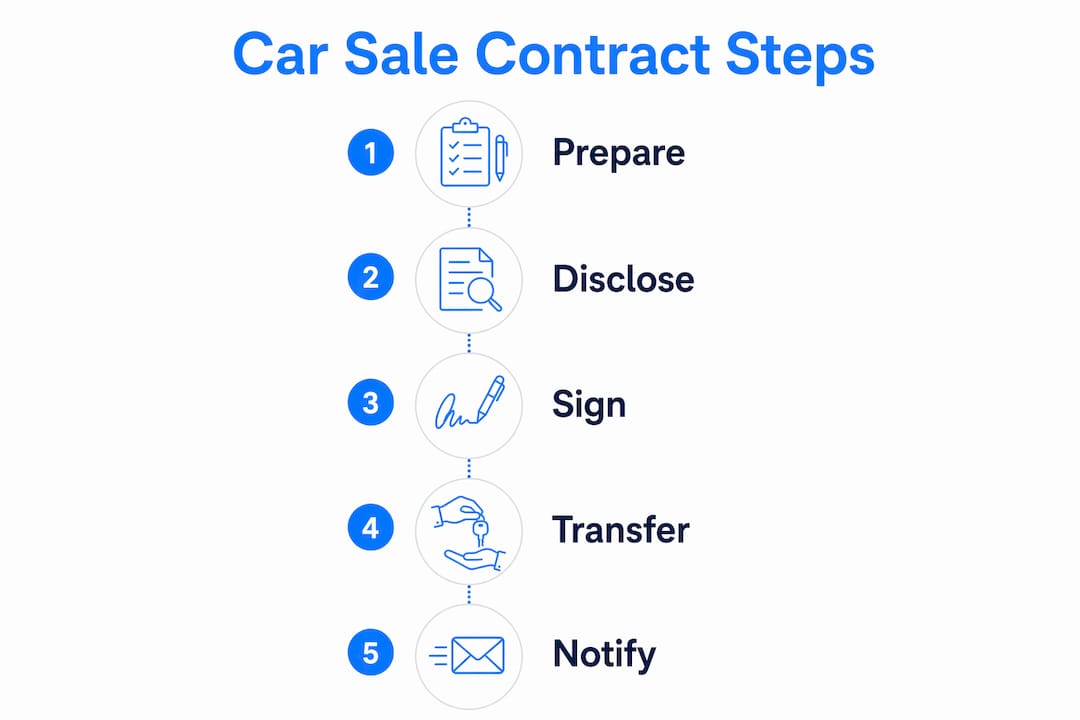
Here is the sequence that protects you after the keys change hands:
- Sign the contract and bill of sale on the day of sale. The date on the document establishes the exact moment liability transferred.
- Transfer the title immediately. A signed title, combined with your contract, creates a complete ownership record.
- File a notice of transfer with your state DMV. The Texas DMV, for example, recommends filing a Vehicle Transfer Notification immediately after the sale. This formally alerts the state that you no longer own the vehicle.
- Remove your license plates and toll tags. License plates and electronic toll tags remain tied to the seller, not the vehicle, in many jurisdictions. If the buyer runs a red light or racks up toll charges, those violations can come back to you.
- Retain copies of all signed documents. Keep physical and digital copies. Store them for at least three years.
Pro Tip: File your DMV transfer notification the same day you sign the contract. Do not wait for the buyer to complete their registration. Your liability clock stops when the state receives your notification, not when the buyer acts.
The bill of sale records details that the title simply does not capture: the agreed price, the odometer reading, and the exact transfer date. Titles transfer ownership legally, but they do not record agreed prices or the date of transfer. That distinction matters enormously if a buyer later disputes what was agreed.
What are the real limits of an “as-is” clause?
An “as-is” clause is powerful, but sellers regularly overestimate what it covers.
An “as-is” clause disclaims implied warranties but does not protect you from active deception or nondisclosure of known defects. That is the critical distinction. If you knew about a problem and did not disclose it, the “as-is” language does not save you from a fraud claim. Courts have consistently ruled that concealment overrides disclaimer language.
Known defects that must be disclosed in writing include:
- Transmission or engine problems
- Flood or water damage
- Salvage or rebuilt title history
- Frame damage or prior major accidents
- Non-functioning safety systems (airbags, ABS)
- Any issue that affects drivability or safety
Pro Tip: Keep your disclosure records inside the contract itself, not on a separate sheet. A buyer who signs the contract signs the disclosures at the same time. Separate sheets can be lost, disputed, or claimed to have been added after signing.
The written disclosure of all known defects within the contract is your real protection against fraud claims. The “as-is” clause handles implied warranty claims. The disclosure section handles fraud claims. You need both working together.
How can sellers use contracts and documents to prevent disputes?
A contract alone is not enough. The sellers who avoid post-sale disputes are the ones who build a complete legal file around the transaction.
The key documents every seller should have in place:
| Document | Purpose | When to Use |
|---|---|---|
| Car sale contract | Records all agreed terms and conditions | Signed at time of sale |
| Bill of sale | Documents price, date, odometer, and condition | Signed at time of sale |
| Title transfer | Legally transfers ownership to buyer | Completed at time of sale |
| DMV transfer notice | Removes seller from state ownership records | Filed same day as sale |
| Release of liability | Formally ends seller’s legal responsibility | Filed with DMV after sale |
Beyond the paperwork, the process matters too. Verify the buyer’s identity before signing anything. Ask for a government-issued ID and write the buyer’s name exactly as it appears on their ID. Retaining all transaction documents supports secure transactions and enforces seller protection if a dispute arises months later.
For payment, use certified checks, bank drafts, or verified electronic transfers. Cash is acceptable for lower-value vehicles. Personal checks create risk because they can bounce after you have handed over the keys. For high-value transactions, an escrow service adds another layer of security.
You can find a complete checklist of the paperwork needed to sell your car privately, including bills of sale and release of liability forms. A complete legal file protects your interests not just today, but for years after the sale closes.
Key Takeaways
A signed, detailed car sale contract is the single most effective tool for protecting sellers from post-sale disputes, fraud claims, and ongoing liability.
| Point | Details |
|---|---|
| Written contracts are legally required | The UCC statute of frauds requires a signed written contract for vehicle sales over $500 to be enforceable. |
| Disclose all known defects in writing | An “as-is” clause does not cover fraud; written disclosure of every known defect is the real protection. |
| File DMV transfer notice immediately | Filing a transfer notification the same day as the sale stops your liability for post-sale infractions. |
| Bills of sale complement the title | Titles transfer ownership but do not record price or date; bills of sale fill those critical gaps. |
| Remove plates and toll tags at sale | License plates and toll tags stay linked to the seller legally until physically removed. |
Why sellers underestimate contract protection until it is too late
I have seen the same pattern repeat itself. A seller completes a private sale, feels relieved it is done, and skips the paperwork. Three months later, a parking ticket or a toll violation shows up in their name. Or worse, the buyer calls claiming the engine was not as described and threatens legal action.
The uncomfortable truth is that most sellers treat the bill of sale as a receipt. It is not. A bill of sale is a critical legal document that records the transfer date and condition, protecting you from liabilities that surface long after the sale. Sellers who understand this distinction almost never end up in disputes.
The other misconception I see constantly: sellers believe the “as-is” clause is a blanket shield. It is not. It disclaims warranty claims. It does nothing for fraud claims. If you knew about a problem and did not write it down, you are exposed regardless of what the contract says elsewhere.
Well-crafted contracts force clarity on terms like vehicle condition and sale conditions, reducing costly disputes. That clarity is not just legal protection. It is the reason most buyers accept the sale and move on rather than looking for leverage after the fact. A buyer who signed a thorough contract has very little room to maneuver.
My advice: spend thirty minutes building a complete contract before you list the car. It is the cheapest insurance you will ever buy.
— Omar
Sellkamocars handles the legal side so you do not have to
Drafting contracts, filing DMV notifications, and managing title transfers takes time and attention most sellers do not have. Sellkamocars builds those protections directly into every transaction.
When you sell through Sellkamocars, you get a transparent sale agreement that documents the transaction, proper title transfer support, and release of liability filing handled for you. The process is backed by over 500 completed transactions and a registered business status that informal platforms cannot match. You get a fair cash offer based on current market data, pickup arranged within 24 hours, and payment confirmed before the vehicle leaves. See how the process works and get your offer today. If you prefer to start with a value estimate, the free car value tool gives you a market-based number before you commit to anything.
FAQ
What makes a car sale contract legally enforceable?
A car sale contract must be in writing, signed by both parties, and include the vehicle details, sale price, and date of transfer. The Uniform Commercial Code requires this for any goods sale over $500.
Does an “as-is” clause fully protect the seller?
No. An “as-is” clause disclaims implied warranties but does not protect sellers from fraud claims if known defects were not disclosed in writing.
Do I need both a contract and a bill of sale?
Yes. The contract records the agreed terms and conditions, while the bill of sale documents the price, odometer reading, and exact transfer date that a title does not capture.
How do I protect myself from post-sale tickets and tolls?
File a DMV transfer notification the same day as the sale, and remove your license plates and toll tags before the buyer drives away. Plates and toll tags remain legally linked to you until removed.
How long should I keep car sale documents?
Keep all signed documents, including the contract, bill of sale, and DMV transfer confirmation, for at least three years. These records are your defense if a dispute surfaces after the sale.
Recommended
Get a real cash offer in 2 minutes
Trusted business. Fair price. Paid on the spot when we pick up your car.